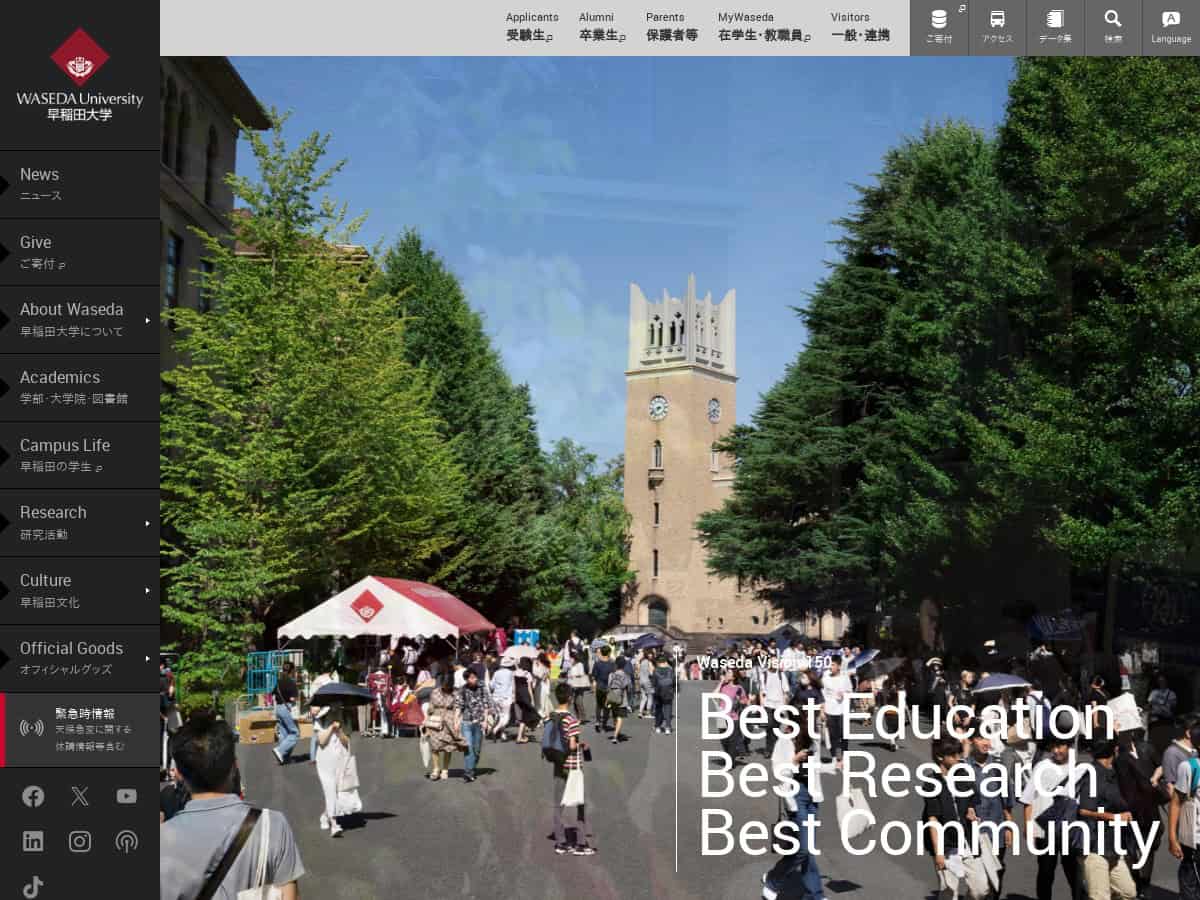
Founded in 1882 by Ōkuma Shigenobu, Waseda University is one of Japan’s most prestigious private comprehensive universities, with strong programs in science and engineering alongside humanities, social sciences, and law.
Waseda University is one of the two leading private universities in Japan, with about 50,000 students and 5,000 staff, and roughly one student in ten from abroad. It was founded in 1882 by Ōkuma Shigenobu, a statesman who served twice as prime minister, as the Tokyo Senmon Gakko, and it received its present name in 1902. The main Waseda campus is in Shinjuku, in the north of Tokyo, with other campuses at Nishi-Waseda, Toyama and Tokorozawa.
The Okuma Auditorium, a clock tower opened in 1927, is the symbol of the university. Waseda stands for independence of scholarship and for a critical attitude towards the state, a position that set it apart from the imperial universities. The Tsubouchi Memorial Theatre Museum honours the writer and translator Tsubouchi Shoyo, who taught at Waseda and translated Shakespeare, and the novelist Haruki Murakami is among the best-known alumni, along with several prime ministers.
The university is large and comprehensive, with schools of political science and economics, law, commerce, letters, education, science and engineering, social sciences, human sciences and international liberal studies. Politics, economics, literature, journalism and engineering are traditionally strong, and Waseda trains a large share of the country’s journalists and writers. Waseda has one of the largest groups of international students among Japanese universities.
As a private university, Waseda charges tuition well above national universities. Annual amounts depend on the school and are higher for science and engineering than for humanities. Check the current tariff. Admission uses the university’s own examinations for each school, and some schools accept the national common test. Programmes in English include the School of International Liberal Studies and several degrees at undergraduate and graduate level, and scholarships are available.
The campus life is lively, with clubs, festivals and a famous baseball rivalry with Keio every year. Shinjuku and the nearby student area of Takadanobaba are lively but expensive.
Domains taught:
Aerospace, AI and Machine Learning, Astroscience, Automation, Bioengineering, Bioinformatics, Chemistry, Civil Engineering, Computer Vision, Data Analytics, Ecology and Sustainability, Electrical and Electronics, Engineering, Fluid Dynamics, Geotechnics, Industrial Design, Life Sciences, Manufacturing, Materials, Mathematics, Mechanical Engineering, Microbiology and Genetics, Nanotechnologies, Optics, Physics, Process Control, Robotics, Signal Processing, Software Engineering, Statistics, Structural Engineering, Telecommunications, Thermodynamics, Transportations
Diplomas*:
Bachelor, Doctor, Master, MBA
Status:
Private
Partnerships:
Member of APRU. Numerous international partnerships and a large international student body. Strong alumni network in politics and industry.
Research:
Robotics & AI, Nanoscience & Materials, Energy & Environmental science, Information & Telecommunication technology.
Famous Alumnis:
Many Prime Ministers of Japan (e.g., Yoshihide Suga, Yasuo Fukuda), Haruki Murakami, Tadashi Yanai.
International recognition**:
Number of staff***:
5000
Current students***:
50000
Foreign students***:
10%
Cumulative former students***:
N/A
Pros
Leading private comprehensive university, strong in both humanities and STEM, influential alumni network, vibrant student life in Tokyo.
Cons
Private university with higher tuition fees, large student population.
Best For
Leading private comprehensive university with strong programs in engineering, science, and architecture.
The comparison with Ritsumeikan University is straightforward on subjects, since both focus on astroscience, aerospace and transportations, and it covers ergonomics and UX and food science as well, and is slightly smaller, at about 36,000 students against roughly 50,000 here.
Both schools build their programmes around astroscience, bioinformatics and nanotechnologies, and Keio University is the one to compare first within the country, since it runs the same bachelor's, master's, doctoral and mba programmes, and covers project management as well.
Fukuoka University is the closest domestic counterpart for aerospace, transportations and bioinformatics; it is smaller, enrolling about 20,000 students against roughly 50,000 here, and is also a private institution.
Also strong in aerospace, transportations and bioinformatics, Chubu University makes a sensible second look at home; it is far smaller, with about 12,000 students against roughly 50,000 here, and is also a private institution.
Meiji University sits close to this institution on aerospace, transportations and bioinformatics; it is smaller, enrolling about 33,000 students against roughly 50,000 here, and is also a private institution.
Most Similar Schools Abroad
Tsinghua, in China, takes a similar route through aerospace, transportations and bioinformatics; it teaches at the same levels, namely bachelor's, master's, doctoral and mba, and covers project management as well.
SJTU brings a China setting to the same core fields, aerospace, transportations and bioinformatics, and it is public, whereas this institution is private, and teaches at the same levels, namely bachelor's, master's, doctoral and mba.
Students considering a move abroad can look at Katholieke Universiteit Leuven in Belgium, where aerospace, bioinformatics and geotechnics also form the core, and it is slightly larger, at about 62,000 students against roughly 50,000 here, and is also a private institution.
For a study option in Poland with a comparable spread of aerospace, transportations and bioinformatics, Warsaw University of Technology is the reference point: it does not run the mba programmes found here and covers metrology and quality as well.
Universität Duisburg-Essen in Germany pursues a similar profile in aerospace, transportations and bioinformatics, and it is public, whereas this institution is private, and does not run the mba programmes found here.
*our own picks (our criteria: a mix between domains, diploma delivered, reputation and size), but obviously too many criteria for an apple-to-apple ranking.
FAQ
Where is Waseda University?
The main campus is at 1-104 Totsukamachi, Shinjuku-ku, Tokyo, Japan.
When was it founded?
In 1882 by Ōkuma Shigenobu, as the Tokyo Senmon Gakko. It took its present name in 1902.
Is Waseda public or private?
It is a private university.
How large is it?
About 50,000 students and 5,000 staff.
What is Waseda best known for?
Political science, economics, literature, journalism and engineering.
Who are famous alumni?
The novelist Haruki Murakami and several prime ministers.
What is the Okuma Auditorium?
A clock tower opened in 1927 that is the symbol of the university.
What does it cost?
Private tuition is well above national universities and depends on the school. Check the current tariff.
Are there courses in English?
Yes. They include the School of International Liberal Studies and several undergraduate and graduate degrees.
What is the rivalry with Keio?
An annual baseball series between the two universities, one of the major events of student life.
*: without any judgment of the quality, readers are strongly encouraged to check the official status of the exact diploma envisioned as many universities have a mix of recognized diplomas, not recognized, “co-delivered,” “equivalent to”, “some pathways” (…), can change over time, and can be named differently from one country to another.
**: international reputation: is based on some criteria that do not mean much in some domains or specialties (number of researchers, of scientific publications, on budget ….). Our approximate 1-4 scale:
known locally
known locally and internationally
is listed in some of the world university’s classifications
is listed among the 20 firsts in some of world university’s classifications
***: estimated numbers, based on online sources and/or feedbacks. The numbers can vary greatly depending on school organisation (ex.: school is part of a group, it employs internal staff or external consultants or has public staff without employing them …). Refer to all the links provided to have accurate and updated numbers.
Innovation.world is not affiliated with this school/university. We recommend to contact them directly on their website for any special request.
To complete or correct any information here or share your opinion, please comment below or > send us a direct message <.