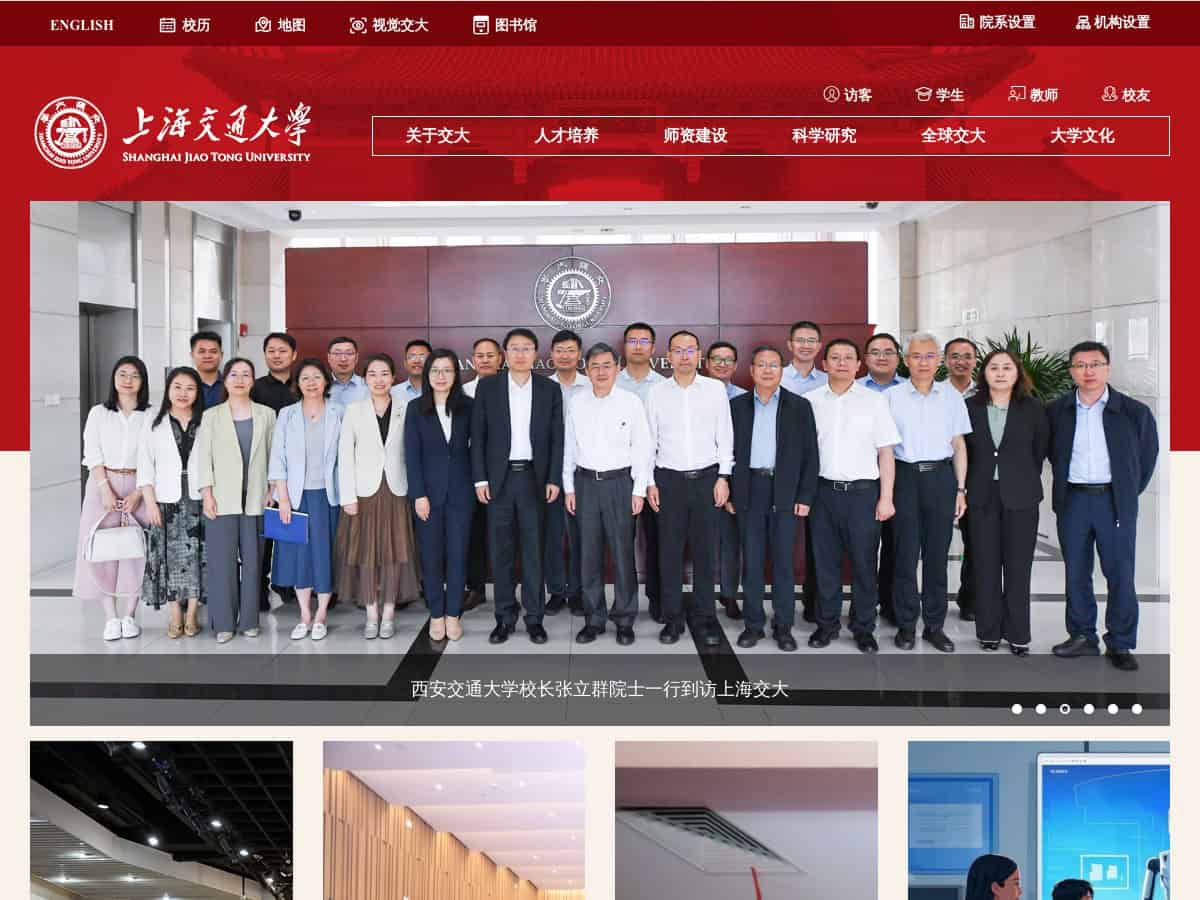
Established in 1896, SJTU is one of China’s oldest and most prestigious universities, with strong programs in engineering, medicine, and sciences.
Shanghai Jiao Tong University has about 40,000 students and 3,500 staff, and it is among the oldest technical universities in China. The large Minhang campus in the south-west of the city is the centre of teaching and research, while the Xuhui campus in the former French concession houses the older buildings and the medical school works from hospitals such as Ruijin. About one student in ten comes from abroad.
The institution started in 1896 as Nanyang Public School, set up by the official Sheng Xuanhuai to train people for the modernisation of China, and it took the name Jiaotong, meaning communication or transport, from its focus on railways and telegraph. The rocket scientist Qian Xuesen, who led China’s early missile and space programmes, graduated from the Jiaotong University of 1934, and Jiang Zemin studied electrical machinery here in the 1940s.
Mechanical engineering, naval architecture and ocean engineering are the traditional strengths, supported by Shanghai’s shipbuilding industry, and materials science, robotics and biomedical engineering are important areas. The Academic Ranking of World Universities was first produced at SJTU in 2003 before it became an independent consultancy. The University of Michigan-SJTU Joint Institute, set up in 2006, teaches engineering in English with a curriculum based on American practice.
Partnerships include Michigan and KTHRoyal Institute of Technology, and research relationships with industry cover advanced manufacturing, marine technology, artificial intelligence and biotechnology. Teaching is mainly in Chinese, with English-taught programmes at the Joint Institute and at graduate level. International applicants apply directly and need to show language ability, and fees are higher for international students.
Shanghai has high rents, but metro line 5 and shuttle buses link the Minhang campus to the city. About 250,000 people have graduated from SJTU, and its engineers are well represented in China’s automotive, shipbuilding and electronics industries.
Domains taught:
Aerospace, AI and Machine Learning, Automation, Bioengineering, Bioinformatics, Chemistry, Civil Engineering, Computer Vision, Data Analytics, Ecology and Sustainability, Electrical and Electronics, Engineering, Fluid Dynamics, Food Science, Industrial Design, Life Sciences, Manufacturing, Marine Science, Materials, Mathematics, Mechanical Engineering, Microbiology and Genetics, Nanotechnologies, Optics, Physics, Process Control, Project Management, Robotics, Signal Processing, Software Engineering, Statistics, Structural Engineering, Telecommunications, Thermodynamics, Transportations
Diplomas*:
Bachelor, Doctor, Master, MBA
Status:
Public
Partnerships:
Global university partnerships (e.g., University of Michigan, KTH Royal Institute of Technology). Strong industry links, especially in manufacturing and shipbuilding.
Research:
Advanced Manufacturing & Robotics, Naval Engineering & Marine Technology, AI & Big Data, Biotechnology & Health, New Energy.
Famous Alumnis:
Jiang Zemin, Qian Xuesen
International recognition**:
Number of staff***:
3500
Current students***:
40000
Foreign students***:
10%
Cumulative former students***:
250000
Pros
Top engineering programs, strong research focus, significant industry collaboration, located in dynamic Shanghai.
Cons
Highly competitive, large campus, some programs may have high pressure.
Best For
Premier university for engineering, particularly mechanical, naval, and materials science.
Shanghai University shares the core fields of this university, namely transportations, bioinformatics and nanotechnologies; it is also a public institution and does not run the mba programmes found here.
Both schools build their programmes around aerospace, transportations and bioinformatics, and Tsinghua is the one to compare first within the country, since it is slightly larger, at about 50,000 students against roughly 40,000 here, and is also a public institution.
Huazhong University of Science and Technology works in much the same fields, chiefly aerospace, transportations and bioinformatics, and it is slightly larger, at about 58,000 students against roughly 40,000 here, and is also a public institution.
Xi'an Jiaotong University works in much the same fields, chiefly aerospace, transportations and bioinformatics, and it has almost the same size, at about 40,000 students, and is also a public institution.
Think of Harbin Institute of Technology when aerospace, transportations and nanotechnologies is the priority: it is slightly smaller, at about 35,000 students against roughly 40,000 here, and is also a public institution.
Most Similar Schools Abroad
If this institution is on your list for aerospace, transportations and bioinformatics, Rheinisch-Westfälische Technische Hochschule Aachen in Germany deserves a comparison, because it does not run the mba programmes found here and covers logistics and geotechnics as well.
Technische Universität München, based in Germany, is built around aerospace, food science and transportations much like this university, and it is slightly larger, at about 48,000 students against roughly 40,000 here, and is also a public institution.
AGH University of Science and Technology in Poland is the nearest foreign match on marine science, aerospace and transportations; it is smaller, enrolling about 25,000 students against roughly 40,000 here, and is also a public institution.
Abroad, Università di Pisa (Italy) covers marine science, aerospace and food science in a comparable way, and it is slightly larger, at about 50,000 students against roughly 40,000 here, and is also a public institution.
Waseda University in Japan shares the aerospace, transportations and bioinformatics orientation of this university, and it is slightly larger, at about 50,000 students against roughly 40,000 here, and is private, whereas this university is public.
*our own picks (our criteria: a mix between domains, diploma delivered, reputation and size), but obviously too many criteria for an apple-to-apple ranking.
FAQ
Where is Shanghai Jiao Tong University?
The main Minhang campus is at 800 Dongchuan Road, in the south-west of Shanghai. The Xuhui campus is in the city centre.
How large is SJTU?
About 40,000 students and 3,500 staff, with roughly 10 percent of students from abroad.
When was SJTU founded?
In 1896 as Nanyang Public School, one of the oldest modern universities in China.
What is SJTU best known for?
Mechanical engineering, naval architecture and ocean engineering, materials science, robotics and medicine.
What is the UM-SJTU Joint Institute?
It is a joint engineering school with the University of Michigan, created in 2006, which teaches in English.
What language is used for teaching?
Mainly Chinese, with English-taught programmes at the Joint Institute and at graduate level.
Did the Academic Ranking of World Universities start at SJTU?
Yes. The ranking was first produced at SJTU in 2003 before it was moved to an independent consultancy.
How much does it cost?
International students pay higher tuition than Chinese citizens. Scholarships are available through Chinese government programmes and the university.
Who are famous alumni?
Qian Xuesen, the rocket scientist, and Jiang Zemin, former president of China, studied at Jiaotong University.
How do you get to the Minhang campus?
By metro line 5 and by university shuttle buses from the city.
Artificial Intelligence (AI), Materials, Robotics, Sustainable Development
*: without any judgment of the quality, readers are strongly encouraged to check the official status of the exact diploma envisioned as many universities have a mix of recognized diplomas, not recognized, “co-delivered,” “equivalent to”, “some pathways” (…), can change over time, and can be named differently from one country to another.
**: international reputation: is based on some criteria that do not mean much in some domains or specialties (number of researchers, of scientific publications, on budget ….). Our approximate 1-4 scale:
known locally
known locally and internationally
is listed in some of the world university’s classifications
is listed among the 20 firsts in some of world university’s classifications
***: estimated numbers, based on online sources and/or feedbacks. The numbers can vary greatly depending on school organisation (ex.: school is part of a group, it employs internal staff or external consultants or has public staff without employing them …). Refer to all the links provided to have accurate and updated numbers.
Innovation.world is not affiliated with this school/university. We recommend to contact them directly on their website for any special request.
To complete or correct any information here or share your opinion, please comment below or > send us a direct message <.