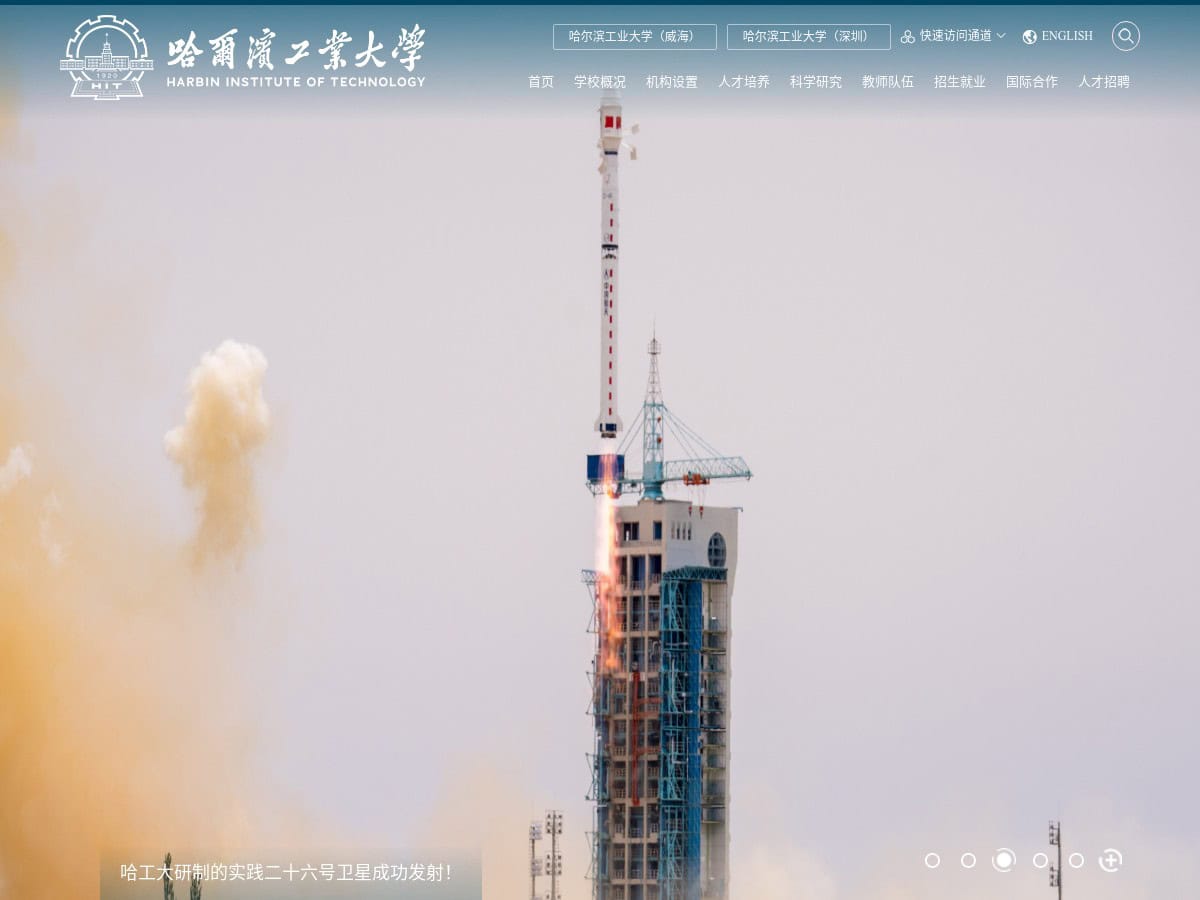
Established in 1920, HIT is a leading Chinese university with a strong focus on science and engineering, particularly renowned for its aerospace and defense-related research. It has campuses in Harbin, Weihai, and Shenzhen.
Harbin Institute of Technology, HIT, is the technical university of north-east China, with about 35,000 students and 3,800 staff. The main campus in Harbin, the capital of Heilongjiang province, is a place of long winters, with temperatures often well below minus 20 degrees. Two further campuses in Weihai and Shenzhen extend its reach to the east and south coasts.
HIT was founded in 1920 as a Sino-Russian industrial school, reflecting the Russian influence on Harbin, and later developed into a university focused on engineering and defence. It belongs to the C9 League and to the group known as the Seven Sons of National Defence, universities with a historic mission in military technology. Aerospace is the clearest strength. HIT built Longjiang-2, a small satellite that entered lunar orbit in 2018, and its research on spacecraft design, control and materials supports the space programme.
Other departments are mechanical engineering, materials science, robotics and advanced manufacturing, with a recognised school for welding and joining technology. Research topics include spacecraft and missile technology, new materials, computer science and automation. Cooperation with the aerospace and defence industries is close, and the university has partnerships with institutions in Russia, Europe and North America.
Teaching is mainly in Chinese, with English-taught programmes at graduate level. Chinese students are admitted through the gaokao, and international applicants apply directly and may need HSK certificates. Tuition for international students is higher than for Chinese citizens, and scholarships include the Chinese Government Scholarship.
Harbin is known for its ice festival in winter and has lower living costs than the big coastal cities. About 150,000 people have graduated from HIT, and its alumni lead many of the engineering teams in China’s space and heavy industry sectors.
Domains taught:
Aerospace, AI and Machine Learning, Automation, Bioengineering, Chemistry, Civil Engineering, Computer Vision, Data Analytics, Ecology and Sustainability, Electrical and Electronics, Engineering, Fluid Dynamics, Industrial Design, Manufacturing, Materials, Mathematics, Mechanical Engineering, Nanotechnologies, Optics, Physics, Process Control, Project Management, Quality, Robotics, Signal Processing, Software Engineering, Statistics, Structural Engineering, Telecommunications, Thermodynamics, Transportations
Diplomas*:
Bachelor, Doctor, Master
Status:
Public
Partnerships:
Member of C9 League. Strong collaborations with aerospace and defense industries. International partnerships, particularly with Russian universities.
For students who like the aerospace, transportations and nanotechnologies focus of this school but want another option nearby, Beihang University fits well: it has almost the same size, at about 35,000 students, and is also a public institution.
Nanjing University of Aeronautics and Astronautics is the closest domestic counterpart for aerospace, transportations and nanotechnologies; it is slightly smaller, at about 30,000 students against roughly 35,000 here, and is also a public institution.
On content, Beijing Institute of Technology and this school are close, as both teach aerospace, transportations and nanotechnologies; it is also a public institution, and teaches at the same levels, namely bachelor's, master's and doctoral.
In terms of fields, National University of Defense Technology is the nearest neighbour, with aerospace, nanotechnologies and optics again at the core; it is also a public institution, and teaches at the same levels, namely bachelor's, master's and doctoral.
Where this school leans on aerospace, transportations and nanotechnologies, Huazhong University of Science and Technology does the same, and it covers bioinformatics and microbiology and genetics as well, and is larger, enrolling about 58,000 students against roughly 35,000 here.
Most Similar Schools Abroad
Warsaw University of Technology in Poland pursues a similar profile in aerospace, transportations and quality, and it covers metrology and bioinformatics as well, and has almost the same size, at about 32,000 students.
Wrocław University of Science and Technology in Poland is the nearest foreign match on aerospace, transportations and quality; it covers metrology and bioinformatics as well, and is slightly smaller, at about 26,000 students against roughly 35,000 here.
Beyond national borders, Universität Stuttgart stands out as a comparable school for aerospace, transportations and nanotechnologies; it is slightly smaller, at about 24,000 students against roughly 35,000 here, and is also a public institution.
Politecnico di Milano in Italy shares the aerospace, nanotechnologies and fluid dynamics orientation of this institution, and it covers bioinformatics as well, and is slightly larger, at about 47,000 students against roughly 35,000 here.
Seen from abroad, Technische Universität Berlin (Germany) is a close relative on subject matter, since aerospace, transportations and quality are central to both, and it is also a public institution, and teaches at the same levels, namely bachelor's, master's and doctoral.
*our own picks (our criteria: a mix between domains, diploma delivered, reputation and size), but obviously too many criteria for an apple-to-apple ranking.
FAQ
Where is Harbin Institute of Technology?
The main campus is at 92 West Dazhi Street in Harbin, Heilongjiang province. Other campuses are in Weihai and Shenzhen.
How large is HIT?
About 35,000 students and 3,800 staff across its campuses.
When was HIT founded?
In 1920 as a Sino-Russian industrial school.
What is HIT best known for?
Aerospace engineering, mechanical engineering, materials science, robotics and welding technology.
What is the C9 League?
It is an alliance of nine leading Chinese universities, and HIT is a member.
Is HIT linked to China's space programme?
Yes. HIT researchers work on spacecraft and satellites, and the university built the Longjiang-2 satellite that entered lunar orbit in 2018.
What language is used for teaching?
Mainly Chinese, with English-taught programmes at graduate level.
How do international students apply?
They apply directly to the university and may need HSK certificates for Chinese-taught programmes. Fees are higher than for Chinese citizens.
What is the climate in Harbin?
Winters are long and very cold, with temperatures often well below minus 20 degrees, and the city is known for its ice festival.
Does HIT have campuses outside Harbin?
Yes, in Weihai on the Shandong coast and in Shenzhen in southern China.
*: without any judgment of the quality, readers are strongly encouraged to check the official status of the exact diploma envisioned as many universities have a mix of recognized diplomas, not recognized, “co-delivered,” “equivalent to”, “some pathways” (…), can change over time, and can be named differently from one country to another.
**: international reputation: is based on some criteria that do not mean much in some domains or specialties (number of researchers, of scientific publications, on budget ….). Our approximate 1-4 scale:
known locally
known locally and internationally
is listed in some of the world university’s classifications
is listed among the 20 firsts in some of world university’s classifications
***: estimated numbers, based on online sources and/or feedbacks. The numbers can vary greatly depending on school organisation (ex.: school is part of a group, it employs internal staff or external consultants or has public staff without employing them …). Refer to all the links provided to have accurate and updated numbers.
Innovation.world is not affiliated with this school/university. We recommend to contact them directly on their website for any special request.
To complete or correct any information here or share your opinion, please comment below or > send us a direct message <.