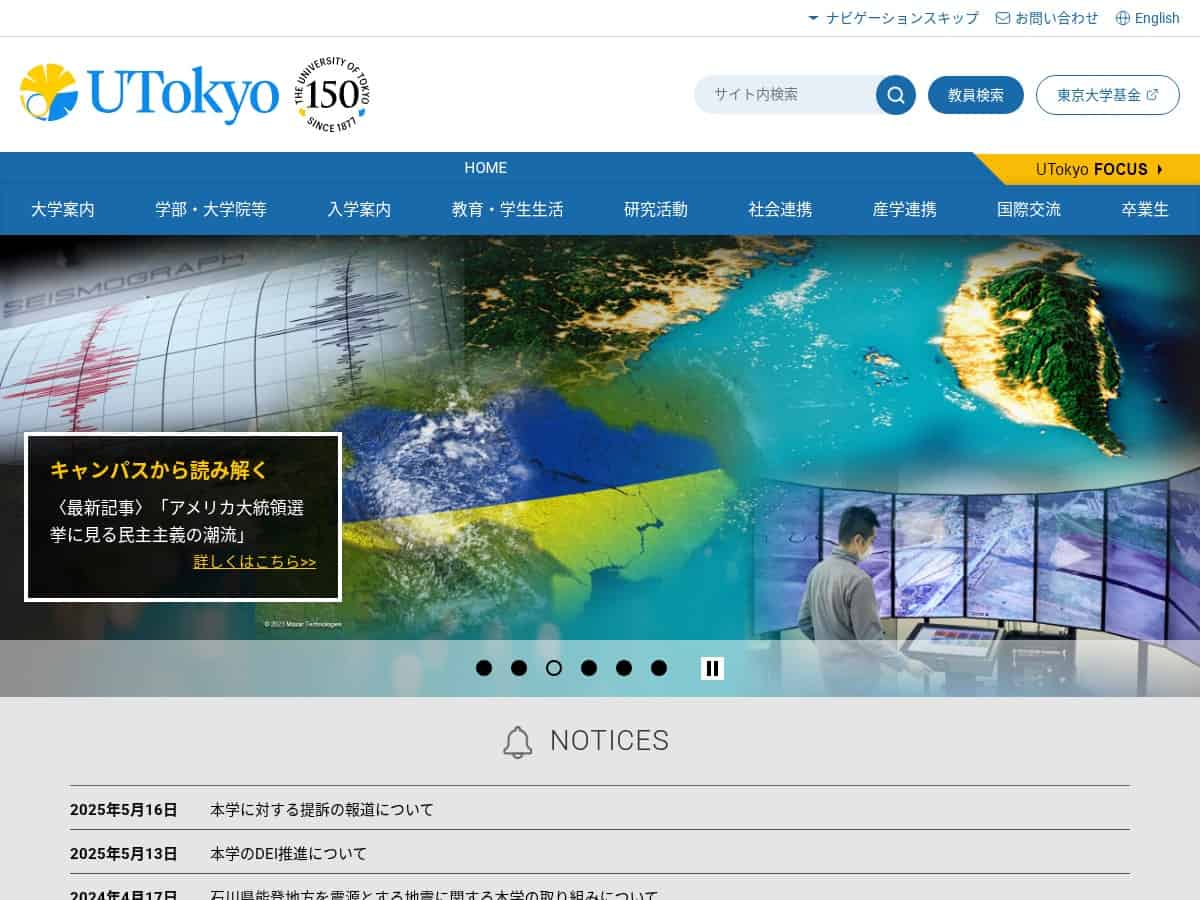
Address: 7-3-1 Hongo, Bunkyo-ku, 113-8654 Tokyo, Tokyo, Japan
Physics, Engineering, Chemistry
Founded in 1877, UTokyo is Japan’s first imperial university and one of its most prestigious. It’s a comprehensive research university with strong programs in science, engineering, law, medicine, and humanities.
The University of Tokyo, known in Japan as Todai, was founded in 1877 and is the oldest national university in the country and the most selective. It has about 28,000 students and 7,800 staff, and around one student in ten comes from abroad. The main Hongo campus stands on the former estate of the Maeda family, lords of Kaga, with the Red Gate, the Yasuda Auditorium and an avenue of ginkgo trees that turns yellow every autumn.
The university has three main campuses. Hongo houses most of the graduate schools and the professional faculties, Komaba is where first and second-year undergraduates follow a common course before choosing a specialisation, and Kashiwa has the new frontier sciences and the Institute for Cosmic Ray Research branch. The Kamioka observatory, run by the institute, is where Takaaki Kajita and his team showed that neutrinos have mass, and Kajita received the Nobel Prize in Physics in 2015 for that work.
Todai is a comprehensive research university, with ten faculties from law, letters and medicine to engineering, agriculture and science. Its graduates have traditionally provided a large share of Japanese civil servants, politicians and business leaders. The Nobel writer Kawabata Yasunari studied here, and the physicist Masatoshi Koshiba, who detected neutrinos from a supernova, was a professor. Research in physics, mathematics, materials science, medicine and robotics is internationally cited.
Admission to undergraduate programmes relies on a national common test followed by the university’s own second-stage examination. National universities charge standard tuition set by the government, roughly in the range of five to six hundred thousand yen a year, plus an entrance fee. Check the current tariff. The university also offers the PEAK programmes in English at Komaba and many graduate degrees in English, and the Japanese government scholarship supports international students.
Tokyo is expensive, but university dormitories and international houses keep costs down for some students.
Domains taught:
Aerospace, AI and Machine Learning, Astroscience, Automation, Bioengineering, Bioinformatics, Chemistry, Civil Engineering, Computer Vision, Data Analytics, Ecology and Sustainability, Electrical and Electronics, Engineering, Fluid Dynamics, Geotechnics, Industrial Design, Life Sciences, Manufacturing, Marine Science, Materials, Mathematics, Mechanical Engineering, Microbiology and Genetics, Nanotechnologies, Optics, Physics, Process Control, Robotics, Signal Processing, Software Engineering, Statistics, Structural Engineering, Telecommunications, Thermodynamics, Transportations
Diplomas*:
Bachelor, Doctor, Master
Status:
Public
Partnerships:
Member of IARU, APRU, AEARU. Numerous international partnerships with top global universities and research institutions. Extensive industry collaborations.
Research:
Quantum computing, AI & Robotics, Space exploration, Life sciences & Health, Sustainable energy & Environment.
Famous Alumnis:
17 Nobel laureates (graduates and faculty) including Leo Esaki, Masatoshi Koshiba; Many Prime Ministers of Japan.
International recognition**:
Number of staff***:
7800
Current students***:
28000
Foreign students***:
10%
Cumulative former students***:
Pros
Top-ranked globally, strong research output, excellent faculty and resources, influential alumni network.
Cons
Highly competitive admissions, intense academic environment, large class sizes in some undergraduate courses.
Best For
Comprehensive excellence in research and education across sciences, engineering, and humanities.
Also strong in astroscience, aerospace and bioinformatics, Tokyo Tech makes a sensible second look at home; it runs the same bachelor's, master's and doctoral programmes, and is smaller, enrolling about 10,000 students against roughly 28,000 here.
Osaka University overlaps with this institution on astroscience, marine science and aerospace, so the two are easy to compare, and it is also a public institution, and runs the same bachelor's, master's and doctoral programmes.
Tokyo University of Science offers a comparable education in astroscience, aerospace and transportations: it covers food science and project management as well, and is slightly smaller, at about 20,000 students against roughly 28,000 here.
Tokyo Metropolitan University works in much the same fields, chiefly astroscience, aerospace and transportations, and it runs the same bachelor's, master's and doctoral programmes, and covers project management as well.
For students who like the astroscience, aerospace and transportations focus of this institution but want another option nearby, University of Tsukuba fits well: it is smaller, enrolling about 17,000 students against roughly 28,000 here, and is also a public institution.
Most Similar Schools Abroad
Tsinghua offers an international parallel to this university, with aerospace, transportations and bioinformatics as common ground; it covers project management as well, and is larger, enrolling about 50,000 students against roughly 28,000 here.
Abroad, Université PSL (France) covers astroscience, bioinformatics and geotechnics in a comparable way, and it teaches at the same levels, namely bachelor's, master's and doctoral, and is smaller, enrolling about 17,000 students against roughly 28,000 here.
On content, Technische Universität München in Germany and this university are close, as both teach aerospace, transportations and bioinformatics; it teaches at the same levels, namely bachelor's, master's and doctoral, and covers food science and project management as well.
The closest overseas parallel on astroscience, marine science and aerospace is Université Grenoble Alpes, located in France; it is larger, enrolling about 59,000 students against roughly 28,000 here, and is also a public institution.
USTC in China shares the astroscience, aerospace and bioinformatics orientation of this university, and it teaches at the same levels, namely bachelor's, master's and doctoral, and has almost the same size, at about 25,000 students.
*our own picks (our criteria: a mix between domains, diploma delivered, reputation and size), but obviously too many criteria for an apple-to-apple ranking.
FAQ
Where is the University of Tokyo?
The main Hongo campus is at 7-3-1 Hongo, Bunkyo-ku, Tokyo, Japan. Other campuses are at Komaba and Kashiwa.
When was it founded?
In 1877, as the first national university in Japan.
How large is it?
About 28,000 students and 7,800 staff, with around 10 percent of students from abroad.
What are the three main campuses?
Hongo, Komaba and Kashiwa.
What do first-year students do?
Undergraduates follow a common course at Komaba before choosing a specialisation.
Which Nobel laureate is linked to the university?
Takaaki Kajita received the 2015 Nobel Prize in Physics for showing that neutrinos have mass. Masatoshi Koshiba was also a professor there.
How do you enter?
Through the national common test followed by the university's own second-stage examination.
What does it cost?
National universities charge standard tuition set by the government, roughly five to six hundred thousand yen a year, plus an entrance fee. Check the current tariff.
Are there courses in English?
Yes. The PEAK programmes at Komaba and many graduate degrees are in English.
Can international students receive scholarships?
Yes. The Japanese government scholarship supports international students.
Artificial Intelligence (AI), Engineering, Environmental Engineering, Robotics, Sustainable Development
*: without any judgment of the quality, readers are strongly encouraged to check the official status of the exact diploma envisioned as many universities have a mix of recognized diplomas, not recognized, “co-delivered,” “equivalent to”, “some pathways” (…), can change over time, and can be named differently from one country to another.
**: international reputation: is based on some criteria that do not mean much in some domains or specialties (number of researchers, of scientific publications, on budget ….). Our approximate 1-4 scale:
known locally
known locally and internationally
is listed in some of the world university’s classifications
is listed among the 20 firsts in some of world university’s classifications
***: estimated numbers, based on online sources and/or feedbacks. The numbers can vary greatly depending on school organisation (ex.: school is part of a group, it employs internal staff or external consultants or has public staff without employing them …). Refer to all the links provided to have accurate and updated numbers.
Innovation.world is not affiliated with this school/university. We recommend to contact them directly on their website for any special request.
To complete or correct any information here or share your opinion, please comment below or > send us a direct message <.