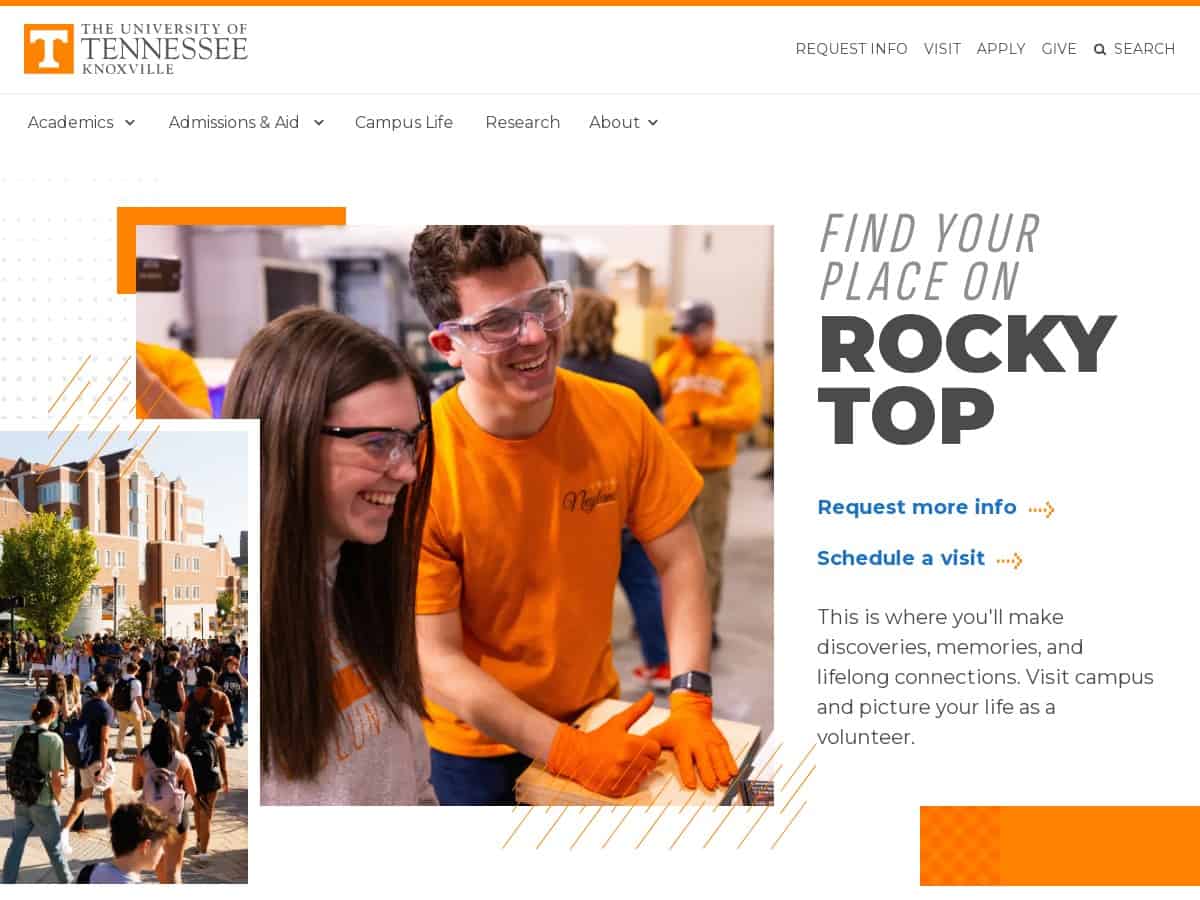
The University of Tennessee, Knoxville, began on 10 September 1794 as Blount College, two years before Tennessee became a state. The institution was renamed East Tennessee College in 1807 and East Tennessee University in 1840, and it has carried the name University of Tennessee since 1879. In 1869 the state designated it as its land-grant institution, linking it to the national system of colleges supported by federal land grants.
The main campus lies in Knoxville, in eastern Tennessee, and the university also operates the University of Tennessee Space Institute in Tullahoma. It is classified by the Carnegie system as an R1 institution, a doctoral university with very high research activity. Its teaching is organised in colleges that include professional schools, and the Howard H. Baker Jr. School of Public Policy and Public Affairs is among its named units.
Research at Knoxville is closely tied to Oak Ridge National Laboratory, one of the large laboratories of the United States government, which the university describes as a partner and which gives faculty and students access to research opportunities beyond the campus. The university also hosts the University of Tennessee Anthropological Research Facility, founded by William M. Bass in 1972 and widely known as the Body Farm, which supports work in forensic anthropology.
Domains taught:
AI and Machine Learning, Data Analytics, Engineering, Life Sciences, Logistics, Physics, Software Engineering
Diplomas*:
Bachelor, Doctor, Master, MBA
Status:
Public
Partnerships:
Flagship land-grant university in Tennessee. Strong partnership with Oak Ridge National Laboratory (ORNL). Known for supply chain management, forensic anthropology (Body Farm), and engineering.
Research:
A research university with strengths in nuclear engineering, materials science, supply chain management, forensic anthropology, and advanced manufacturing, often in collaboration with ORNL.
Famous Alumnis:
Peyton Manning, Dolly Parton (honorary), Al Gore (attended divinity school briefly, also Vanderbilt), Howard Baker
International recognition**:
Number of staff***:
7000
Current students***:
34000
Foreign students***:
5%
Cumulative former students***:
260000
Pros
Strong programs in supply chain and nuclear engineering, unique forensic anthropology research, close ties with a major national laboratory.
Cons
Large student population, some programs less nationally prominent, Knoxville is a smaller city.
Best For
Students interested in supply chain management, nuclear engineering, forensic anthropology, or other STEM fields, often valuing research opportunities with Oak Ridge National Lab.
North Carolina State University is a public university in Raleigh whose main fields are engineering, agriculture and veterinary medicine, which gives it a profile close to Knoxville's applied strengths.
Virginia Polytechnic Institute and State University, a public university in Blacksburg, combines engineering and agriculture with architecture and offers a comparable technical orientation.
University of Florida, a public university in Gainesville, lists agriculture, engineering and health sciences among its main fields, which mirrors the mix of a large state university.
Ohio State University is a public university in Columbus with engineering, business and health sciences as leading areas, giving a similar breadth of professional colleges.
Purdue University, West Lafayette is a public university with aerospace engineering, general engineering and agriculture as main fields, which suits applicants interested in technical research.
Most Similar Schools Abroad
McMaster University in Canada is a public research university whose main fields include health sciences, engineering and nuclear science, which parallels Knoxville's strength in nuclear engineering.
University of Queensland in Australia is a public university covering engineering, science, agriculture and medicine, a broad state-funded profile comparable to Tennessee's.
University of Nottingham in the United Kingdom is public and lists pharmacy, engineering and agriculture among its main fields, which overlaps with Knoxville's applied disciplines.
Hokkaido University in Japan is a public university where agricultural sciences, environmental and earth sciences and engineering stand out, offering a comparable applied research orientation.
University College Dublin in Ireland is public and strong in agriculture, food science and engineering, so it is a practical alternative for students drawn to applied sciences.
*our own picks (our criteria: a mix between domains, diploma delivered, reputation and size), but obviously too many criteria for an apple-to-apple ranking.
FAQ
What was the University of Tennessee called before it received its present name?
It opened in 1794 as Blount College and became East Tennessee College in 1807 and East Tennessee University in 1840. The present name, University of Tennessee, has been in use since 1879.
When did Tennessee give the university land-grant status?
The state designated the institution as its land-grant university in 1869, when it was still East Tennessee University. That status connects it to the federal land-grant system that supports teaching in practical and scientific fields.
Does the university have a site outside Knoxville?
Yes, the University of Tennessee Space Institute is located in Tullahoma and belongs to the university. Applicants should check which location offers the programme they are interested in.
What does the R1 classification mean for research at Knoxville?
R1 is the Carnegie label for doctoral universities with very high research activity. The University of Tennessee, Knoxville, is placed in this group, which points to a large doctoral and research enterprise.
How does the university work with Oak Ridge National Laboratory?
The university partners with the laboratory, which is a major United States government research centre, and the ties open research opportunities for faculty and students. Details of joint projects and programmes are published on the university research pages.
What is the Body Farm?
It is the University of Tennessee Anthropological Research Facility, founded in 1972 by William M. Bass, and it supports forensic anthropology research. It is one of the best-known facilities attached to the Knoxville campus.
Where can an applicant find current admission rules and tuition?
Admission requirements, deadlines and tuition are set each year and published on the official site utk.edu. Because they differ by programme and by residency, it is best to read the pages for the specific degree before applying.
*: without any judgment of the quality, readers are strongly encouraged to check the official status of the exact diploma envisioned as many universities have a mix of recognized diplomas, not recognized, “co-delivered,” “equivalent to”, “some pathways” (…), can change over time, and can be named differently from one country to another.
**: international reputation: is based on some criteria that do not mean much in some domains or specialties (number of researchers, of scientific publications, on budget ….). Our approximate 1-4 scale:
known locally
known locally and internationally
is listed in some of the world university’s classifications
is listed among the 20 firsts in some of world university’s classifications
***: estimated numbers, based on online sources and/or feedbacks. The numbers can vary greatly depending on school organisation (ex.: school is part of a group, it employs internal staff or external consultants or has public staff without employing them …). Refer to all the links provided to have accurate and updated numbers.
Innovation.world is not affiliated with this school/university. We recommend to contact them directly on their website for any special request.
To complete or correct any information here or share your opinion, please comment below or > send us a direct message <.