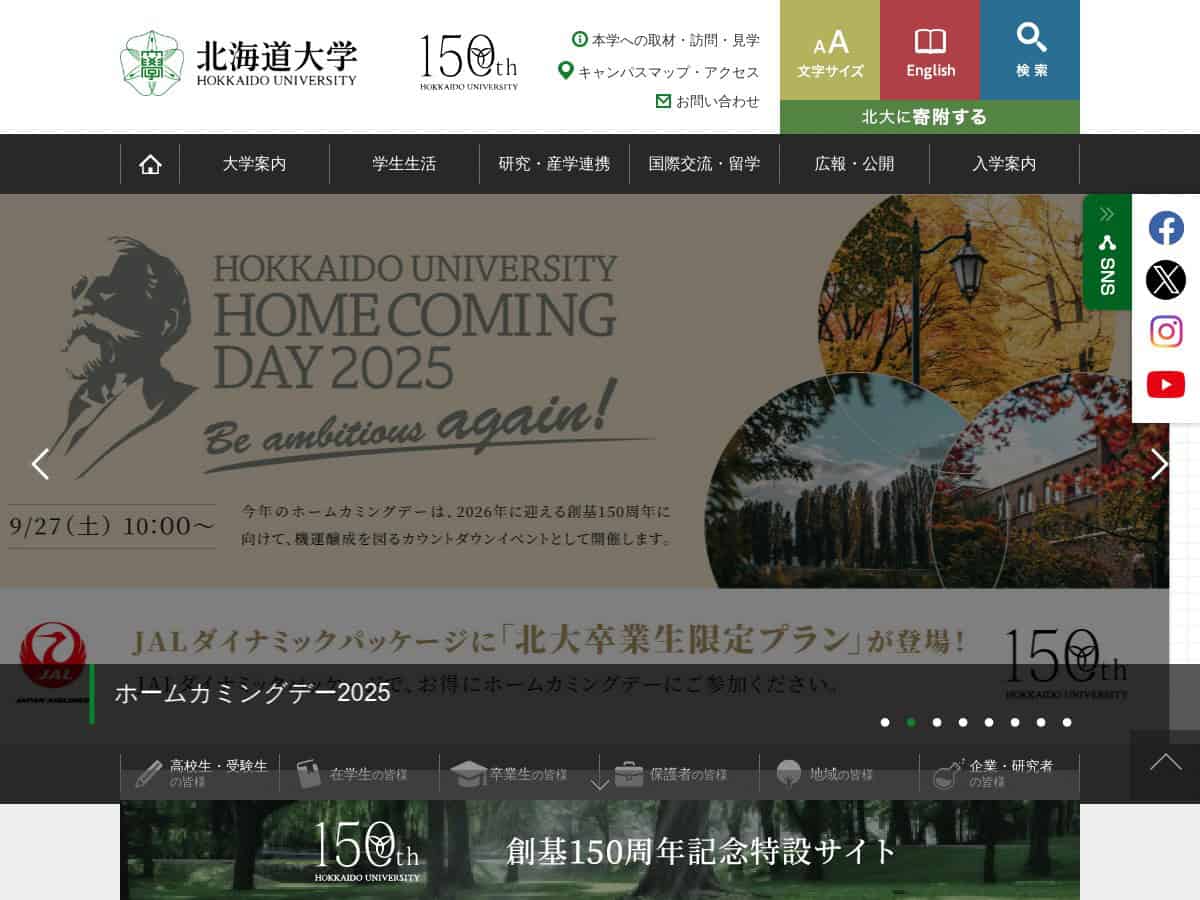
Founded in 1876 as Sapporo Agricultural College, Hokkaido University is one of Japan’s oldest and most prestigious national universities, known for its large campus, strengths in agriculture, life sciences, and environmental science.
Hokkaido University was founded in 1876 as Sapporo Agricultural College, with the American educator William S. Clark as vice-president. Clark taught for only eight months, but his farewell phrase, Boys, be ambitious, is still the best-known motto in Japan. The university became an Imperial University in 1918 and now has about 18,000 students and 4,000 staff, and around one student in ten comes from abroad. The main campus lies in the north of Sapporo and is one of the largest in Japan.
The campus has avenues of poplar and ginkgo trees, a botanical garden with Ainu cultural plants, farmland, a museum and a research forest. In winter it is covered in snow, and the university has strong ties to cold-region science and to the study of the natural environment. A second campus at Hakodate focuses on fisheries sciences, and research stations are located across Hokkaido.
The university is organised in faculties and graduate schools that include agriculture, veterinary medicine, fisheries sciences, science, engineering, medicine, letters, law and economics. Akira Suzuki, a professor of chemistry, received the 2010 Nobel Prize in Chemistry for the palladium-catalysed coupling reaction that carries his name, which is used widely in the making of drugs and electronic materials. Catalysis, polar science, agriculture and environmental research are further strengths.
Admission relies on a national common test and the university’s own examination. National universities charge standard tuition set by the government, roughly in the range of five to six hundred thousand yen a year, plus an entrance fee. Check the current tariff. Hokkaido University offers programmes in English, particularly at graduate level, and the Japanese government scholarship supports international students.
Sapporo is a large city with cheaper rents than Tokyo. Summers are cool and winters are long, and students can ski within an hour from the campus. The city is known for its seafood, dairy and the Snow Festival.
Domains taught:
Aerospace, Agriculture, AI and Machine Learning, Astroscience, Automation, Bioengineering, Bioinformatics, Chemistry, Civil Engineering, Computer Vision, Data Analytics, Ecology and Sustainability, Electrical and Electronics, Engineering, Fluid Dynamics, Food Science, Geotechnics, Life Sciences, Manufacturing, Marine Science, Materials, Mathematics, Mechanical Engineering, Microbiology and Genetics, Nanotechnologies, Optics, Physics, Process Control, Robotics, Signal Processing, Software Engineering, Statistics, Structural Engineering, Telecommunications, Thermodynamics, Transportations
Diplomas*:
Bachelor, Doctor, Master
Status:
Public
Partnerships:
Member of RU11, AEARU. Strong international collaborations, particularly in fields related to cold regions and sustainability.
Another national school that puts astroscience, marine science and aerospace at the centre is Niigata University, and it is also a public institution, and teaches at the same levels, namely bachelor's, master's and doctoral.
Kagoshima University overlaps with this institution on astroscience, marine science and aerospace, so the two are easy to compare, and it teaches at the same levels, namely bachelor's, master's and doctoral, and covers industrial design as well.
Nagoya University overlaps with this university on astroscience, aerospace and food science, so the two are easy to compare, and it is also a public institution, and teaches at the same levels, namely bachelor's, master's and doctoral.
Where this university leans on astroscience, marine science and agriculture, Ehime University does the same, and it is smaller, enrolling about 10,000 students against roughly 18,000 here, and is also a public institution.
Kyushu University is the closest domestic counterpart for astroscience, marine science and aerospace; it teaches at the same levels, namely bachelor's, master's and doctoral, and covers ergonomics and UX and industrial design as well.
Most Similar Schools Abroad
The closest overseas parallel on astroscience, aerospace and agriculture is Justus-Liebig-Universität Gießen, located in Germany; it is slightly larger, at about 26,000 students against roughly 18,000 here, and is also a public institution.
Wrocław University of Environmental and Life Sciences in Poland shares the marine science, aerospace and agriculture orientation of this university, and it is smaller, enrolling about 9,000 students against roughly 18,000 here, and is also a public institution.
For a study option in Germany with a comparable spread of marine science, aerospace and transportations, Universität Bremen is the reference point: it teaches at the same levels, namely bachelor's, master's and doctoral, and covers industrial design and project management as well.
Université de Genève, based in Switzerland, is built around astroscience, marine science and bioinformatics much like this institution, and it runs the same bachelor's, master's and doctoral programmes, and has almost the same size, at about 19,000 students.
Universität Bern in Switzerland is the nearest foreign match on astroscience, aerospace and bioinformatics; it is also a public institution, and teaches at the same levels, namely bachelor's, master's and doctoral.
*our own picks (our criteria: a mix between domains, diploma delivered, reputation and size), but obviously too many criteria for an apple-to-apple ranking.
FAQ
Where is Hokkaido University?
On Kita 8, Nishi 5, Kita-ku in Sapporo, Hokkaido, Japan.
When was it founded?
In 1876, as Sapporo Agricultural College.
Who was William S. Clark?
An American educator who taught at the college for eight months. His farewell phrase, Boys, be ambitious, is a famous motto in Japan.
How large is it?
About 18,000 students and 4,000 staff.
What is it known for?
Agriculture, veterinary medicine, fisheries, catalysis, polar science and environmental research.
Which Nobel laureate is linked to it?
Akira Suzuki, who received the 2010 Nobel Prize in Chemistry for the palladium-catalysed coupling reaction.
Where is the fisheries campus?
At Hakodate.
How do you enter?
Through a national common test and the university's own examination.
What does it cost?
National universities charge standard tuition set by the government, roughly five to six hundred thousand yen a year, plus an entrance fee. Check the current tariff.
What is Sapporo like for students?
Rents are cheaper than in Tokyo, winters are long and students can ski within an hour.
*: without any judgment of the quality, readers are strongly encouraged to check the official status of the exact diploma envisioned as many universities have a mix of recognized diplomas, not recognized, “co-delivered,” “equivalent to”, “some pathways” (…), can change over time, and can be named differently from one country to another.
**: international reputation: is based on some criteria that do not mean much in some domains or specialties (number of researchers, of scientific publications, on budget ….). Our approximate 1-4 scale:
known locally
known locally and internationally
is listed in some of the world university’s classifications
is listed among the 20 firsts in some of world university’s classifications
***: estimated numbers, based on online sources and/or feedbacks. The numbers can vary greatly depending on school organisation (ex.: school is part of a group, it employs internal staff or external consultants or has public staff without employing them …). Refer to all the links provided to have accurate and updated numbers.
Innovation.world is not affiliated with this school/university. We recommend to contact them directly on their website for any special request.
To complete or correct any information here or share your opinion, please comment below or > send us a direct message <.