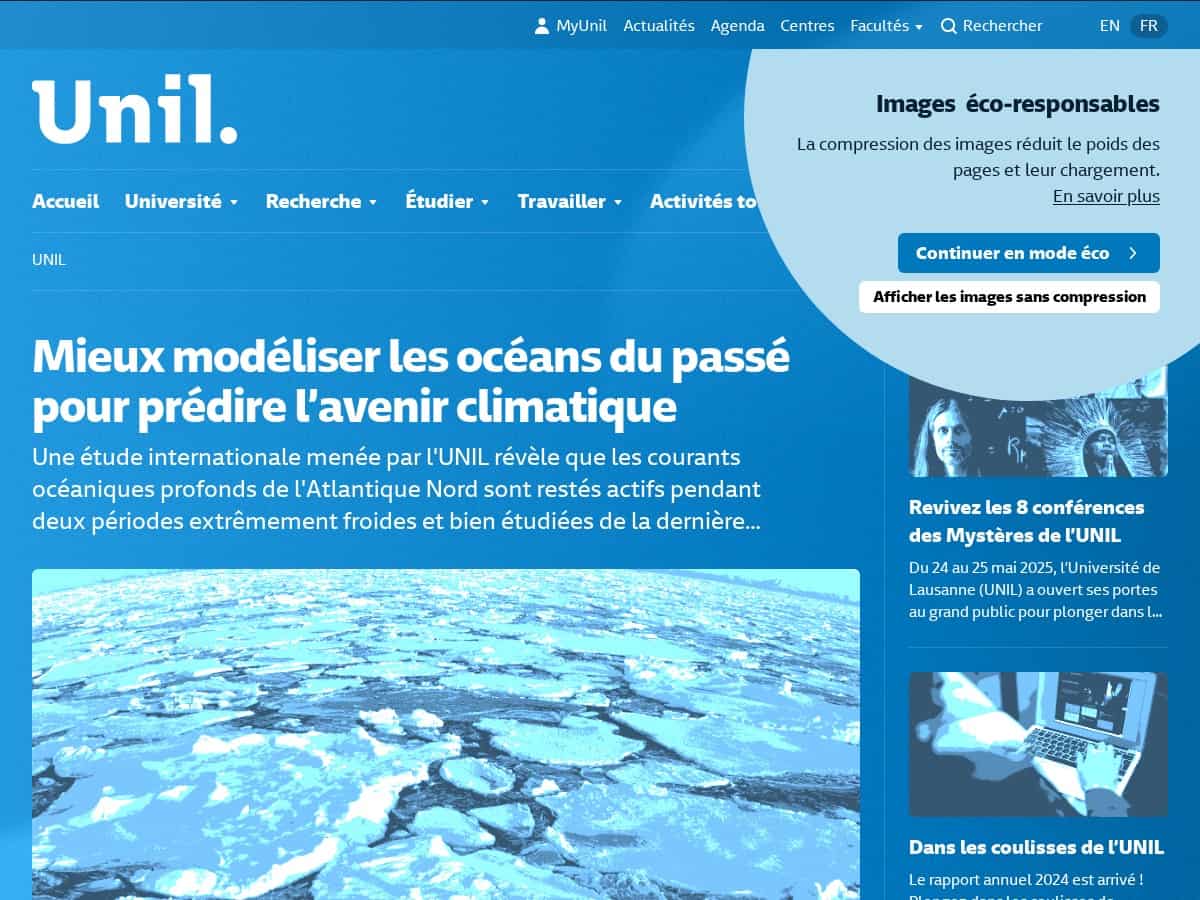
The University of Lausanne, founded in 1537 as a school of theology, became a university in 1890. Its Faculty of Biology and Medicine (FBM) and Faculty of Geosciences and Environment (FGSE) offer relevant science programs.
The University of Lausanne, UNIL, traces its history to the Academy founded in 1537 by the Bernese authorities as a school of theology, and it became a university in 1890. It has about 17,000 students and 3,500 staff, and around one student in five comes from abroad. The campus at Dorigny, in Chamberonne, lies on the shore of Lake Geneva, west of the city, next to EPFL, with the Unicentre building at the centre and large lawns, laboratories and student residences.
The university is organised in seven faculties: theology and religious studies, law, criminal sciences and public administration, arts, social and political sciences, business and economics, which is known as HEC Lausanne, biology and medicine, and geosciences and environment. The Faculty of Law and Criminal Sciences has an old school of criminology, and the business school is one of the leading ones in the French-speaking region. The university works closely with the Lausanne University Hospital, CHUV.
The university is a leader in life sciences, with a close link to the Swiss Institute of Bioinformatics and the Ludwig Institute for Cancer Research. Jacques Dubochet, who received the 2017 Nobel Prize in Chemistry for the development of cryo-electron microscopy, was a professor at Lausanne. Research in earth sciences benefits from the Alps nearby, and the university is part of cooperation with EPFL in the Lausanne campus. Together they are one of the major academic sites of Switzerland.
Tuition fees are low by international standards, around 500 to 600 francs per semester at present. Check the current tariff. Bachelor’s programmes are taught in French, while a growing number of master’s programmes are in English. Admission requires a Swiss Matura or an equivalent, and foreign applicants must meet language and academic conditions. The university offers French courses to international students.
Lausanne is a hilly city with a lively cultural scene. The metro connects the campus to the city centre in minutes, and student housing is scarce, so applying early for a room is advised.
Domains taught:
Bioengineering, Bioinformatics, Chemistry, Data Analytics, Ecology and Sustainability, Engineering, Fluid Dynamics, Geotechnics, Marine Science, Materials, Mathematics, Mechanical Engineering, Microbiology and Genetics, Nanotechnologies, Physics, Process Control, Signal Processing, Software Engineering, Statistics, Structural Engineering, Thermodynamics
Diplomas*:
Bachelor, Doctor, Master
Status:
Public
Partnerships:
Numerous international partnerships for student exchange and research. Collaborates closely with EPFL and other institutions in the Lake Geneva region.
Research:
Strong research in genomics, molecular biosciences, ecology and evolution, earth surface processes, environmental change, and forensic science.
Famous Alumnis:
Claude Nicollier
International recognition**:
Number of staff***:
3500
Current students***:
17000
Foreign students***:
20%
Cumulative former students***:
70000
Pros
Good reputation in life sciences and geosciences, pleasant campus environment by Lake Geneva.
Cons
Limited engineering programs; focus is on sciences.
Best For
Students focused on life sciences, geosciences, or environmental sciences in a research-oriented university.
Université de Genève sits close to this university on marine science, bioinformatics and geotechnics; it is also a public institution, and teaches at the same levels, namely bachelor's, master's and doctoral.
Universität Zürich works in much the same fields, chiefly bioinformatics, geotechnics and nanotechnologies, and it is larger, enrolling about 28,000 students against roughly 17,000 here, and is also a public institution.
In terms of fields, Universität Bern is the nearest neighbour, with bioinformatics, geotechnics and nanotechnologies again at the core; it is also a public institution, and runs the same bachelor's, master's and doctoral programmes.
Also strong in bioinformatics, nanotechnologies and microbiology and genetics, Universität Basel makes a sensible second look at home; it is also a public institution, and teaches at the same levels, namely bachelor's, master's and doctoral.
Both schools build their programmes around bioinformatics, nanotechnologies and signal processing, and EPFL is the one to compare first within the country, since it teaches at the same levels, namely bachelor's, master's and doctoral, and covers metrology and aerospace as well.
Most Similar Schools Abroad
University of Gdańsk, based in Poland, is built around marine science, bioinformatics and nanotechnologies much like this university, and it teaches at the same levels, namely bachelor's, master's and doctoral, and covers astroscience and optics as well.
Students considering a move abroad can look at Ruprecht-Karls-Universität Heidelberg in Germany, where bioinformatics, geotechnics and nanotechnologies also form the core, and it runs the same bachelor's, master's and doctoral programmes, and covers astroscience and optics as well.
University of Łódź, based in Poland, is built around bioinformatics, nanotechnologies and microbiology and genetics much like this university, and it covers astroscience and optics as well, and is larger, enrolling about 26,000 students against roughly 17,000 here.
For bioinformatics, geotechnics and nanotechnologies outside the home country, Université de Liège in Belgium is a natural reference; it covers aerospace and food science as well, and is larger, enrolling about 26,000 students against roughly 17,000 here.
For a study option in Japan with a comparable spread of marine science, bioinformatics and geotechnics, Hokkaido University is the reference point: it covers astroscience and aerospace as well, and has almost the same size, at about 18,000 students.
*our own picks (our criteria: a mix between domains, diploma delivered, reputation and size), but obviously too many criteria for an apple-to-apple ranking.
FAQ
Where is the University of Lausanne?
The main campus is at UNIL-Chamberonne, Unicentre, in Lausanne, Switzerland, on the shore of Lake Geneva.
When was it founded?
As an Academy in 1537, and it became a university in 1890.
How large is it?
About 17,000 students and 3,500 staff.
What are its faculties?
Theology and religious studies, law and criminal sciences, arts, social and political sciences, HEC Lausanne for business and economics, biology and medicine, and geosciences and environment.
What is HEC Lausanne?
The faculty of business and economics, one of the leading business schools in the French-speaking region.
Which Nobel laureate worked there?
Jacques Dubochet, who received the 2017 Nobel Prize in Chemistry for cryo-electron microscopy.
How is it linked to EPFL?
The two schools share the Lausanne campus and cooperate in research and teaching.
What does it cost?
Tuition fees are low by international standards, around 500 to 600 francs per semester at present. Check the current tariff.
In which language are courses taught?
Mostly in French, with a growing number of master's programmes in English.
*: without any judgment of the quality, readers are strongly encouraged to check the official status of the exact diploma envisioned as many universities have a mix of recognized diplomas, not recognized, “co-delivered,” “equivalent to”, “some pathways” (…), can change over time, and can be named differently from one country to another.
**: international reputation: is based on some criteria that do not mean much in some domains or specialties (number of researchers, of scientific publications, on budget ….). Our approximate 1-4 scale:
known locally
known locally and internationally
is listed in some of the world university’s classifications
is listed among the 20 firsts in some of world university’s classifications
***: estimated numbers, based on online sources and/or feedbacks. The numbers can vary greatly depending on school organisation (ex.: school is part of a group, it employs internal staff or external consultants or has public staff without employing them …). Refer to all the links provided to have accurate and updated numbers.
Innovation.world is not affiliated with this school/university. We recommend to contact them directly on their website for any special request.
To complete or correct any information here or share your opinion, please comment below or > send us a direct message <.