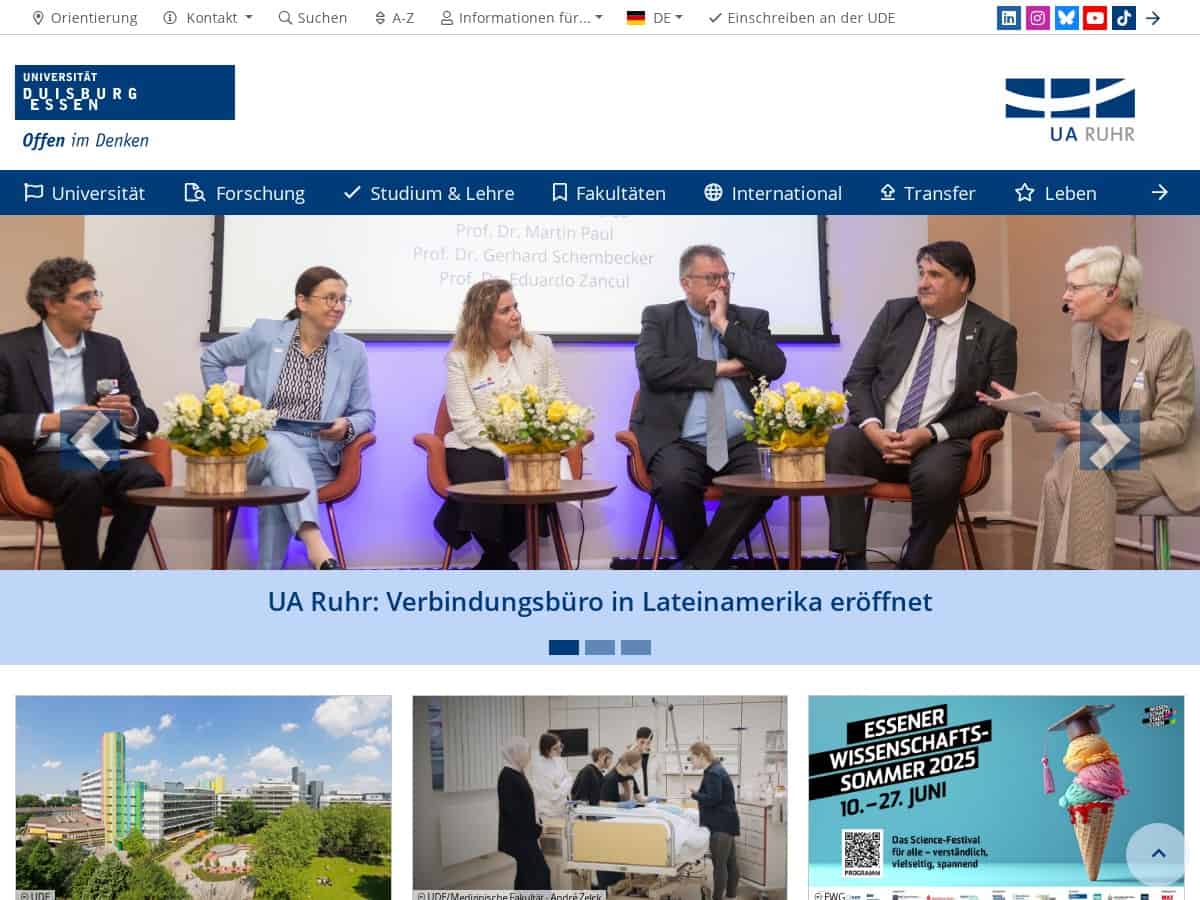
Higher education in Duisburg goes back to 1655, when an academy opened there; it was closed in 1818. The present Universität Duisburg-Essen (UDE) dates from 1 January 2003, when the universities in Duisburg and Essen were merged into a single institution.
UDE runs two campuses, Duisburg and Essen, plus the University Hospital Essen. Its faculties include engineering, medicine, chemistry, physics, mathematics, the humanities, the social sciences and the Mercator School of Management. About 43,000 students were enrolled according to figures published for 2017 and 2019.
Nanoscience is a visible research field: the Center for Nanointegration Duisburg-Essen (CENIDE) coordinates work in chemistry, physics, engineering, biology and medicine, and the Interdisciplinary Center for Analytics on the Nanoscale (ICAN) belongs to the same field. Current degree programmes, language requirements and application dates are listed on the university’s official English pages.
Domains taught:
Aerospace, AI and Machine Learning, Automation, Bioengineering, Bioinformatics, Chemistry, Civil Engineering, Computer Vision, Data Analytics, Ecology and Sustainability, Electrical and Electronics, Engineering, Fluid Dynamics, Geotechnics, Industrial Design, Life Sciences, Logistics, Manufacturing, Materials, Mathematics, Mechanical Engineering, Microbiology and Genetics, Nanotechnologies, Optics, Physics, Process Control, Project Management, Robotics, Signal Processing, Software Engineering, Statistics, Structural Engineering, Telecommunications, Thermodynamics, Transportations
Diplomas*:
Bachelor, Doctor, Master
Status:
Public
Partnerships:
Member of UAMR, AURORA European University Alliance. Strong research in nanoscience, water research, and urban systems.
Research:
Nanoscale materials and energy conversion, Water science and environmental research, Biomedical sciences and engineering, Urban systems and logistics, Information and communication technology.
Famous Alumnis:
N/A
International recognition**:
Number of staff***:
5000
Current students***:
42000
Foreign students***:
10%
Cumulative former students***:
N/A
Pros
Large comprehensive university with diverse engineering and science programs, strong in nanoscience and water research.
Cons
Geographically dispersed across two main cities (Duisburg and Essen), recent merger history.
Best For
Large comprehensive university with strong programs in engineering, nanomaterials, and water science.
Ruhr-Universität Bochum, a public university in the same Ruhr region, lists Materials Science & Engineering, IT Security & Computer Science, and Mechanical & Civil Engineering.
Technische Universität Dortmund is a public university in Dortmund focused on Production & Logistics, Chemical & Bioengineering and Computer Science & Data Science.
Bergische Universität Wuppertal in Wuppertal is public, with Mechanical Engineering & Safety Engineering, Electrical Engineering and Civil Engineering & Architecture.
Westfälische Wilhelms-Universität Münster is a public university covering Chemistry & Pharmacy, Physics & Geosciences and Mathematics & Computer Science.
University of Aveiro (Portugal) is a public university covering engineering, sciences, health, and social and political sciences.
University of Central Florida (United States) is a public university in Orlando with sciences, health professions and engineering.
TU Wien (Austria) is a public technical university offering architecture, chemistry and civil engineering among other fields.
University of South Australia is a public university in Adelaide with engineering, health, information technology and business.
*our own picks (our criteria: a mix between domains, diploma delivered, reputation and size), but obviously too many criteria for an apple-to-apple ranking.
FAQ
When was the Universität Duisburg-Essen created?
It was created on 1 January 2003. Two universities, one in Duisburg and one in Essen, were merged.
Did a university exist in Duisburg earlier?
Yes, an academy opened in Duisburg in 1655 and closed in 1818.
Where are the campuses?
There is one in Duisburg and one in Essen, and the University Hospital Essen is a third site. The two cities are in North Rhine-Westphalia.
Which faculties does it offer?
They include engineering, medicine, chemistry, physics, mathematics, humanities, social sciences and the Mercator School of Management. Check the university site for the current faculty structure.
How many students does UDE have?
About 43,000, according to figures published for 2017 and 2019.
What is CENIDE?
CENIDE is the Center for Nanointegration Duisburg-Essen, which coordinates nanoscience across chemistry, physics, engineering, biology and medicine. ICAN, the Interdisciplinary Center for Analytics on the Nanoscale, belongs to the same research landscape.
Where do international applicants find admission rules?
The English-language pages of the university and its international office list programmes, language requirements and application dates. Rules differ by degree, so use the official pages.
Engineering, Environmental Engineering, Renewable Energy, Sustainable Development
*: without any judgment of the quality, readers are strongly encouraged to check the official status of the exact diploma envisioned as many universities have a mix of recognized diplomas, not recognized, “co-delivered,” “equivalent to”, “some pathways” (…), can change over time, and can be named differently from one country to another.
**: international reputation: is based on some criteria that do not mean much in some domains or specialties (number of researchers, of scientific publications, on budget ….). Our approximate 1-4 scale:
known locally
known locally and internationally
is listed in some of the world university’s classifications
is listed among the 20 firsts in some of world university’s classifications
***: estimated numbers, based on online sources and/or feedbacks. The numbers can vary greatly depending on school organisation (ex.: school is part of a group, it employs internal staff or external consultants or has public staff without employing them …). Refer to all the links provided to have accurate and updated numbers.
Innovation.world is not affiliated with this school/university. We recommend to contact them directly on their website for any special request.
To complete or correct any information here or share your opinion, please comment below or > send us a direct message <.