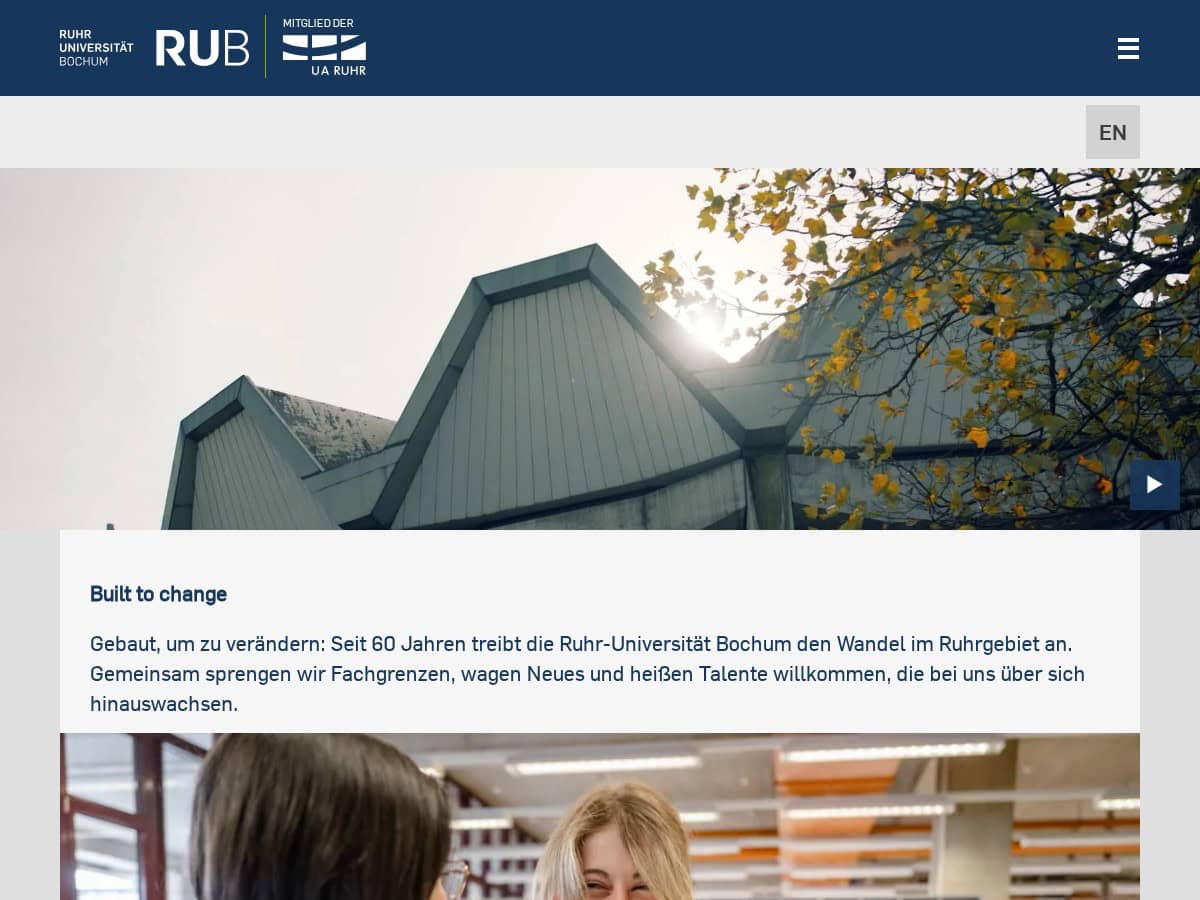
Teaching began in 1965 at the Ruhr-Universität Bochum, which describes itself as the driving force behind the transformation of the Ruhr district from a mining area into a knowledge region. Its campus lies on a single compact site south of the centre of Bochum.
The university has 21 faculties covering natural and engineering sciences, life sciences, medicine, humanities and social sciences. Most disciplines sit on one compact campus built largely in the 1960s, with some expansion to further locations in Bochum, so that students from very different subjects share the same grounds.
More than 37,000 students are enrolled, and the university belongs to the University Alliance Ruhr (UA Ruhr). Together with TU Dortmund it forms the Ruhr Innovation Lab, which was named a University Consortium of Excellence in the German Excellence Strategy on 2 October 2026, with funding from 1 January 2027. Its self-chosen claim is Built to change.
Domains taught:
Aerospace, AI and Machine Learning, Automation, Bioengineering, Bioinformatics, Chemistry, Civil Engineering, Computer Vision, Data Analytics, Ecology and Sustainability, Electrical and Electronics, Engineering, Fluid Dynamics, Geotechnics, Industrial Design, Life Sciences, Manufacturing, Materials, Mathematics, Mechanical Engineering, Microbiology and Genetics, Nanotechnologies, Optics, Physics, Process Control, Project Management, Robotics, Signal Processing, Software Engineering, Statistics, Structural Engineering, Telecommunications, Thermodynamics, Transportations
Diplomas*:
Bachelor, Doctor, Master
Status:
Public
Partnerships:
Member of UAMR (University Alliance Metropolis Ruhr). Strong research in materials science, IT security, and neurosciences.
Research:
Materials research (e.g., RESOLV cluster), Cybersecurity (Horst Görtz Institute), Plasma science and technology, Neuroscience, Subsurface engineering.
Famous Alumnis:
N/A
International recognition**:
Number of staff***:
6000
Current students***:
42000
Foreign students***:
N/A%
Cumulative former students***:
N/A
Pros
Large research university with strong engineering and science programs, notable for IT security and materials research.
Cons
Large campus university, located in Bochum (Ruhr area).
Best For
Large research university strong in materials science, IT security, and engineering.
Aalborg University in Denmark is a public university noted for problem-based learning and engineering.
Linköping University (Sweden) combines engineering, computer science and education.
Tampere University in Finland lists signal processing, photonics and automation.
AGH University of Science and Technology (Poland) is a public university with materials science and engineering and computer science.
*our own picks (our criteria: a mix between domains, diploma delivered, reputation and size), but obviously too many criteria for an apple-to-apple ranking.
FAQ
When did teaching start at RUB?
Teaching began in 1965. The university presents that year as the start of its role in changing the Ruhr area.
How many faculties are there?
There are 21, spread across engineering, natural sciences, life sciences, medicine, humanities and social sciences. This makes it a very broad university.
What does the campus look like?
Most disciplines share one compact campus south of Bochum, mainly built in the 1960s. Some units have since moved to other locations in the city.
How many students study at RUB?
More than 37,000. The university website lists the most recent enrolment.
What is UA Ruhr?
It is the University Alliance Ruhr, of which Bochum is a member. With TU Dortmund, RUB forms the Ruhr Innovation Lab, named a University Consortium of Excellence on 2 October 2026.
Which pages list admission and fee information?
The official study pages of the university, which list requirements per programme.
*: without any judgment of the quality, readers are strongly encouraged to check the official status of the exact diploma envisioned as many universities have a mix of recognized diplomas, not recognized, “co-delivered,” “equivalent to”, “some pathways” (…), can change over time, and can be named differently from one country to another.
**: international reputation: is based on some criteria that do not mean much in some domains or specialties (number of researchers, of scientific publications, on budget ….). Our approximate 1-4 scale:
known locally
known locally and internationally
is listed in some of the world university’s classifications
is listed among the 20 firsts in some of world university’s classifications
***: estimated numbers, based on online sources and/or feedbacks. The numbers can vary greatly depending on school organisation (ex.: school is part of a group, it employs internal staff or external consultants or has public staff without employing them …). Refer to all the links provided to have accurate and updated numbers.
Innovation.world is not affiliated with this school/university. We recommend to contact them directly on their website for any special request.
To complete or correct any information here or share your opinion, please comment below or > send us a direct message <.