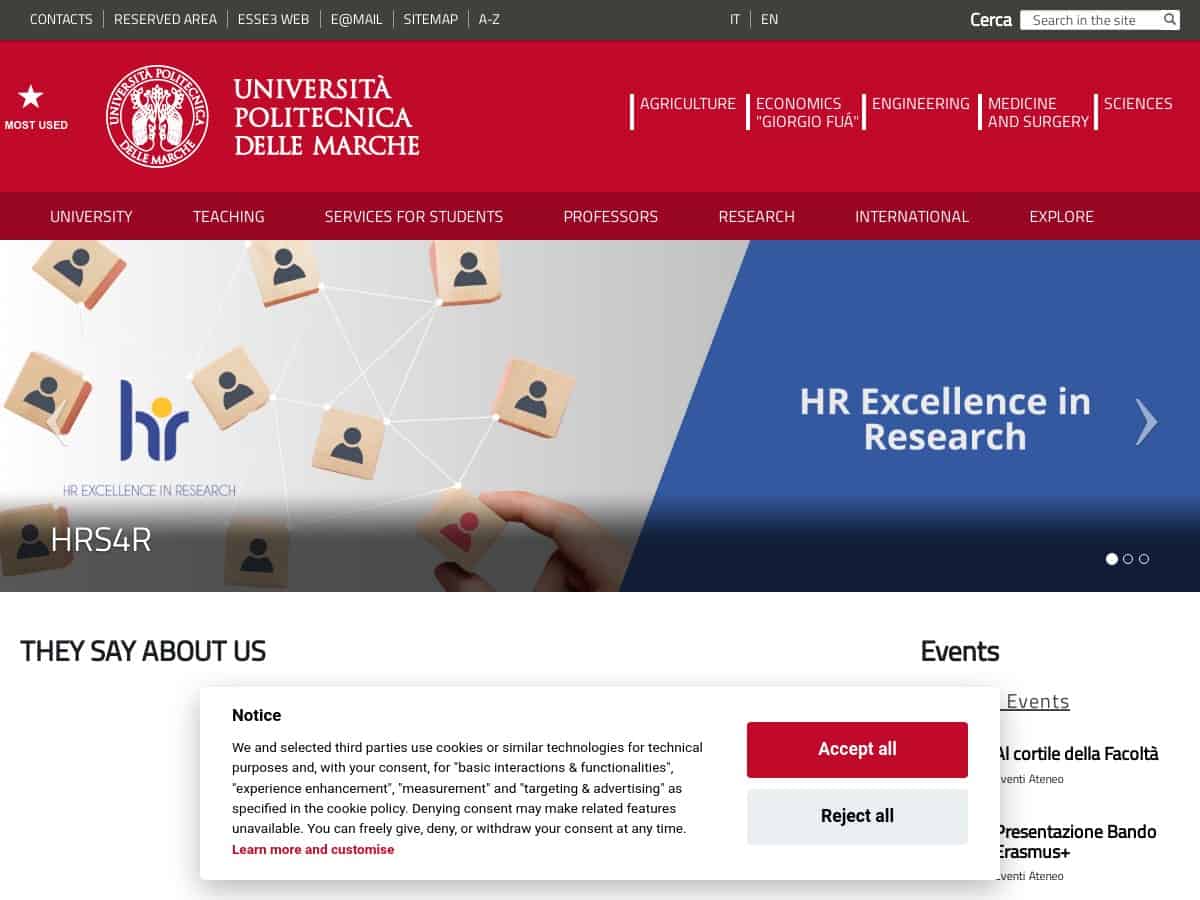
Ancona, the port city of the Marche region on the Adriatic coast, is the seat of the Università Politecnica delle Marche. It began in 1969 as the Free University of Ancona, with the first years of engineering and the biological track of medicine, and today it is a state university.
Its teaching has been grouped into five faculties: Agriculture, Economics, Engineering, Medicine and Surgery, and Science. The university is therefore broader than its polytechnic name suggests, since it combines technical subjects with agriculture, economics and medicine.
Students looking for current degree programmes, admission rules and fees should use the university’s official site, which lists them by course.
Domains taught:
Agriculture, AI and Machine Learning, Automation, Bioengineering, Civil Engineering, Ecology and Sustainability, Electrical and Electronics, Engineering, Food Science, Industrial Design, Life Sciences, Marine Science, Materials, Mechanical Engineering, Robotics, Software Engineering, Structural Engineering
Diplomas*:
Bachelor, Doctor, Master
Status:
Public
Partnerships:
Active in Erasmus+ and other international exchange programs. Partnerships with local industries in Marche region.
Food science, information engineering and agricultural sciences are listed by Università degli Studi di Udine in Udine.
Most Similar Schools Abroad
Polytechnic University of Valencia in Spain teaches civil engineering, architecture, industrial engineering and agriculture, which resembles Ancona's technical and agricultural mix.
University of Aveiro in Portugal, near the Atlantic coast, offers engineering, sciences and health.
Université de Montpellier in France lists ecology and environmental science, biology and health sciences.
For marine biology, University of Gdańsk in Poland has oceanography and marine biology among its main fields.
Universiteit Gent in Belgium combines life sciences, engineering and biotechnology.
*our own picks (our criteria: a mix between domains, diploma delivered, reputation and size), but obviously too many criteria for an apple-to-apple ranking.
FAQ
When was the Università Politecnica delle Marche founded?
It started in 1969 as the Free University of Ancona. AlmaLaurea and Wikipedia both give 1969 as the founding year.
In which city is the university based?
Its main seat is in Ancona, in the Marche region of Italy.
What fields does it cover?
Five faculties cover Agriculture, Economics, Engineering, Medicine and Surgery, and Science. This mix of technical, economic and biomedical subjects is unusual for a university with Politecnica in its name.
Is it a state or a private university?
It is a state university. It began as a free university and is a state university today.
What did the first teaching include?
Early teaching consisted of the first two years of engineering and the biological track of medicine and surgery. Further faculties were added over the following decades.
Where can foreign students find application information?
The international office pages of the university explain application and enrolment steps. Italian degree programmes also set their own language and entry requirements.
*: without any judgment of the quality, readers are strongly encouraged to check the official status of the exact diploma envisioned as many universities have a mix of recognized diplomas, not recognized, “co-delivered,” “equivalent to”, “some pathways” (…), can change over time, and can be named differently from one country to another.
**: international reputation: is based on some criteria that do not mean much in some domains or specialties (number of researchers, of scientific publications, on budget ….). Our approximate 1-4 scale:
known locally
known locally and internationally
is listed in some of the world university’s classifications
is listed among the 20 firsts in some of world university’s classifications
***: estimated numbers, based on online sources and/or feedbacks. The numbers can vary greatly depending on school organisation (ex.: school is part of a group, it employs internal staff or external consultants or has public staff without employing them …). Refer to all the links provided to have accurate and updated numbers.
Innovation.world is not affiliated with this school/university. We recommend to contact them directly on their website for any special request.
To complete or correct any information here or share your opinion, please comment below or > send us a direct message <.