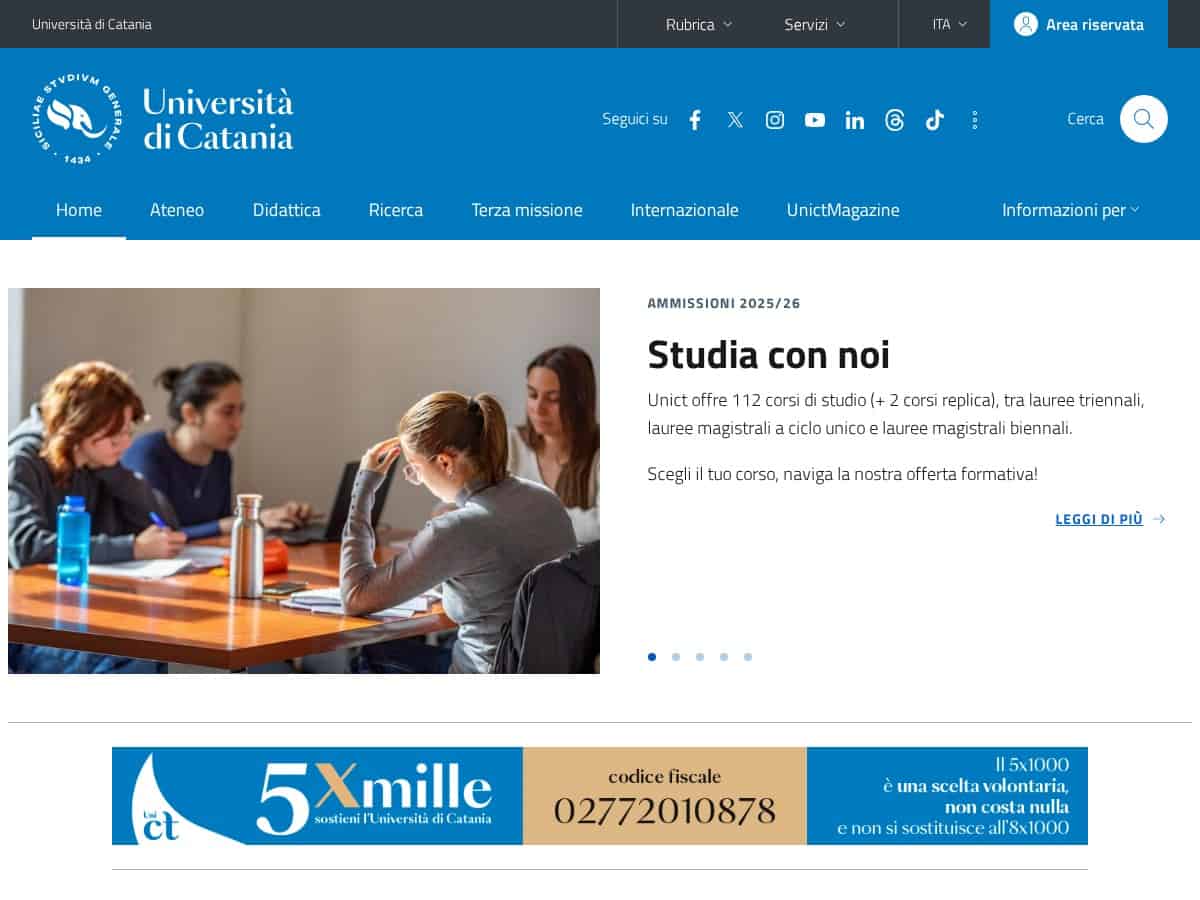
Address: Piazza Università 2, 95131 Catania, Sicilia, Italy
Engineering, Physics, Computer Science
The University of Catania traces its origin to 1434, when Alfonso of Aragon granted the privilege that created a general study in the Sicilian city. Pope Eugene IV gave his approval in 1444, and teaching began in 1445 with a small group of about ten students. Since then the institution has been a fixture of Catania’s cultural life.
Its historic seat is on Piazza Università in the old city centre, where the Palazzo dell’Università houses the rector’s offices. A newer science campus, the Cittadella Universitaria, represents the modern side of the university. The university also runs teaching sites in Ragusa and Syracuse, which remain administratively tied to the headquarters in Catania.
Students should consult the university’s official English pages for the current list of departments and degree programmes, as well as tuition rules, which are set under Italian national and regional regulations.
Domains taught:
Agriculture, AI and Machine Learning, Astroscience, Automation, Bioengineering, Bioinformatics, Chemistry, Civil Engineering, Computer Vision, Data Analytics, Ecology and Sustainability, Electrical and Electronics, Engineering, Fluid Dynamics, Food Science, Geotechnics, Life Sciences, Manufacturing, Materials, Mathematics, Mechanical Engineering, Microbiology and Genetics, Nanotechnologies, Physics, Process Control, Robotics, Software Engineering, Statistics, Structural Engineering, Telecommunications, Thermodynamics
Diplomas*:
Bachelor, Doctor, Master
Status:
Public
Partnerships:
EUA, UNIMED. Various international programs and regional partnerships.
Research:
Volcanology and geophysics (due to proximity to Etna), Microelectronics and photonics, Agrifood and biotechnology, Neurosciences.
The Università degli Studi di Messina, public and in Messina, lists engineering, life sciences and chemical sciences.
The public Università degli Studi di Salerno lists computer science, engineering and chemistry.
On Sardinia, the public Università degli Studi di Cagliari lists engineering, computer science and environmental sciences.
Most Similar Schools Abroad
Portugal's University of Porto, a public institution, covers engineering, sciences, medicine and architecture.
In Spain, the public University of Granada lists sciences, health sciences and pharmacy.
France's Université Grenoble Alpes, public, combines physics and nanosciences with computer science.
Poland's Jagiellonian University, a public university in Kraków, lists physics and astronomy, chemistry and computer science.
Hungary's University of Szeged is public and spans medicine, pharmacy and science and informatics.
*our own picks (our criteria: a mix between domains, diploma delivered, reputation and size), but obviously too many criteria for an apple-to-apple ranking.
FAQ
How old is the University of Catania?
It dates from 1434, when Alfonso of Aragon granted its founding privilege. Papal recognition followed in 1444 and lessons began in 1445.
Who approved the university in the Church's name?
Pope Eugene IV recognised the new study in 1444. Teaching started the following year.
How many students were in the first group?
Early sources mention only about ten students at the start of teaching.
Where are the main sites?
The historic headquarters stands on Piazza Università in Catania, and the modern Cittadella Universitaria hosts scientific departments. Additional teaching sites exist in Ragusa and Syracuse.
Is the university only in Catania?
No, Ragusa and Syracuse also host university activities. These sites still belong to the headquarters in Catania.
What is housed in the Palazzo dell'Università?
The palace on Piazza Università serves as the university's main building and as the seat of the rector. It is part of the old city centre.
How can I find the course list and fees?
The university publishes its departments, degree courses and contribution rules on its official website, including English pages. Check them for your chosen level of study and academic year.
Engineering, Environmental Engineering, Innovation, Physics, Sustainable Development
*: without any judgment of the quality, readers are strongly encouraged to check the official status of the exact diploma envisioned as many universities have a mix of recognized diplomas, not recognized, “co-delivered,” “equivalent to”, “some pathways” (…), can change over time, and can be named differently from one country to another.
**: international reputation: is based on some criteria that do not mean much in some domains or specialties (number of researchers, of scientific publications, on budget ….). Our approximate 1-4 scale:
known locally
known locally and internationally
is listed in some of the world university’s classifications
is listed among the 20 firsts in some of world university’s classifications
***: estimated numbers, based on online sources and/or feedbacks. The numbers can vary greatly depending on school organisation (ex.: school is part of a group, it employs internal staff or external consultants or has public staff without employing them …). Refer to all the links provided to have accurate and updated numbers.
Innovation.world is not affiliated with this school/university. We recommend to contact them directly on their website for any special request.
To complete or correct any information here or share your opinion, please comment below or > send us a direct message <.