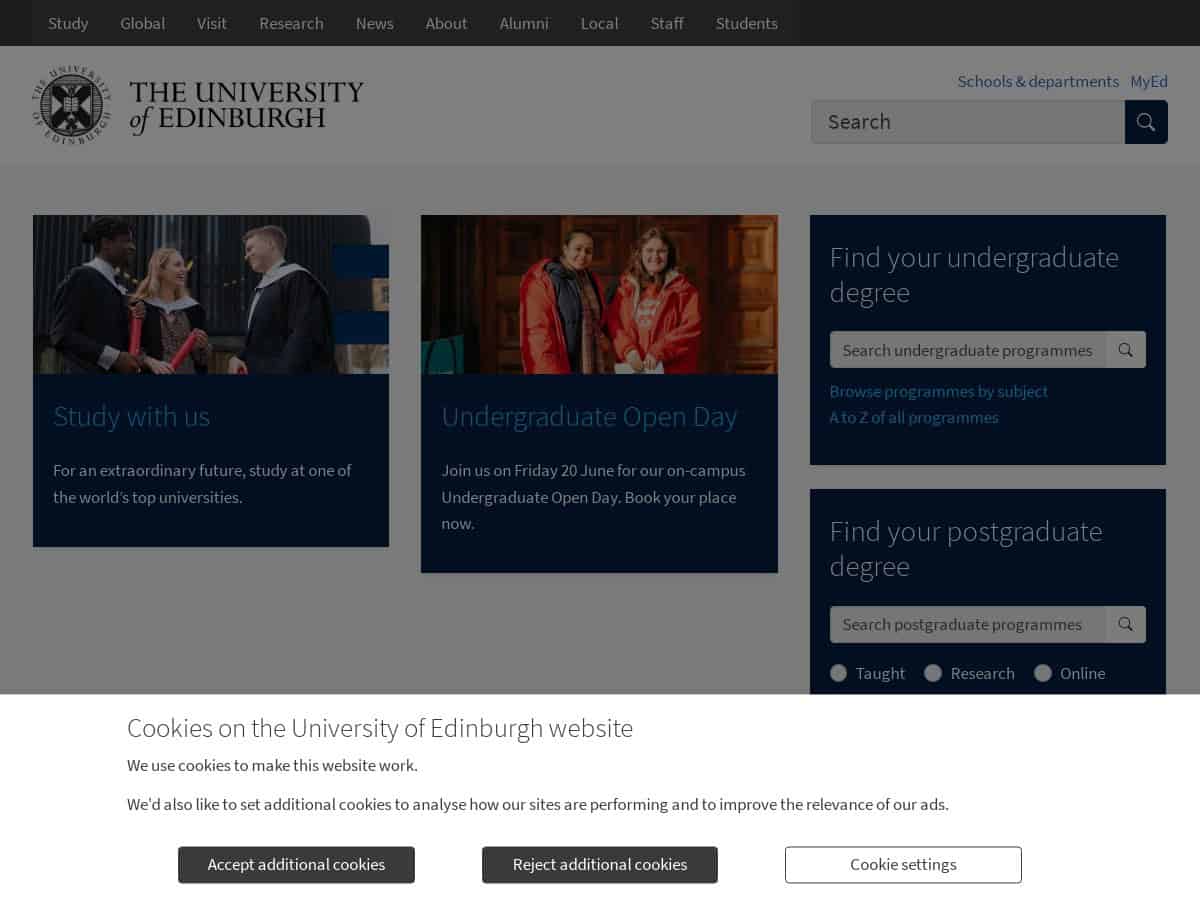
Address: Old College, South Bridge, Edinburgh, EH8 9YL, Scotland, United Kingdom
Medicine, Informatics, Arts and Humanities
Founded in 1583, a prestigious public research university in Scotland’s capital. A member of the Russell Group and one of Scotland’s ancient universities, with a global reputation.
The University of Edinburgh was founded in 1583 by a royal charter of James VI, and it is one of the ancient universities of Scotland. It has about 46,000 students and 10,500 staff, and around 40 percent of the students come from abroad. The Old College on South Bridge, designed by Robert Adam and William Playfair, is the historic centre, and the university now has campuses at George Square, King’s Buildings for sciences and engineering, and the Easter Bush site for veterinary medicine.
Edinburgh was a centre of the Scottish Enlightenment in the eighteenth century, and the university played a major role. David Hume and Adam Ferguson were figures of the period, and the university’s medical school became one of the most influential in Europe. Charles Darwin spent two years as a medical student in Edinburgh in the 1820s, and Arthur Conan Doyle studied medicine here, drawing on his professor Joseph Bell for the character of Sherlock Holmes.
James Clerk Maxwell and Alexander Graham Bell are among those linked to the city’s university. Peter Higgs, who proposed the Higgs mechanism, was a professor of theoretical physics and received the 2013 Nobel Prize in Physics. The Roslin Institute, part of the university, is where Dolly the sheep was cloned in 1996. The School of Informatics, formed in 2002, is one of the leading centres for artificial intelligence in Europe.
Undergraduate applications go through UCAS. Scottish students normally pay no tuition fees, while students from the rest of the United Kingdom pay up to about nine and a half thousand pounds a year, and international students pay much higher fees, often between twenty-five and forty thousand pounds depending on the course. Check the current tariff. Teaching is in English, and many degrees in Scotland last four years.
Edinburgh is a compact city of hills, castles and festivals, including the Fringe in August, and rents are high. Student housing is available in university halls, and early applications are advised.
Domains taught:
AI and Machine Learning, Data Analytics, Engineering, Life Sciences, Physics, Robotics, Software Engineering
Diplomas*:
Bachelor, Doctor, Master, MBA
Status:
Public
Partnerships:
Extensive global research and teaching partnerships. Member of Russell Group, LERU, and Universitas 21. Strong links with Scottish institutions and industry.
Research:
World-leading research across a vast range of disciplines, particularly strong in medicine, veterinary medicine, informatics (AI, robotics, data science), and humanities. Major AI research hub.
Famous Alumnis:
Charles Darwin, David Hume, Alexander Graham Bell, J.K. Rowling (honorary), Sir Arthur Conan Doyle
International recognition**:
Number of staff***:
10500
Current students***:
46000
Foreign students***:
40%
Cumulative former students***:
310000
Pros
Globally renowned historic university, Russell Group member, leading research institution, vibrant city location, wide course selection, strong international community.
Cons
Highly competitive admissions, large student body, cost of living in Edinburgh can be high, some older buildings.
Best For
High-achieving students looking for a world-class, research-intensive education at a historic university in a major European capital, particularly strong in AI, medicine, and humanities.
Among national alternatives, University College London stands out for its focus on robotics, physics and life sciences, and it has almost the same size, at about 48,000 students, and is also a public institution.
Both schools build their programmes around physics, life sciences and AI and machine learning, and University of Glasgow is the one to compare first within the country, since it teaches at the same levels, namely bachelor's, master's, doctoral and mba, and covers chemistry and mathematics as well.
The University of Manchester takes a similar route through physics, life sciences and AI and machine learning, and it is also a public institution, and teaches at the same levels, namely bachelor's, master's, doctoral and mba.
Another national school that puts physics, life sciences and AI and machine learning at the centre is University of Nottingham, and it is also a public institution, and runs the same bachelor's, master's, doctoral and mba programmes.
On content, University of Leeds and this university are close, as both teach robotics, life sciences and AI and machine learning; it is slightly smaller, at about 39,500 students against roughly 46,000 here, and is also a public institution.
Most Similar Schools Abroad
Seen from abroad, Columbia University (the United States) is a close relative on subject matter, since physics, life sciences and data analytics are central to both, and it is slightly smaller, at about 34,200 students against roughly 46,000 here, and is private, whereas this university is public.
Beyond national borders, University of California, Los Angeles stands out as a comparable school for life sciences, data analytics and AI and machine learning; it is also a public institution, and teaches at the same levels, namely bachelor's, master's, doctoral and mba.
McMaster University in Canada is the nearest foreign match on physics, life sciences and data analytics; it teaches at the same levels, namely bachelor's, master's, doctoral and mba, and covers materials as well.
McGill University in Canada is the nearest foreign match on physics, life sciences and data analytics; it covers ecology and sustainability as well, and is slightly smaller, at about 39,500 students against roughly 46,000 here.
If this institution is on your list for physics, life sciences and data analytics, Nanyang Technological University in Singapore deserves a comparison, because it is also a public institution, and teaches at the same levels, namely bachelor's, master's, doctoral and mba.
*our own picks (our criteria: a mix between domains, diploma delivered, reputation and size), but obviously too many criteria for an apple-to-apple ranking.
FAQ
Where is the University of Edinburgh?
The Old College is on South Bridge in Edinburgh, Scotland. Other campuses are at George Square, King's Buildings and Easter Bush.
When was it founded?
In 1583, by a royal charter of James VI.
How large is it?
About 46,000 students and 10,500 staff, with around 40 percent of students from abroad.
What was the Scottish Enlightenment?
An intellectual movement of the eighteenth century in which the university played a major role.
Who studied there?
Charles Darwin spent two years as a medical student, and Arthur Conan Doyle studied medicine.
Which Nobel laureate worked there?
Peter Higgs, who received the 2013 Nobel Prize in Physics.
What is the Roslin Institute?
A research institute of the university where Dolly the sheep was cloned in 1996.
What is the School of Informatics known for?
It is one of the leading centres for artificial intelligence in Europe.
What does it cost?
Scottish students normally pay no tuition fees. Students from the rest of the United Kingdom pay up to about nine and a half thousand pounds a year, and international fees are much higher. Check the current tariff.
*: without any judgment of the quality, readers are strongly encouraged to check the official status of the exact diploma envisioned as many universities have a mix of recognized diplomas, not recognized, “co-delivered,” “equivalent to”, “some pathways” (…), can change over time, and can be named differently from one country to another.
**: international reputation: is based on some criteria that do not mean much in some domains or specialties (number of researchers, of scientific publications, on budget ….). Our approximate 1-4 scale:
known locally
known locally and internationally
is listed in some of the world university’s classifications
is listed among the 20 firsts in some of world university’s classifications
***: estimated numbers, based on online sources and/or feedbacks. The numbers can vary greatly depending on school organisation (ex.: school is part of a group, it employs internal staff or external consultants or has public staff without employing them …). Refer to all the links provided to have accurate and updated numbers.
Innovation.world is not affiliated with this school/university. We recommend to contact them directly on their website for any special request.
To complete or correct any information here or share your opinion, please comment below or > send us a direct message <.