Address: 76 Lenin Prospekt, Chelyabinsk, 454080, Russia
Mechanical Engineering, Metallurgy, Information Technology
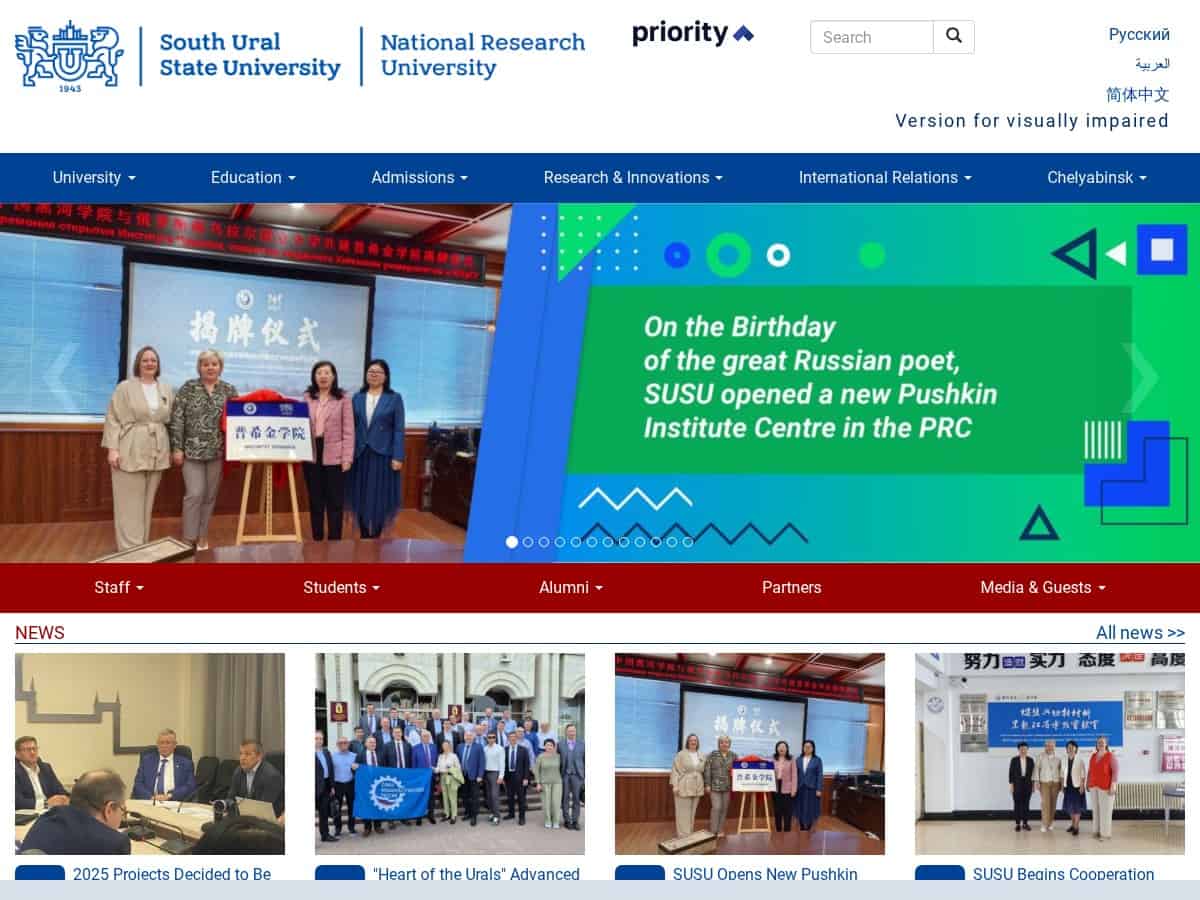
South Ural State University (SUSU) in Chelyabinsk traces its beginning to 1943, when the Chelyabinsk Mechanical Engineering Institute was established. In 1951 it was reorganised as the Chelyabinsk Polytechnic Institute, and in 1990 it became Chelyabinsk State Technical University.
The present name dates from 1997. In 2010 the university was given the status of a National Research University, and SUSU also took part in the Project 5-100 programme.
The official history page divides the university’s past into stages, from the first stage of 1943 to 1949 up to the period beginning in 2015. Totals for students and staff differ on different pages, so the university’s current publications should be used for any exact figure.
Domains taught:
Aerospace, AI and Machine Learning, Electrical and Electronics, Engineering, Materials, Mechanical Engineering, Software Engineering
Diplomas*:
Bachelor, Doctor, Master
Status:
Public
Partnerships:
Collaborates with over 100 international universities and research centers; active in student and staff mobility programs.
Research:
Research in areas like supercomputing, alternative energy sources, new materials, aerospace technologies, and digital industry.
Famous Alumnis:
Viktor Khristenko
International recognition**:
Number of staff***:
3000
Current students***:
27000
Foreign students***:
10%
Cumulative former students***:
200000
Pros
Large multidisciplinary university, strong engineering traditions, increasing focus on research and internationalization, designated as a Smart University.
Cons
Regional university, some programs stronger than others.
Siberian Federal University in Krasnoyarsk, another large institution with metallurgy and power engineering.
Tomsk Polytechnic University in Tomsk, comparable through power and chemical engineering.
Samara National Research University in Samara, a research-designated institution with aerospace and engine manufacturing.
Russian State University of Oil and Gas in Moscow, with petroleum engineering, geology and chemical technology.
National Research Nuclear University in Moscow, another research-designated institution with engineering physics.
Most Similar Schools Abroad
Taiyuan University of Technology in China, comparable through mining, materials and chemical engineering.
Universität Stuttgart in Germany, with automotive, aerospace and manufacturing engineering.
Ajou University in South Korea, combining mechanical engineering with machine learning.
National Institute of Technology Rourkela in India, with metallurgical and materials engineering.
Silesian University of Technology in Poland, with mechanical engineering, automation and mining.
*our own picks (our criteria: a mix between domains, diploma delivered, reputation and size), but obviously too many criteria for an apple-to-apple ranking.
FAQ
When was South Ural State University founded?
Its origins lie in 1943, when the Chelyabinsk Mechanical Engineering Institute was established. The official history begins its first stage in that year.
How has the name changed over time?
The institution became Chelyabinsk Polytechnic Institute in 1951, Chelyabinsk State Technical University in 1990 and South Ural State University in 1997.
What is the "National Research University" status?
SUSU received it in 2010. It is a Russian designation for universities selected for research development.
In which city is SUSU located?
Its main base is in Chelyabinsk.
What was Project 5-100?
A Russian government programme in which SUSU took part; the university's own history page links to it.
Why do student totals vary between pages?
Published figures often carry no year and may count different groups, so the university's own current publications are the safest basis for quoting numbers.
Additive Manufacturing, Aerospace, Engineering, Environmental Engineering, Mechanical Engineering, Metallurgy, Research and Development, Sustainable Development
*: without any judgment of the quality, readers are strongly encouraged to check the official status of the exact diploma envisioned as many universities have a mix of recognized diplomas, not recognized, “co-delivered,” “equivalent to”, “some pathways” (…), can change over time, and can be named differently from one country to another.
**: international reputation: is based on some criteria that do not mean much in some domains or specialties (number of researchers, of scientific publications, on budget ….). Our approximate 1-4 scale:
known locally
known locally and internationally
is listed in some of the world university’s classifications
is listed among the 20 firsts in some of world university’s classifications
***: estimated numbers, based on online sources and/or feedbacks. The numbers can vary greatly depending on school organisation (ex.: school is part of a group, it employs internal staff or external consultants or has public staff without employing them …). Refer to all the links provided to have accurate and updated numbers.
Innovation.world is not affiliated with this school/university. We recommend to contact them directly on their website for any special request.
To complete or correct any information here or share your opinion, please comment below or > send us a direct message <.