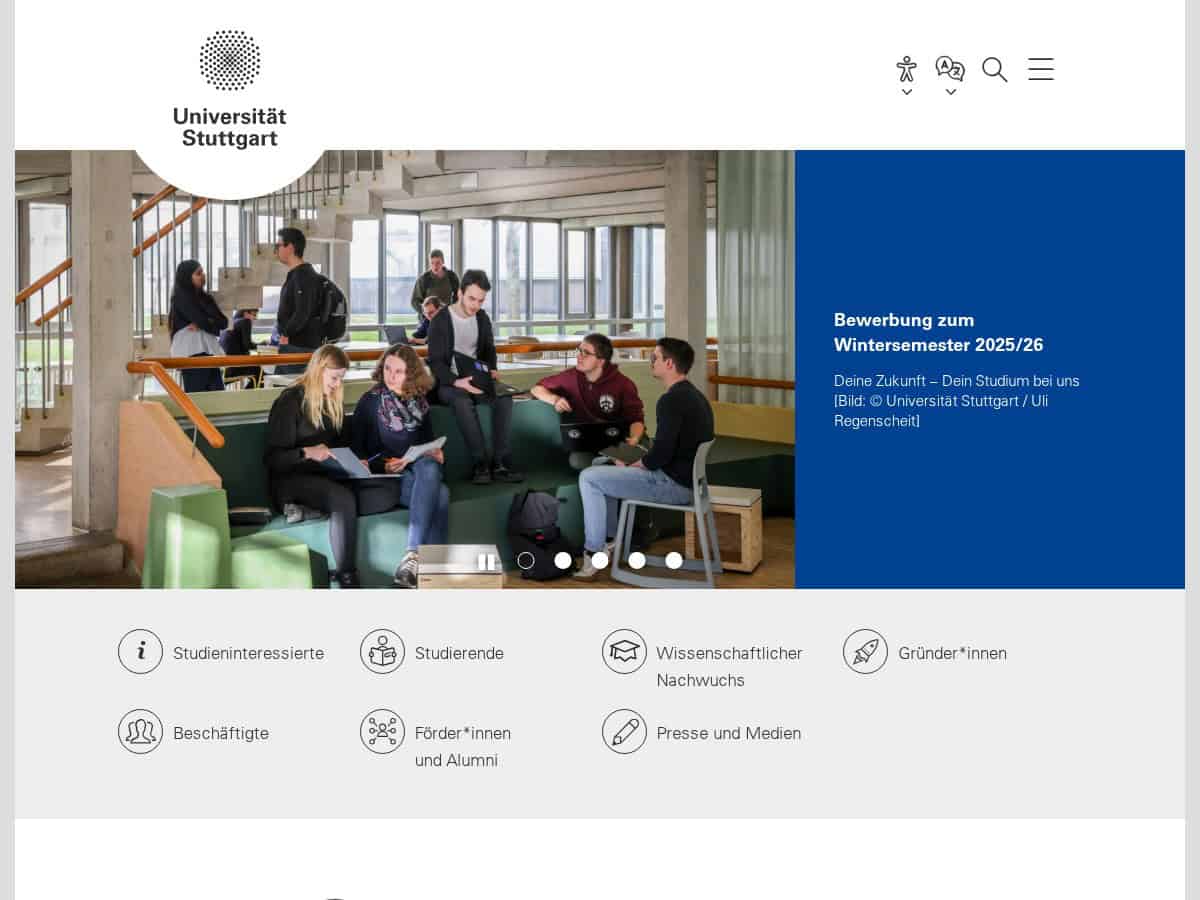
The University of Stuttgart was founded in 1829 under King William I of Württemberg as a combined school for trades and applied sciences, and it received its present name in 1967. Intermediate names reflected its rise in status: a polytechnic school in 1840, a Polytechnikum in 1876 and a Technische Hochschule in 1890. In 1900 it gained the right to award doctorates in engineering and the natural sciences, and women were admitted to study from the winter semester of 1905/06.
The university has two main sites in Stuttgart. The city-centre campus near the main station hosts the humanities, social sciences, economics and architecture, while the campus in the suburb of Vaihingen, begun in the late 1950s, hosts most of the natural science and engineering institutes. Since 2002 teaching has been organised in ten faculties, including architecture and urban planning, civil and environmental engineering, aerospace engineering and geodesy, and engineering design, production engineering and automotive engineering.
About 20,000 students were enrolled in 2025. It belongs to TU9, the alliance of leading German universities of technology, and it hosts the High-Performance Computing Center Stuttgart, one of three federal high-performance computing centres in Germany. The Shanghai Ranking places it in the 301-400 band in 2026, with aerospace engineering among its best subjects.
Domains taught:
Aerospace, AI and Machine Learning, Automation, Bioengineering, Chemistry, Civil Engineering, Computer Vision, Data Analytics, Ecology and Sustainability, Electrical and Electronics, Engineering, Fluid Dynamics, Geotechnics, Industrial Design, Life Sciences, Manufacturing, Materials, Mathematics, Mechanical Engineering, Nanotechnologies, Optics, Physics, Process Control, Project Management, Robotics, Signal Processing, Software Engineering, Statistics, Structural Engineering, Telecommunications, Thermodynamics, Transportations
Diplomas*:
Bachelor, Doctor, Master
Status:
Public
Partnerships:
Member of TU9, T.I.M.E. Strong collaborations with automotive industry (Mercedes-Benz, Porsche, Bosch) and aerospace sector in Baden-Württemberg.
Karlsruher Institut für Technologie is a public institution with mechanical engineering, computer science, and physics and materials science as main fields, the nearest technical peer in Baden-Württemberg.
Technische Universität München is a public university whose main fields include mechanical, electrical and informatics engineering and natural sciences.
Technische Universität Berlin is public and focuses on mechanical engineering, computer science and electrical engineering, and process sciences.
Dresden University of Technology is a public university in Dresden covering engineering, natural sciences, medicine and the humanities.
Most Similar Schools Abroad
Politecnico di Torino in Italy is a public technical university with automotive engineering, aerospace engineering and ICT as main fields, a close match to Stuttgart's strengths.
Technische Universiteit Delft in the Netherlands is public and lists aerospace engineering, civil engineering and computer science among its main fields.
Chalmers University of Technology in Sweden is a private university whose main fields include nanotechnology, materials science and sustainable energy.
Tokyo Tech in Japan is public and lists mechanical, electrical and computer science engineering among its main fields.
*our own picks (our criteria: a mix between domains, diploma delivered, reputation and size), but obviously too many criteria for an apple-to-apple ranking.
FAQ
When was the University of Stuttgart founded?
It was founded in 1829 under King William I of Württemberg. Its early form was a combined school for trades and applied sciences.
How did the institution get its current name?
It was a polytechnic school from 1840, a Polytechnikum from 1876 and a Technische Hochschule from 1890. In 1967 it was renamed Universität Stuttgart as the humanities and social sciences were added.
Where are the campuses?
There is a campus in the city centre, mainly for humanities, social sciences, economics and architecture, and a campus in Vaihingen for the natural sciences and engineering. Applicants should check which site hosts their degree.
How many faculties does the university have?
Since 2002 it has had ten faculties, among them chemistry, mathematics and physics, and computer science, electrical engineering and information technology. The faculties are listed on the official site.
What is TU9?
TU9 is an alliance of nine leading German universities of technology, and Stuttgart is a member. The group promotes research and teaching in technical fields.
What research infrastructure is notable?
The High-Performance Computing Center Stuttgart is one of three federal high-performance computing centres in Germany and is attached to the university. It supports simulation work across engineering and the sciences.
How large is the university?
About 20,000 students were enrolled in 2025. Figures vary slightly by the date and counting method used.
*: without any judgment of the quality, readers are strongly encouraged to check the official status of the exact diploma envisioned as many universities have a mix of recognized diplomas, not recognized, “co-delivered,” “equivalent to”, “some pathways” (…), can change over time, and can be named differently from one country to another.
**: international reputation: is based on some criteria that do not mean much in some domains or specialties (number of researchers, of scientific publications, on budget ….). Our approximate 1-4 scale:
known locally
known locally and internationally
is listed in some of the world university’s classifications
is listed among the 20 firsts in some of world university’s classifications
***: estimated numbers, based on online sources and/or feedbacks. The numbers can vary greatly depending on school organisation (ex.: school is part of a group, it employs internal staff or external consultants or has public staff without employing them …). Refer to all the links provided to have accurate and updated numbers.
Innovation.world is not affiliated with this school/university. We recommend to contact them directly on their website for any special request.
To complete or correct any information here or share your opinion, please comment below or > send us a direct message <.