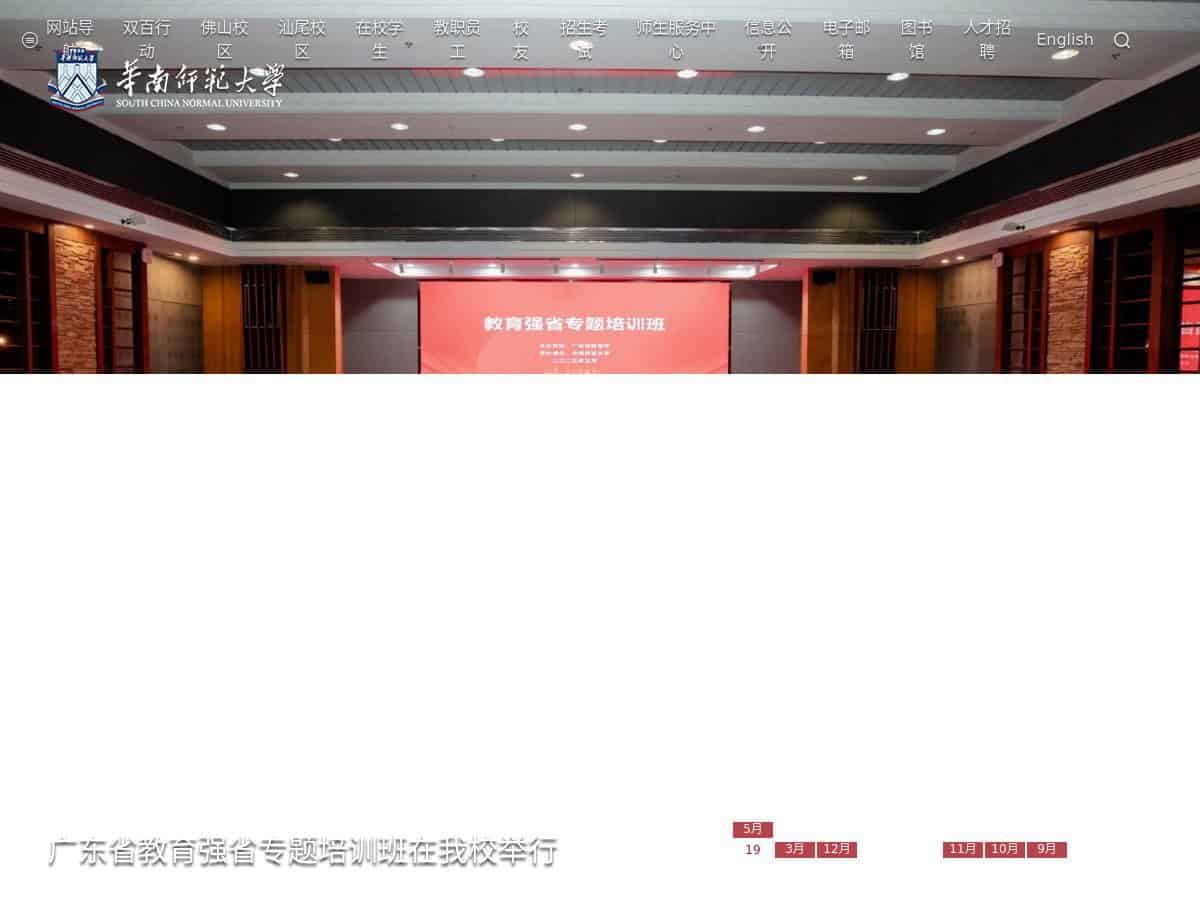
South China Normal University traces its beginnings to 1933 and stands in Guangzhou, in Guangdong province. It is a public university, and the words “Normal University” in its name point to the teacher-education tradition on which the institution was built.
Today its academic structure goes well beyond teacher training. Its schools include education, law, chemistry, life sciences, psychology and computer science, and Times Higher Education lists the university in subject areas that run from education, law and psychology to chemistry, physics, mathematics, computer science, business and economics, and several social sciences.
ShanghaiRanking places the university in the 401-500 band of its Academic Ranking of World Universities 2026. Wikipedia also lists schools of physics and telecommunications engineering, materials and new energy, data science and engineering, and tourism management. The official website is scnu.edu.cn.
Domains taught:
AI and Machine Learning, Astroscience, Bioengineering, Bioinformatics, Chemistry, Computer Vision, Data Analytics, Ecology and Sustainability, Electrical and Electronics, Life Sciences, Materials, Mathematics, Microbiology and Genetics, Nanotechnologies, Optics, Physics, Software Engineering, Statistics, Telecommunications
Diplomas*:
Bachelor, Doctor, Master
Status:
Public
Partnerships:
Leading normal university in South China. Growing research in science and technology.
Research:
Optical Information Technology & Quantum Physics, Functional Materials & Green Chemistry, AI & Educational Technology, Environmental Science.
Famous Alumnis:
N/A
International recognition**:
Number of staff***:
2000
Current students***:
40000
Foreign students***:
N/A%
Cumulative former students***:
N/A
Pros
Strong in basic sciences and educational technology, located in Guangzhou.
Cons
Primary focus is teacher education, though science faculties are strong.
Best For
Leading normal university with strong programs in physics, chemistry, and computer science.
Hunan Normal University is another public normal university, in Changsha, whose listed strengths in chemistry and materials, physics and information technology, and life sciences echo the science side of South China Normal University.
Capital Normal University in Beijing is a public teacher-oriented institution with mathematics, physics and electronic engineering among its recorded specialties.
Zhejiang Normal University, a public university in Jinhua, pairs physics and electronic information engineering with chemistry and life sciences.
East China Normal University in Shanghai is a public institution with software engineering, geography and environmental science, and data science among its specialties.
Beijing Normal University is a normal university in Beijing with geography and remote sensing and environmental science and engineering among its specialties.
Most Similar Schools Abroad
Flinders University in Australia is a public university whose education, psychology and social work faculty mirrors the teaching focus found at South China Normal University.
University of Canterbury in New Zealand is a public university in which education sits beside arts, business, engineering, health, law and science.
Linköping University in Sweden is a public university that joins engineering and computer science to education, a mix comparable to the school structure in Guangzhou.
University of Turku in Finland is a public comprehensive university covering humanities, education, medicine, science, law and social sciences.
École Normale Supérieure de Rennes in France is a public institution whose "normale" heritage parallels the normal-university tradition, with mathematics, computer science and physics among its fields.
*our own picks (our criteria: a mix between domains, diploma delivered, reputation and size), but obviously too many criteria for an apple-to-apple ranking.
FAQ
When was South China Normal University founded, and in which city is it based?
The institution dates from 1933 and is based in Guangzhou, Guangdong province, in southern China. It is a public university.
What can a student study at the university?
Times Higher Education lists it in education, law, psychology, chemistry, physics, mathematics, computer science, business and economics, and a number of social sciences. Its schools include education, law, chemistry, life sciences, psychology and computer science.
How does South China Normal University rank internationally?
ShanghaiRanking's Academic Ranking of World Universities 2026 places it in the 401-500 band. Ranking positions differ between organisations and years, so they are best compared across several editions.
Is the university limited to education and the humanities?
No. Wikipedia lists schools of physics and telecommunications engineering, chemistry, materials and new energy, life sciences, computer science, and data science and engineering, so science and engineering sit alongside teacher education.
What does "Normal University" mean in the name?
In Chinese higher education a normal university is an institution that historically concentrated on training teachers. South China Normal University keeps that label, and education remains one of its listed subject areas.
Where can applicants check admission rules and fees?
The university's official website is scnu.edu.cn. Conditions differ by programme and between domestic and international applicants, so the official admissions pages are the dependable source.
Artificial Intelligence (AI), Chemistry, Innovation, Physics, Sustainable Development
*: without any judgment of the quality, readers are strongly encouraged to check the official status of the exact diploma envisioned as many universities have a mix of recognized diplomas, not recognized, “co-delivered,” “equivalent to”, “some pathways” (…), can change over time, and can be named differently from one country to another.
**: international reputation: is based on some criteria that do not mean much in some domains or specialties (number of researchers, of scientific publications, on budget ….). Our approximate 1-4 scale:
known locally
known locally and internationally
is listed in some of the world university’s classifications
is listed among the 20 firsts in some of world university’s classifications
***: estimated numbers, based on online sources and/or feedbacks. The numbers can vary greatly depending on school organisation (ex.: school is part of a group, it employs internal staff or external consultants or has public staff without employing them …). Refer to all the links provided to have accurate and updated numbers.
Innovation.world is not affiliated with this school/university. We recommend to contact them directly on their website for any special request.
To complete or correct any information here or share your opinion, please comment below or > send us a direct message <.