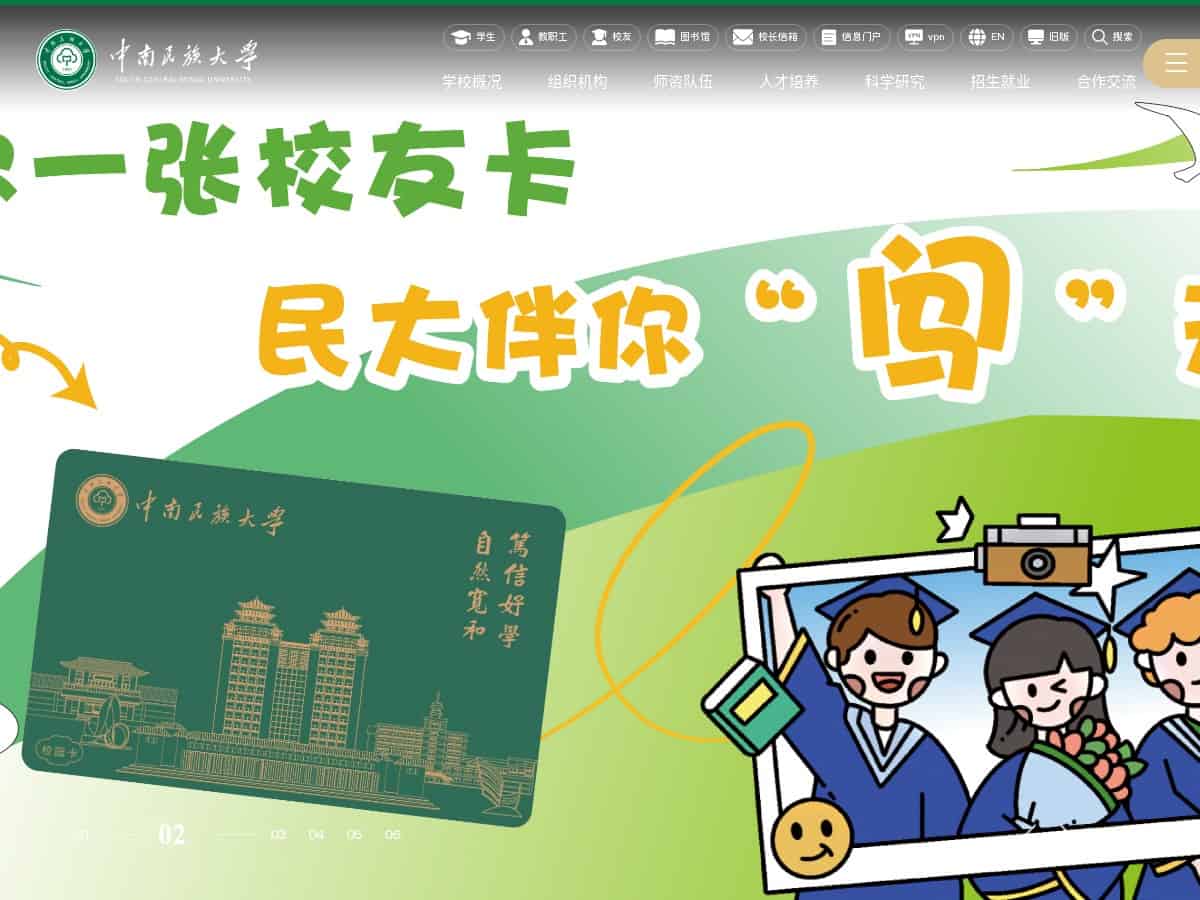
Founded in 1951, SCMZU (also known as South-Central University for Nationalities) is a comprehensive university primarily for ethnic minority students, but offering programs in sciences, engineering, and other fields to all. This entry focuses on its technical/science aspects.
Domains taught:
AI and Machine Learning, Bioengineering, Bioinformatics, Chemistry, Computer Vision, Data Analytics, Ecology and Sustainability, Electrical and Electronics, Engineering, Food Science, Life Sciences, Manufacturing, Materials, Mathematics, Mechanical Engineering, Microbiology and Genetics, Optics, Physics, Process Control, Software Engineering, Statistics, Structural Engineering, Telecommunications, Thermodynamics
Diplomas*:
Bachelor, Doctor, Master
Status:
Public
Partnerships:
Focus on ethnic minority education and regional development, particularly for Central and Southern China’s ethnic groups.
Research:
Ethnopharmacy & Bioresources, New Materials & Catalysis, AI & Big Data Applications, Environmental Science & Protection.
Famous Alumnis:
N/A
International recognition**:
Number of staff***:
1500
Current students***:
28000
Foreign students***:
N/A%
Cumulative former students***:
N/A
Pros
Serves ethnic minority students, comprehensive offerings with growing science and engineering programs.
Cons
More regional and ethnic focus, less research-intensive in engineering than specialized universities.
Best For
Comprehensive university with a focus on ethnic minority education, offering programs in chemistry, life sciences, and computer science.
Dalian Minzu University takes a similar route through food science, bioinformatics and microbiology and genetics, and it covers fluid dynamics and civil engineering as well, and is smaller, enrolling about 16,000 students against roughly 28,000 here.
Shanxi University overlaps with this university on bioinformatics, microbiology and genetics and optics, so the two are easy to compare, and it runs the same bachelor's, master's and doctoral programmes, and covers astroscience and nanotechnologies as well.
A good alternative in the same country is Fudan, which likewise covers bioinformatics, microbiology and genetics and optics; it covers astroscience and nanotechnologies as well, and is slightly larger, at about 35,000 students against roughly 28,000 here.
Both schools build their programmes around bioinformatics, microbiology and genetics and optics, and Peking University is the one to compare first within the country, since it is larger, enrolling about 45,000 students against roughly 28,000 here, and is also a public institution.
Another national school that puts food science, bioinformatics and microbiology and genetics at the centre is Inner Mongolia University, and it is also a public institution, and teaches at the same levels, namely bachelor's, master's and doctoral.
Most Similar Schools Abroad
University of Łódź offers an international parallel to this university, with bioinformatics, microbiology and genetics and optics as common ground; it is also a public institution, and runs the same bachelor's, master's and doctoral programmes.
Adam Mickiewicz University in Poznań brings a Poland setting to the same core fields, bioinformatics, microbiology and genetics and optics, and it covers astroscience and geotechnics as well, and is slightly larger, at about 35,000 students against roughly 28,000 here.
In Germany, Ruprecht-Karls-Universität Heidelberg teaches much the same core subjects, bioinformatics, microbiology and genetics and optics, and it has almost the same size, at about 29,000 students, and is also a public institution.
The closest overseas parallel on bioinformatics, microbiology and genetics and optics is Universität Leipzig, located in Germany; it has almost the same size, at about 30,000 students, and is also a public institution.
The closest overseas parallel on food science, bioinformatics and microbiology and genetics is Université de Rouen Normandie, located in France; it covers geotechnics and nanotechnologies as well, and is slightly larger, at about 32,000 students against roughly 28,000 here.
*our own picks (our criteria: a mix between domains, diploma delivered, reputation and size), but obviously too many criteria for an apple-to-apple ranking.
Artificial Intelligence (AI), Chemistry, Engineering, Life Cycle Assessment (LCA), Materials, Sustainable Development
*: without any judgment of the quality, readers are strongly encouraged to check the official status of the exact diploma envisioned as many universities have a mix of recognized diplomas, not recognized, “co-delivered,” “equivalent to”, “some pathways” (…), can change over time, and can be named differently from one country to another.
**: international reputation: is based on some criteria that do not mean much in some domains or specialties (number of researchers, of scientific publications, on budget ….). Our approximate 1-4 scale:
known locally
known locally and internationally
is listed in some of the world university’s classifications
is listed among the 20 firsts in some of world university’s classifications
***: estimated numbers, based on online sources and/or feedbacks. The numbers can vary greatly depending on school organisation (ex.: school is part of a group, it employs internal staff or external consultants or has public staff without employing them …). Refer to all the links provided to have accurate and updated numbers.
Innovation.world is not affiliated with this school/university. We recommend to contact them directly on their website for any special request.
To complete or correct any information here or share your opinion, please comment below or > send us a direct message <.