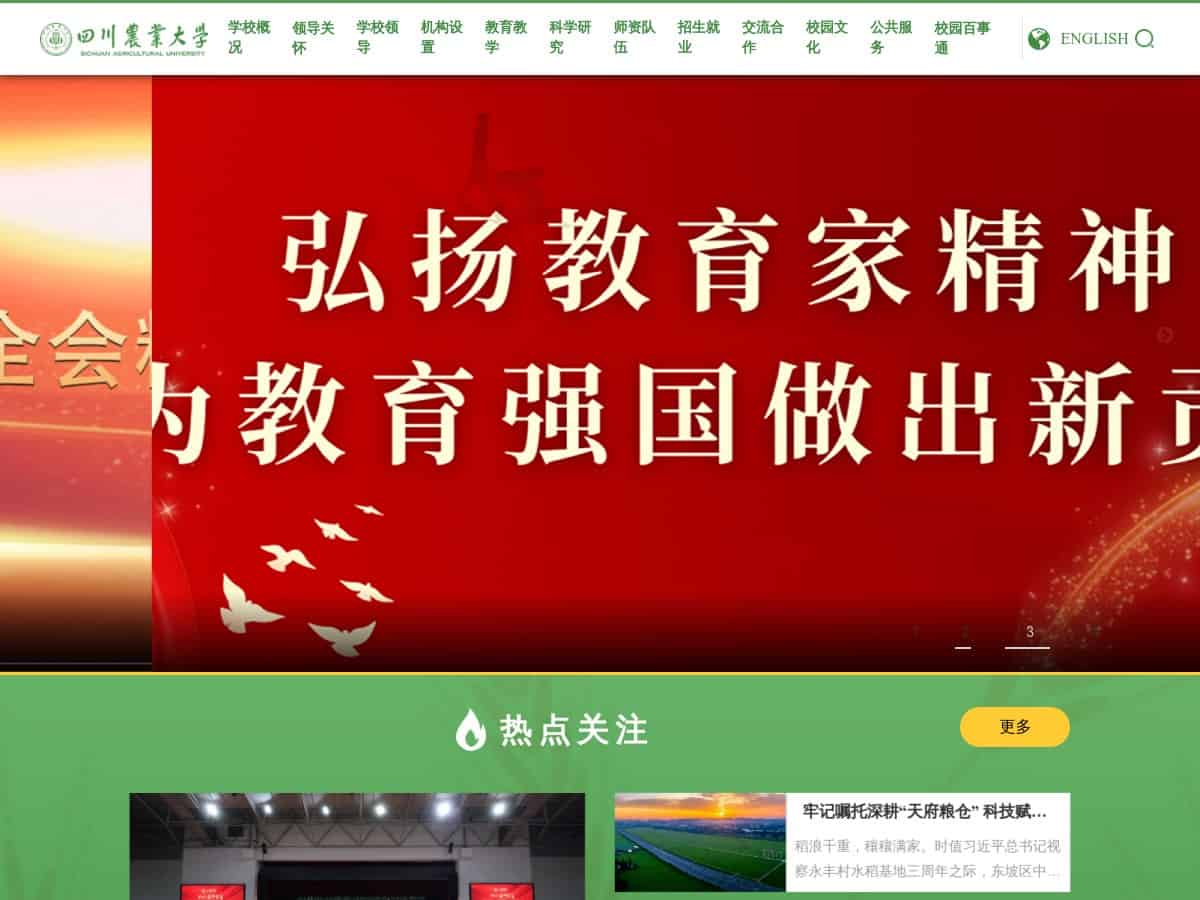
Sichuan Agricultural University grew out of the Sichuan Provincial Agricultural School, which opened in Chengdu in 1906. The school became a separate institution named Sichuan Agricultural College in 1956, and it received its present name, Sichuan Agricultural University, in 1985. Agriculture is therefore both its founding discipline and a word that still appears in its title, and the university sits in Sichuan Province in south-west China.
Teaching and research are spread over three campuses: Ya’an, Chengdu (in the Wenjiang area) and Dujiangyan. The university’s own overview lists more than 25 colleges together with four research institutes, and it states that its programmes cover ten discipline categories: agronomy, science, engineering, economics, management, medicine, literature, education, law and the arts.
That spread of subjects means the institution works as a multi-disciplinary university with an agricultural core, rather than as a single-subject college. Applicants and visiting researchers should consult the official website for the current list of colleges, programme requirements and information for international students, since the structure and enrolment of Chinese universities are updated each year.
Domains taught:
Agriculture, AI and Machine Learning, Bioengineering, Bioinformatics, Chemistry, Data Analytics, Ecology and Sustainability, Electrical and Electronics, Engineering, Fluid Dynamics, Food Science, Geotechnics, Life Sciences, Manufacturing, Materials, Mathematics, Mechanical Engineering, Microbiology and Genetics, Physics, Process Control, Robotics, Software Engineering, Statistics, Structural Engineering, Thermodynamics
Diplomas*:
Bachelor, Doctor, Master
Status:
Public
Partnerships:
Strong collaborations with agricultural research institutes and enterprises in Southwest China. International partnerships.
Research:
Rice and corn genetics and breeding, Animal nutrition and disease control, Forest ecology and silviculture, Agricultural economics and rural development.
Famous Alumnis:
N/A
International recognition**:
Number of staff***:
2000
Current students***:
45000
Foreign students***:
N/A%
Cumulative former students***:
N/A
Pros
Leading agricultural university in Sichuan, strong in crop and animal sciences, contributes to agricultural development in Southwest China.
Cons
Multi-campus university, specialized in agriculture.
Best For
Agricultural sciences, animal science, and forestry in Sichuan.
Southwest University, based in Chongqing, is a public university whose recorded fields include agricultural science and biotechnology, life sciences and ecology, and food science and engineering.
Jiangsu University in Zhenjiang is a public university with agricultural engineering and machinery, automotive engineering, and food science and engineering among its fields.
Nanjing Agricultural University is a public institution in Nanjing working in crop science, plant protection and agricultural resources.
Shandong Agricultural University in Tai'an focuses on agronomy and crop science, plant protection and agricultural engineering.
Fujian Agriculture and Forestry University, in Fuzhou, pairs plant science and forestry with animal science and food-related subjects.
Most Similar Schools Abroad
Universität Hohenheim in Germany, a public university in Stuttgart, is organised around agricultural sciences, bioeconomy and food science.
University of Guelph in Canada is a public university in Guelph whose main fields are agriculture and food science, veterinary medicine and environmental subjects.
Kansas State University, a public university in Manhattan in the United States, combines agriculture and veterinary medicine with engineering.
Justus-Liebig-Universität Gießen in Germany brings together agricultural and environmental sciences with chemistry and materials subjects at a public university in Gießen.
Università degli Studi di Perugia in Italy is a public university in Perugia whose specialties include agricultural sciences, engineering and chemistry.
*our own picks (our criteria: a mix between domains, diploma delivered, reputation and size), but obviously too many criteria for an apple-to-apple ranking.
FAQ
When was Sichuan Agricultural University founded?
Its origins go back to 1906, when the Sichuan Provincial Agricultural School was established in Chengdu. It became Sichuan Agricultural College as a separate institution in 1956 and took the name Sichuan Agricultural University in 1985.
Where are the campuses located?
The university has three campuses, in Ya'an, in Chengdu (Wenjiang) and in Dujiangyan. Students should check which campus hosts their college before applying, because the colleges are distributed across the three sites.
What subjects can be studied here?
The university describes ten discipline categories: agronomy, science, engineering, economics, management, medicine, literature, education, law and the arts. Agriculture-related fields remain the historical core, but the range is considerably wider than farming alone.
How is the university organised?
It reports more than 25 colleges and four research institutes or centres. The exact number of colleges changes between publications, so the official site is the best place to see the current structure.
Did the institution always carry its present name?
No. It began as a provincial agricultural school in 1906, became Sichuan Agricultural College in 1956 and has been called Sichuan Agricultural University since 1985.
Where can international applicants find admission and tuition details?
Admission rules and fees for foreign students are set and published by the university and by the Chinese education authorities. Prospective applicants should read the international pages of the official website and contact the international office directly for the current intake.
Agriculture, Ecology, Environmental Engineering, Food, Sustainable Development
*: without any judgment of the quality, readers are strongly encouraged to check the official status of the exact diploma envisioned as many universities have a mix of recognized diplomas, not recognized, “co-delivered,” “equivalent to”, “some pathways” (…), can change over time, and can be named differently from one country to another.
**: international reputation: is based on some criteria that do not mean much in some domains or specialties (number of researchers, of scientific publications, on budget ….). Our approximate 1-4 scale:
known locally
known locally and internationally
is listed in some of the world university’s classifications
is listed among the 20 firsts in some of world university’s classifications
***: estimated numbers, based on online sources and/or feedbacks. The numbers can vary greatly depending on school organisation (ex.: school is part of a group, it employs internal staff or external consultants or has public staff without employing them …). Refer to all the links provided to have accurate and updated numbers.
Innovation.world is not affiliated with this school/university. We recommend to contact them directly on their website for any special request.
To complete or correct any information here or share your opinion, please comment below or > send us a direct message <.