Address: Grabengasse 1, 69117 Heidelberg, Baden-Württemberg, Germany
Physics & Astronomy, Chemistry & Geosciences, Molecular Life Sciences
Founded in 1386, Heidelberg University is Germany’s oldest university and one of Europe’s leading research institutions, with strong programs in medicine, life sciences, physics, chemistry, and humanities.
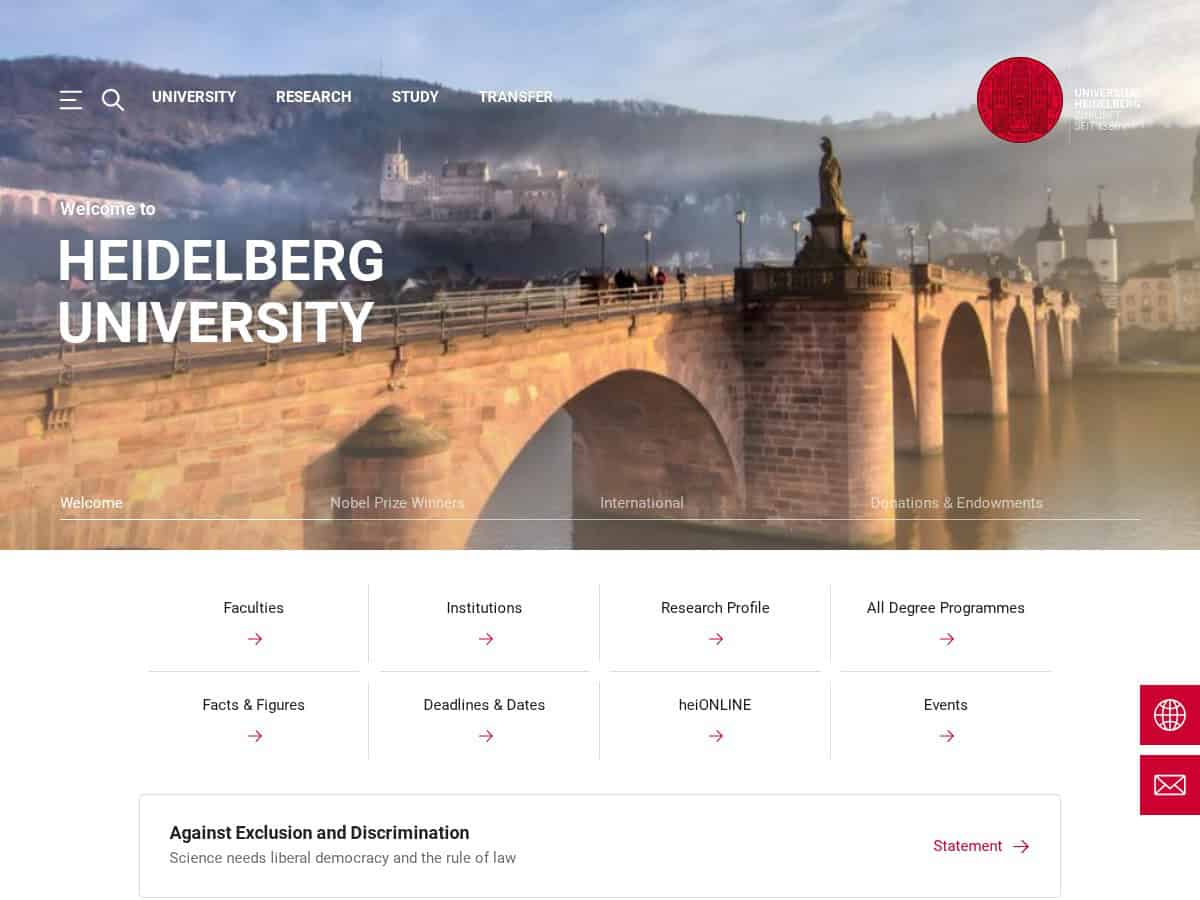
Heidelberg University is the oldest university in Germany, founded in 1386 by Elector Rupert I with the approval of Pope Urban VI. It has about 29,000 students and 7,500 staff, and around one student in five comes from abroad. The old town below the castle holds the university library, the historic Alte Universität and the Studentenkarzer, a former student prison with walls covered in drawings.
The humanities and law are taught in the old town, while the natural sciences and medicine are concentrated on the Neuenheimer Feld campus across the Neckar. The university hospital is one of the biggest in Germany, and the German Cancer Research Center DKFZ and the European Molecular Biology Laboratory are located nearby. Harald zur Hausen, who received the 2008 Nobel Prize in Medicine for work on papillomaviruses and cervical cancer, worked in Heidelberg.
Robert Bunsen and Gustav Kirchhoff developed spectral analysis here in the nineteenth century, and Max Weber taught economics and sociology. More recently, the university has been strong in molecular biology, physics, medicine, environmental sciences, Asian studies and the study of languages and cultures. Heidelberg is a University of Excellence and a member of the League of European Research Universities.
Baden-Württemberg charges tuition to students from outside the EU, historically around 1,500 euros per semester, in addition to a semester contribution. Exemptions and rules change, so check the current regulations. Bachelor’s programmes are mainly in German, and a range of master’s programmes are in English. Admission to medicine and some other subjects is restricted.
Heidelberg is a small city where students make up a large share of the population. Housing is tight and rents are high, and the old town fills with visitors in summer. The university library holds a large collection of medieval manuscripts, including the Codex Manesse, one of the best-known German illuminated manuscripts.
Domains taught:
AI and Machine Learning, Astroscience, Bioengineering, Bioinformatics, Chemistry, Computer Vision, Data Analytics, Ecology and Sustainability, Fluid Dynamics, Geotechnics, Life Sciences, Manufacturing, Materials, Mathematics, Mechanical Engineering, Microbiology and Genetics, Nanotechnologies, Optics, Physics, Process Control, Signal Processing, Software Engineering, Statistics, Structural Engineering, Telecommunications, Thermodynamics
Diplomas*:
Bachelor, Doctor, Master
Status:
Public
Partnerships:
Member of LERU, Coimbra Group, German U15, 4EU+ Alliance. Numerous Nobel laureates.
Research:
Molecular biology & Cancer research, Medical physics & Biomedical engineering, Theoretical astrophysics & Cosmology, Materials chemistry & Catalysis, Environmental physics.
Famous Alumnis:
Numerous Nobel laureates including Philipp Lenard, Walther Bothe, Georg Wittig.
International recognition**:
Number of staff***:
7500
Current students***:
29000
Foreign students***:
20%
Cumulative former students***:
Pros
Germany’s oldest university, excellence in research (especially life sciences and physics), beautiful historic city, strong international reputation.
Cons
Traditional academic environment, engineering faculties are less prominent.
Best For
Oldest German university, renowned for research in physics, chemistry, and life sciences.
Both schools build their programmes around astroscience, bioinformatics and nanotechnologies, and Julius-Maximilians-Universität Würzburg is the one to compare first within the country, since it runs the same bachelor's, master's and doctoral programmes, and has almost the same size, at about 27,000 students.
Where this institution leans on astroscience, bioinformatics and geotechnics, Universität zu Köln does the same, and it teaches at the same levels, namely bachelor's, master's and doctoral, and is larger, enrolling about 48,000 students against roughly 29,000 here.
Another national school that puts astroscience, bioinformatics and nanotechnologies at the centre is Humboldt-Universität zu Berlin, and it is slightly larger, at about 35,000 students against roughly 29,000 here, and is also a public institution.
A good alternative in the same country is Johann Wolfgang Goethe-Universität Frankfurt am Main, which likewise covers astroscience, bioinformatics and geotechnics; it is also a public institution, and teaches at the same levels, namely bachelor's, master's and doctoral.
A good alternative in the same country is Freie Universität Berlin, which likewise covers astroscience, bioinformatics and geotechnics; it is also a public institution, and runs the same bachelor's, master's and doctoral programmes.
Most Similar Schools Abroad
In Poland, Jagiellonian University teaches much the same core subjects, astroscience, bioinformatics and nanotechnologies, and it teaches at the same levels, namely bachelor's, master's and doctoral, and is slightly larger, at about 40,000 students against roughly 29,000 here.
For a study option in Poland with a comparable spread of astroscience, bioinformatics and geotechnics, Adam Mickiewicz University in Poznań is the reference point: it runs the same bachelor's, master's and doctoral programmes, and is slightly larger, at about 35,000 students against roughly 29,000 here.
For a study option in China with a comparable spread of astroscience, bioinformatics and geotechnics, Peking University is the reference point: it is larger, enrolling about 45,000 students against roughly 29,000 here, and is also a public institution.
Looking internationally, Université Clermont Auvergne in France is where astroscience, bioinformatics and geotechnics get a comparable treatment; it is also a public institution, and teaches at the same levels, namely bachelor's, master's and doctoral.
In Switzerland, Universität Basel teaches much the same core subjects, astroscience, bioinformatics and nanotechnologies, and it covers robotics and electrical and electronics as well, and is smaller, enrolling about 13,000 students against roughly 29,000 here.
*our own picks (our criteria: a mix between domains, diploma delivered, reputation and size), but obviously too many criteria for an apple-to-apple ranking.
FAQ
Where is Heidelberg University?
The central address is Grabengasse 1 in Heidelberg, in Baden-Württemberg. The sciences are on the Neuenheimer Feld campus.
How old is it?
It was founded in 1386, which makes it the oldest university in Germany.
How large is it?
About 29,000 students and 7,500 staff.
What is it known for?
Medicine, molecular biology, physics, law, the humanities and Asian studies.
Which research centres are nearby?
The German Cancer Research Center DKFZ and the European Molecular Biology Laboratory.
Which Nobel laureate worked in Heidelberg?
Harald zur Hausen, who received the 2008 Nobel Prize in Medicine.
Does Heidelberg charge tuition?
Baden-Württemberg charges tuition to students from outside the EU, historically around 1,500 euros per semester. Check the current rules and exemptions.
In which language are courses taught?
Bachelor's programmes are mainly in German. A range of master's programmes are in English.
What is the Studentenkarzer?
A former student prison in the old town, now a visitor attraction.
Is housing easy to find?
No. Heidelberg is small and housing is tight, so apply early for a residence.
Chemistry, Innovation, Life Cycle Assessment (LCA), Physics
*: without any judgment of the quality, readers are strongly encouraged to check the official status of the exact diploma envisioned as many universities have a mix of recognized diplomas, not recognized, “co-delivered,” “equivalent to”, “some pathways” (…), can change over time, and can be named differently from one country to another.
**: international reputation: is based on some criteria that do not mean much in some domains or specialties (number of researchers, of scientific publications, on budget ….). Our approximate 1-4 scale:
known locally
known locally and internationally
is listed in some of the world university’s classifications
is listed among the 20 firsts in some of world university’s classifications
***: estimated numbers, based on online sources and/or feedbacks. The numbers can vary greatly depending on school organisation (ex.: school is part of a group, it employs internal staff or external consultants or has public staff without employing them …). Refer to all the links provided to have accurate and updated numbers.
Innovation.world is not affiliated with this school/university. We recommend to contact them directly on their website for any special request.
To complete or correct any information here or share your opinion, please comment below or > send us a direct message <.