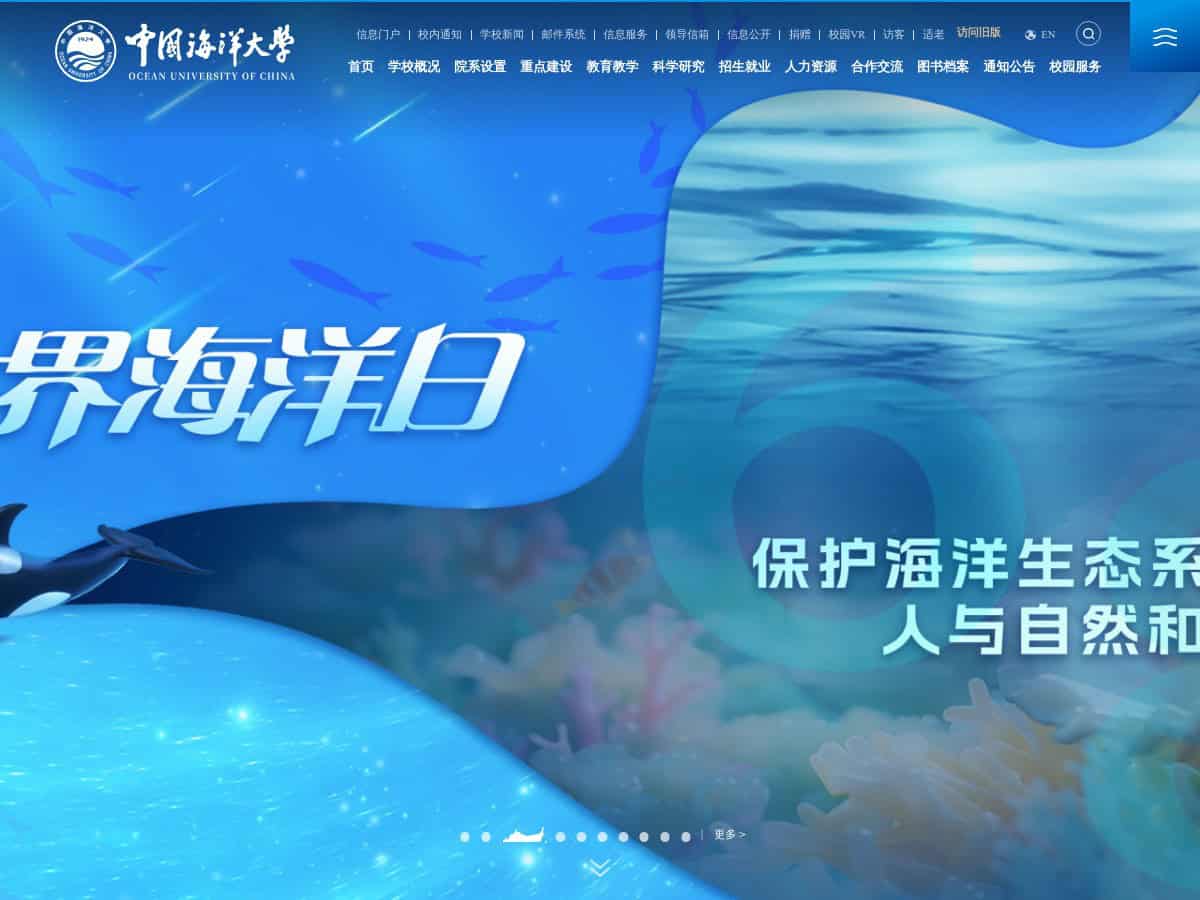
Ocean University of China is a public university in Qingdao, on the coast of Shandong province, with a profile centred on the sea. Its history goes back to 1924, when it was founded as Private Qingdao University. It became the Shandong College of Oceanography in 1959, was renamed Ocean University of Qingdao in 1988, and took its present name in October 2002.
The university is a comprehensive institution that is especially known for marine and fishery sciences, and it also teaches engineering, management, economics and law. Its campuses in Qingdao are located at Yushan, Fushan and Laoshan, with the Yushan site occupying the grounds of the former Bismarck Barracks. Teaching is organised in about twenty colleges.
Chinese government programmes list the university among the institutions in Project 211 and Project 985 and in the Double First-Class Construction. The university operates research vessels, including the Dongfanghong 3, which are used for marine scientific research. The marine disciplines range from physical oceanography and marine life science to fisheries and ocean engineering.
Domains taught:
AI and Machine Learning, Bioengineering, Bioinformatics, Chemistry, Computer Vision, Data Analytics, Ecology and Sustainability, Electrical and Electronics, Engineering, Fluid Dynamics, Food Science, Geotechnics, Life Sciences, Manufacturing, Marine Science, Materials, Mathematics, Mechanical Engineering, Microbiology and Genetics, Optics, Physics, Process Control, Project Management, Robotics, Signal Processing, Software Engineering, Statistics, Structural Engineering, Telecommunications, Thermodynamics
Diplomas*:
Bachelor, Doctor, Master
Status:
Public
Partnerships:
Leading institution for marine sciences in China. Collaborations with international oceanographic institutions and maritime industries.
Xiamen University is a public university on the coast whose main fields include chemistry, marine science and materials science, the closest match for ocean research.
Qingdao University, a public university in the same city, covers medicine, engineering, textile engineering and the sciences, so it shares the Qingdao setting but a broader profile.
Hainan University is a public university in Haikou that lists tropical agriculture and marine sciences among its main fields.
Ningbo University is a public university with marine sciences and engineering as main fields, located on China's east coast.
SJTU is a public university in Shanghai where naval architecture and ocean engineering stand out next to mechanical engineering.
Most Similar Schools Abroad
Kobe University in Japan is a public university with maritime sciences and engineering among its main fields, a direct parallel to marine technology teaching.
University of Bergen in Norway is public and lists marine science and climate research as main fields, which fits a university built around the ocean.
James Cook University in Australia is a public university where marine biology and tropical environment studies feature alongside medicine.
University of Gdańsk in Poland, a public university, includes oceanography and marine biology among its main fields.
University of Southampton in the United Kingdom is public and combines ocean and earth science with engineering, so it suits students interested in applied marine research.
*our own picks (our criteria: a mix between domains, diploma delivered, reputation and size), but obviously too many criteria for an apple-to-apple ranking.
FAQ
When and how was Ocean University of China founded?
It was established in 1924 as Private Qingdao University in Qingdao. It was reorganised several times and received its current name in 2002.
What earlier names did the university use?
After the private university period it became the Shandong College of Oceanography in 1959 and then Ocean University of Qingdao in 1988. The name Ocean University of China followed in October 2002.
In which city are the campuses located?
The Yushan, Fushan and Laoshan campuses are in Qingdao, Shandong. Applicants should confirm which campus hosts their college before enrolling.
What is the university best known for?
It is known for marine sciences and fisheries, within a broader discipline system that includes engineering, life sciences and social sciences. The university also teaches other subjects as a comprehensive institution.
How is the university organised?
Teaching is spread across about twenty colleges, among them colleges of fisheries, marine life science, engineering, management, economics and law. Each college publishes its own programme details.
Which national programmes include the university?
It is part of Project 211, Project 985 and the Double First-Class Construction. These are Chinese government initiatives that provide extra support to selected universities.
Does the university operate research ships?
Yes, it operates research vessels, including the Dongfanghong 3, that are used for marine scientific research. Details of cruises are published by the colleges concerned.
Aquaculture, Climate Change, Environmental Engineering, Marine Ecosystems, Marine Life Impact, Renewable Energy, Sustainable Development
*: without any judgment of the quality, readers are strongly encouraged to check the official status of the exact diploma envisioned as many universities have a mix of recognized diplomas, not recognized, “co-delivered,” “equivalent to”, “some pathways” (…), can change over time, and can be named differently from one country to another.
**: international reputation: is based on some criteria that do not mean much in some domains or specialties (number of researchers, of scientific publications, on budget ….). Our approximate 1-4 scale:
known locally
known locally and internationally
is listed in some of the world university’s classifications
is listed among the 20 firsts in some of world university’s classifications
***: estimated numbers, based on online sources and/or feedbacks. The numbers can vary greatly depending on school organisation (ex.: school is part of a group, it employs internal staff or external consultants or has public staff without employing them …). Refer to all the links provided to have accurate and updated numbers.
Innovation.world is not affiliated with this school/university. We recommend to contact them directly on their website for any special request.
To complete or correct any information here or share your opinion, please comment below or > send us a direct message <.