Address: Boulevard de l’Observatoire, CS 34229, 06304 Nice, Provence-Alpes-Côte d’Azur, France
Astrophysics & Planetology, Geosciences & Oceanography, Space Mechanics & Instrumentation
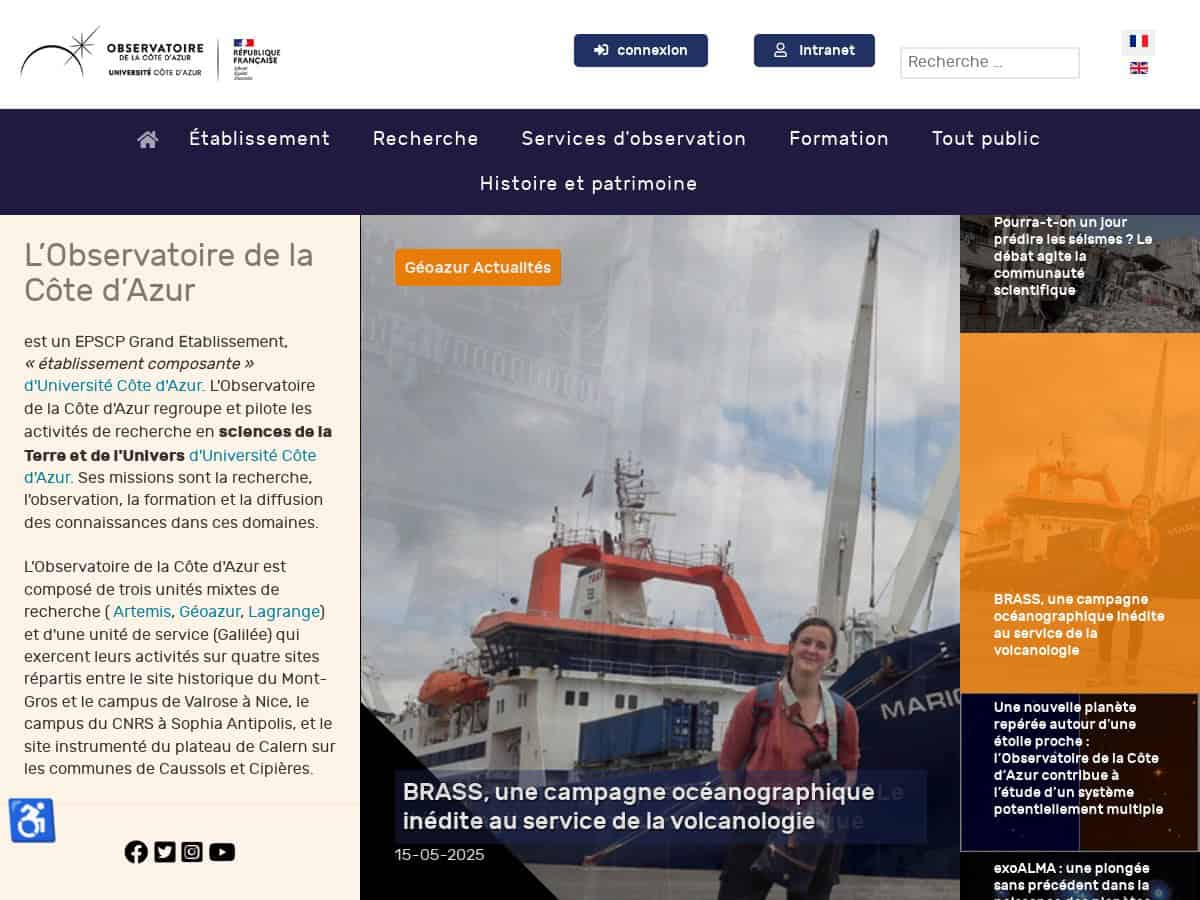
The Observatoire de la Côte d’Azur, known as OCA, is an astronomy and Earth-science research institution based in Nice, with its headquarters on the historic Mont Gros site. It took its present name in 1988, when the Nice Observatory merged with CERGA, the geodynamics and astrometry research centre. The Nice Observatory itself had been created on the summit of Mont Gros by the banker Raphaël Bischoffsheim, and its buildings were designed by the architect Charles Garnier.
OCA works on several sites: Mont Gros and the Valrose campus in Nice, the Plateau de Calern observatory and the Sophia Antipolis technopole. Three research laboratories, Artemis, Géoazur and Lagrange, operate under the shared supervision of the observatory and partners including the CNRS and the IRD.
OCA is an observatoire des sciences de l’univers (OSU). Its laboratories teach at the university in Nice from bachelor’s level up to doctorate, which links the observatory’s research to degree programmes.
Domains taught:
Aerospace, AI and Machine Learning, Astroscience, Computer Vision, Data Analytics, Ecology and Sustainability, Electrical and Electronics, Engineering, Fluid Dynamics, Geotechnics, Marine Science, Mathematics, Mechanical Engineering, Metrology, Optics, Physics, Signal Processing, Software Engineering, Statistics, Telecommunications, Thermodynamics
Diplomas*:
Doctor, Master
Status:
Public
Partnerships:
Part of Université Côte d’Azur. Collaborations with CNRS, CNES, ESA, ESO, and international observatories.
Research:
Stellar and galactic astrophysics, Exoplanets and planetary systems, Seismology and natural hazards, Marine geosciences and ocean dynamics, Development of astronomical instrumentation.
Famous Alumnis:
N/A
International recognition**:
Number of staff***:
300
Current students***:
100
Foreign students***:
N/A%
Cumulative former students***:
N/A
Pros
Leading research institute in astrophysics and geosciences, operates astronomical observatories, strong graduate training programs.
Cons
Highly specialized in research, education primarily at graduate level.
Best For
Research institute and observatory for astrophysics, geosciences, and space mechanics, offering graduate education.
Observatoire de Paris - PSL, a public institution in Paris, covers astronomy and astrophysics, space science and planetology, and the metrology of time.
Institut de Physique du Globe de Paris, public and located in Paris, studies geophysics and seismology, geochemistry and volcanology, and marine geoscience.
Climate science and modelling, atmospheric and oceanographic sciences are the focus of Institut Pierre Simon Laplace, a public institute in Paris.
In the same city of Nice, Université Côte d'Azur is a public university with computer science and AI, smart systems, and Earth and space sciences.
Muséum National d'Histoire Naturelle, public and based in Paris, works on evolutionary biology and biodiversity, and on Earth sciences and paleontology.
Most Similar Schools Abroad
Instituto de Astrofísica de Andalucía in Granada, Spain, is a public institute working on astrophysics, planetary sciences and space instrumentation.
In Italy, Gran Sasso Science Institute in Abruzzo is listed for astroparticle physics.
Switzerland's Universität Bern is known for space research, climate science and biomedical sciences.
Rijksuniversiteit Groningen in the Netherlands covers astrophysics, nanoscience and chemical engineering.
University of Leicester, England, combines space science with archaeology and genetics.
*our own picks (our criteria: a mix between domains, diploma delivered, reputation and size), but obviously too many criteria for an apple-to-apple ranking.
FAQ
What is the Observatoire de la Côte d'Azur?
It is a research institution in astronomy and Earth sciences based in Nice. It has the status of an observatoire des sciences de l'univers and also contributes to teaching.
When did OCA take its present form?
In 1988 the Nice Observatory merged with CERGA, the geodynamics and astrometry research centre, to form OCA. Before that the Nice Observatory had operated on its own on Mont Gros.
Who founded the Nice Observatory and who designed it?
The banker Raphaël Bischoffsheim founded it on the summit of Mont Gros. The architect Charles Garnier designed its buildings.
Where are OCA's sites?
They are Mont Gros and the Valrose campus in Nice, the Plateau de Calern observatory and the Sophia Antipolis technopole. Mont Gros is the headquarters and historic site.
Which laboratories belong to OCA?
Artemis, Géoazur and Lagrange are the three research units. They work under shared supervision of the observatory and partners such as the CNRS and the IRD.
Can students study at OCA?
OCA laboratories teach at the university in Nice at bachelor's, master's and doctoral levels according to the observatory's presentation of its education role. Prospective students should check the university's own programme pages for admission rules.
Astrophysics, Environmental Engineering, Environmental Impact, Marine Ecosystems, Marine Life Impact, Space
*: without any judgment of the quality, readers are strongly encouraged to check the official status of the exact diploma envisioned as many universities have a mix of recognized diplomas, not recognized, “co-delivered,” “equivalent to”, “some pathways” (…), can change over time, and can be named differently from one country to another.
**: international reputation: is based on some criteria that do not mean much in some domains or specialties (number of researchers, of scientific publications, on budget ….). Our approximate 1-4 scale:
known locally
known locally and internationally
is listed in some of the world university’s classifications
is listed among the 20 firsts in some of world university’s classifications
***: estimated numbers, based on online sources and/or feedbacks. The numbers can vary greatly depending on school organisation (ex.: school is part of a group, it employs internal staff or external consultants or has public staff without employing them …). Refer to all the links provided to have accurate and updated numbers.
Innovation.world is not affiliated with this school/university. We recommend to contact them directly on their website for any special request.
To complete or correct any information here or share your opinion, please comment below or > send us a direct message <.