Product Design, Manufacturing & Innovation Resources
Home » National University of Life and Environmental Sciences of Ukraine (NUBiP)

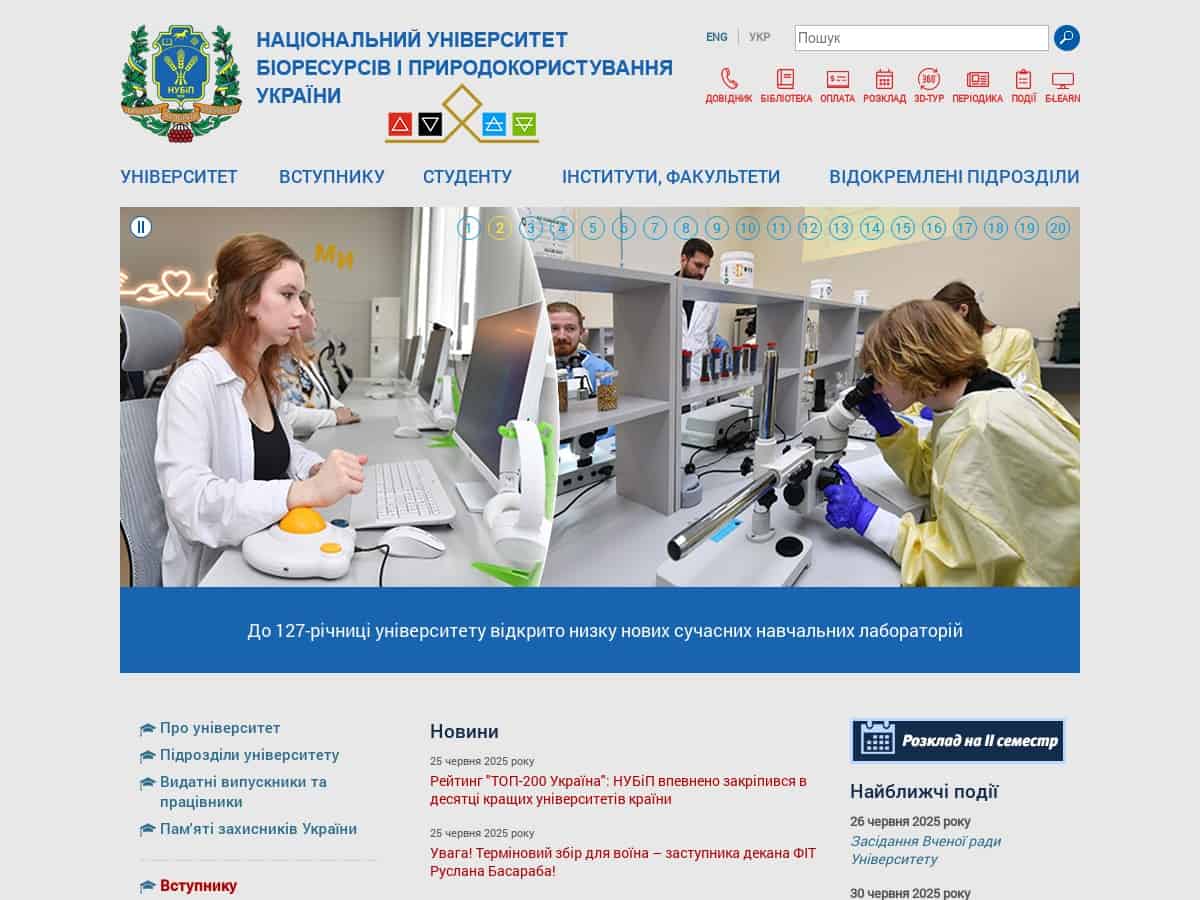
National University of Life and Environmental Sciences of Ukraine (NUBiP)

National University of Life and Environmental Sciences of Ukraine (NUBiP)
Address: 15 Heroiv Oborony St, Kyiv, 03041, Ukraine
Agricultural Engineering, Ecology and Sustainability, Food Technology

History from 1898, NUBiP is a leading Ukrainian university for agricultural sciences, forestry, veterinary medicine, and also has strong programs in agricultural engineering, land management, ecology, and food technology. Technical aspects focused on.

The National University of Life and Environmental Sciences of Ukraine, NUBiP, in Kyiv is the largest agricultural university in the country. Its history goes back to 1898, when the agricultural department of the Kyiv Polytechnic Institute was set up, and it developed into the Kyiv Agricultural Institute and later into a national university. It has about 26,000 students and 3,000 staff, and around one student in ten comes from abroad. The main campus is on Heroiv Oborony Street, in the Holosiiv district in the south of Kyiv, in a park setting with fields, greenhouses and experimental plots.

The university trains specialists for agriculture, food production, forestry, veterinary medicine, environmental protection, land management, construction and economics. Its faculties and institutes include agrobiology, plant protection, biotechnology and ecology, animal husbandry, veterinary medicine, forestry and landscape design, land management, information technologies, economics and management, and law. Ukraine has some of the richest black soils in the world, and agriculture is a main sector of the national economy, so the university plays an important role.

Research is carried out in plant breeding, soil science, animal health, forest management, food technology, ecology and agricultural machinery, often together with national academies and with farms. The campus has an educational and research farm, a botanical garden and a museum. The university cooperates with partners in Europe and North America, and it takes part in programmes for rural development and food security.

Ukrainian applicants enter through the national multi-subject test and compete for state-funded places or pay contract fees. Foreign students normally pay a contract fee, and many begin with a preparatory year in Ukrainian. Fees vary by programme, so check the current tariff. Teaching is in Ukrainian, with a number of programmes in English. Since 2022, teaching has been adapted to wartime conditions, with a mix of online and in-person classes, so check the current situation before applying.

Kyiv has lower living costs than Western Europe, and the campus offers dormitories and sports facilities. The metro and buses connect the campus to the city centre.


Domains taught:

Diplomas*:

Status:

Partnerships:

Extensive international network, collaborations with agricultural universities and research centers worldwide; active in EU programs.

Research:

Research in sustainable agriculture, agricultural machinery, soil science, forestry, animal husbandry, food safety, and renewable energy from biomass.

Famous Alumnis:

N/A

International recognition**:

Number of staff***:

3000

Current students***:

26000

Foreign students***:

10%

Cumulative former students***:

200000

Pros

Leading agricultural university, large campus, strong focus on environmental sciences and sustainable development.

Cons

Focus primarily on agricultural and life sciences, less on core industrial engineering.

Best For

Agricultural Engineering and Ecology

Most Similar Schools Locally

  • Mykolaiv National Agrarian University offers a comparable education in agriculture, food science and bioengineering: it covers automation as well, and is far smaller, with about 6,000 students against roughly 26,000 here.
  • A good alternative in the same country is Bila Tserkva National Agrarian University, which likewise covers agriculture, food science and bioengineering; it covers automation as well, and is far smaller, with about 7,000 students against roughly 26,000 here.
  • The comparison with Odesa State Agrarian University is straightforward on subjects, since both focus on agriculture, food science and geotechnics, and it is also a public institution, and runs the same bachelor's, master's and doctoral programmes.
  • Polissia National University works in much the same fields, chiefly agriculture, geotechnics and bioengineering, and it is far smaller, with about 5,500 students against roughly 26,000 here, and is also a public institution.
  • Sumy National Agrarian University takes a similar route through agriculture, food science and bioengineering, and it runs the same bachelor's, master's and doctoral programmes, and covers civil engineering as well.

Most Similar Schools Abroad

  • The closest overseas parallel on agriculture, bioengineering and mechanical engineering is São Paulo State University, located in Brazil; it is slightly larger, at about 30,000 students against roughly 26,000 here, and is also a public institution.
  • South China Agricultural University, based in China, is built around agriculture, food science and ecology and sustainability much like this university, and it teaches at the same levels, namely bachelor's, master's and doctoral, and covers microbiology and genetics and life sciences as well.
  • On content, Southwest University in China and this institution are close, as both teach agriculture, food science and bioengineering; it covers bioinformatics and microbiology and genetics as well, and is larger, enrolling about 50,000 students against roughly 26,000 here.
  • If this university is on your list for agriculture, food science and bioengineering, University of Guelph in Canada deserves a comparison, because it covers bioinformatics and life sciences as well, and is slightly larger, at about 30,000 students against roughly 26,000 here.
  • For ecology and sustainability and engineering outside the home country, Federal University of Santa Catarina in Brazil is a natural reference; it is also a public institution, and runs the same bachelor's, master's and doctoral programmes.

*our own picks (our criteria: a mix between domains, diploma delivered, reputation and size), but obviously too many criteria for an apple-to-apple ranking.

FAQ

Where is NUBiP?

At 15 Heroiv Oborony Street in Kyiv, Ukraine.

What is it known for?

It is the largest agricultural university in Ukraine.

What is its history?

It goes back to 1898, when the agricultural department of the Kyiv Polytechnic Institute was set up.

How large is it?

About 26,000 students and 3,000 staff.

What does it teach?

Agriculture, food production, forestry, veterinary medicine, environmental protection, land management, construction and economics.

Why is agriculture important in Ukraine?

Ukraine has some of the richest black soils in the world, and agriculture is a main sector of the economy.

What research does it do?

Plant breeding, soil science, animal health, forest management, food technology and ecology.

How do foreign students enter?

They normally pay a contract fee, and many begin with a preparatory year in Ukrainian. Check the current tariff.

In which language are courses taught?

Mainly in Ukrainian, with a number of programmes in English.

How has the war affected teaching?

Since 2022, teaching has been adapted with a mix of online and in-person classes. Check the current situation before applying.

*: without any judgment of the quality, readers are strongly encouraged to check the official status of the exact diploma envisioned as many universities have a mix of recognized diplomas, not recognized, “co-delivered,” “equivalent to”,  “some pathways” (…), can change over time, and can be named differently from one country to another.


**: international reputation: is based on some criteria that do not mean much in some domains or specialties (number of researchers, of scientific publications, on budget ….). Our approximate 1-4 scale: 

  1. known locally
  2. known locally and internationally
  3. is listed in some of the world university’s classifications
  4. is listed among the 20 firsts in some of world university’s classifications

***: estimated numbers, based on online sources and/or feedbacks. The numbers can vary greatly depending on school organisation (ex.: school is part of a group, it employs internal staff or external consultants or has public staff without employing them …). Refer to all the links provided to have accurate and updated numbers.

Innovation.world is not affiliated with this school/university.
We recommend to contact them directly on their website for any special request.


To complete or correct any information here or share your opinion, please comment below or > send us a direct message <.

10th year anniversary

Full size images and downloads are only available, 100% free, for registered members.

> Login <















