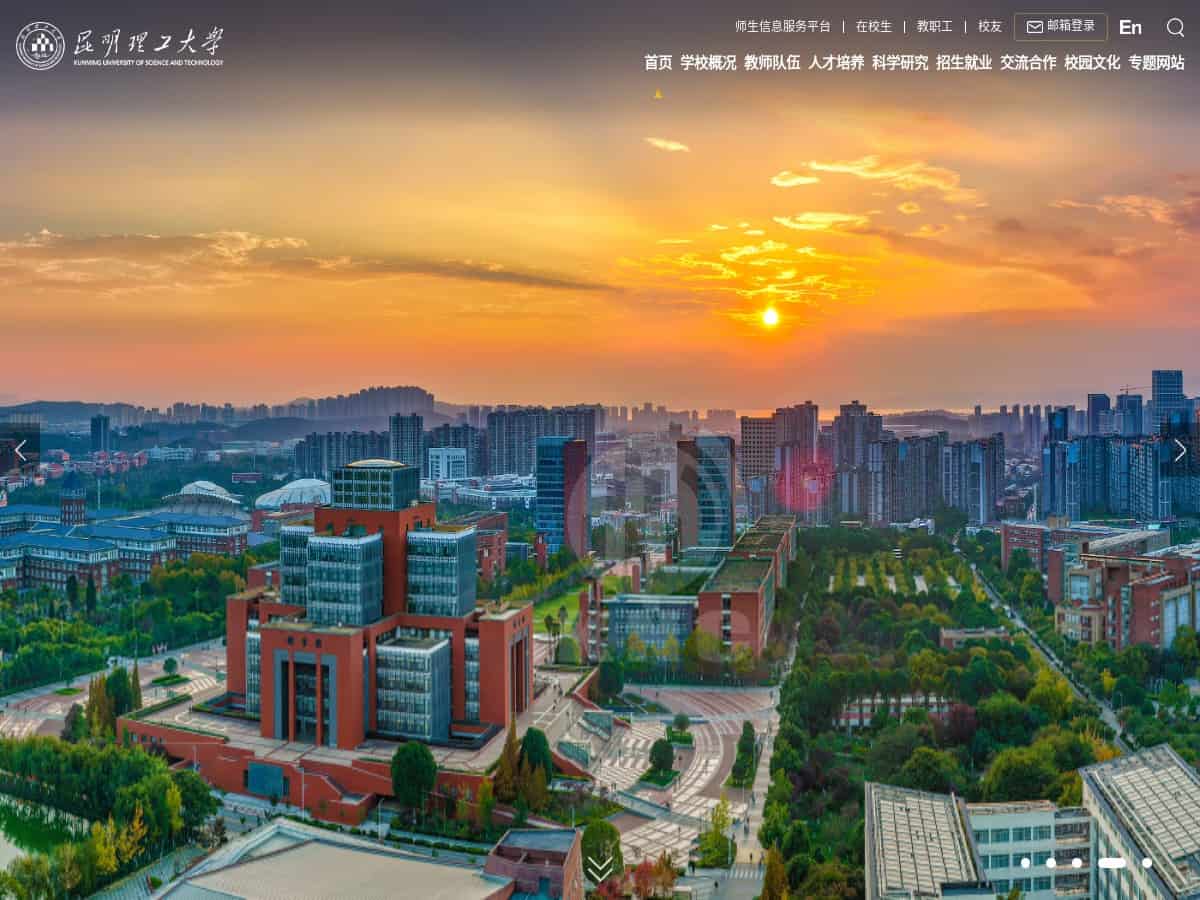
Kunming University of Science and Technology became an independent institution in September 1954 under the name Kunming Institute of Technology. In 1999 it merged with the former Yunnan Polytechnic University to form the present university, which is based in Kunming, the capital of Yunnan Province in south-west China.
Its campuses in Kunming include Chenggong, Lianhua and Xinying, and a City College is part of the university’s structure. Academic units listed include Metallurgical and Energy Engineering, Materials Science and Engineering, Management and Economics, Law, a Medical School and a Graduate School, so that the profile reaches well beyond the engineering fields for which it is best known.
More than 40,000 students are enrolled. ShanghaiRanking’s Academic Ranking of World Universities 2026 places the university in the 401-500 band. During an inspection visit to Yunnan in 2015, General Secretary Xi Jinping praised the university, an episode that both English and Chinese Wikipedia record.
Domains taught:
AI and Machine Learning, Automation, Bioengineering, Chemistry, Civil Engineering, Computer Vision, Data Analytics, Ecology and Sustainability, Electrical and Electronics, Engineering, Fluid Dynamics, Geotechnics, Industrial Design, Life Sciences, Manufacturing, Materials, Mathematics, Mechanical Engineering, Microbiology and Genetics, Nanotechnologies, Optics, Physics, Process Control, Project Management, Quality, Robotics, Signal Processing, Software Engineering, Statistics, Structural Engineering, Telecommunications, Thermodynamics, Transportations
Diplomas*:
Bachelor, Doctor, Master
Status:
Public
Partnerships:
Strong ties with mining and metallurgical industries in Southwest China and Southeast Asia.
Research:
Nonferrous Metallurgy & New Materials, Mineral Processing & Resource Utilization, Environmental Protection in Mining, Mechanical & Electrical Engineering.
Famous Alumnis:
N/A
International recognition**:
Number of staff***:
2500
Current students***:
40000
Foreign students***:
N/A%
Cumulative former students***:
N/A
Pros
Leading university for metallurgy and mining in Southwest China, strong regional focus on resource utilization.
Cons
Located in Kunming, traditional industrial focus.
Best For
Leading university for metallurgical, materials, and mining engineering in Southwest China.
Central South University in Changsha brings together materials science, mining engineering and civil and transport engineering.
Xi'an University of Science and Technology is a public university in Xi'an with mining, safety science and surveying as main fields.
Shandong University of Science and Technology, in Qingdao, lists mining engineering, surveying and geomatics, and mechanical engineering and automation.
Most Similar Schools Abroad
Luleå University of Technology (Sweden) lists mining and metallurgical engineering together with space science and wood technology.
Silesian University of Technology (Poland), in Gliwice, covers mechanical engineering and robotics, automation and mining among its fields.
Mines Saint-Étienne (France) is an engineering school whose specialties include materials science and engineering and industrial engineering.
Saint Petersburg Mining University (Russia) is a specialist school for mining engineering, geology, and oil and gas engineering.
Siberian Federal University (Russia), in Krasnoyarsk Krai, includes metallurgy, mining engineering and power engineering.
*our own picks (our criteria: a mix between domains, diploma delivered, reputation and size), but obviously too many criteria for an apple-to-apple ranking.
FAQ
What was the university called when it began in 1954?
It was founded as an independent institution under the name Kunming Institute of Technology in September 1954. Its profile has widened considerably since then.
Which institutions merged to create the present university?
In 1999 the Kunming institution merged with the former Yunnan Polytechnic University. The merged university took the name Kunming University of Science and Technology.
Does the university have more than one campus?
Yes, its campuses in Kunming include Chenggong, Lianhua and Xinying. Chenggong is the one listed in the university's postal address.
Are subjects outside engineering taught there?
Besides Metallurgical and Energy Engineering and Materials Science and Engineering, the units include Management and Economics, Law and a Medical School. A Graduate School handles postgraduate study.
What is the university's position in ShanghaiRanking?
The Academic Ranking of World Universities 2026 places it in the 401-500 band. Bands change between editions, so the latest edition should be checked.
How big is the student body?
More than 40,000 students are enrolled, according to Wikipedia and Times Higher Education. The university's statistics page on its English website gives current figures.
*: without any judgment of the quality, readers are strongly encouraged to check the official status of the exact diploma envisioned as many universities have a mix of recognized diplomas, not recognized, “co-delivered,” “equivalent to”, “some pathways” (…), can change over time, and can be named differently from one country to another.
**: international reputation: is based on some criteria that do not mean much in some domains or specialties (number of researchers, of scientific publications, on budget ….). Our approximate 1-4 scale:
known locally
known locally and internationally
is listed in some of the world university’s classifications
is listed among the 20 firsts in some of world university’s classifications
***: estimated numbers, based on online sources and/or feedbacks. The numbers can vary greatly depending on school organisation (ex.: school is part of a group, it employs internal staff or external consultants or has public staff without employing them …). Refer to all the links provided to have accurate and updated numbers.
Innovation.world is not affiliated with this school/university. We recommend to contact them directly on their website for any special request.
To complete or correct any information here or share your opinion, please comment below or > send us a direct message <.