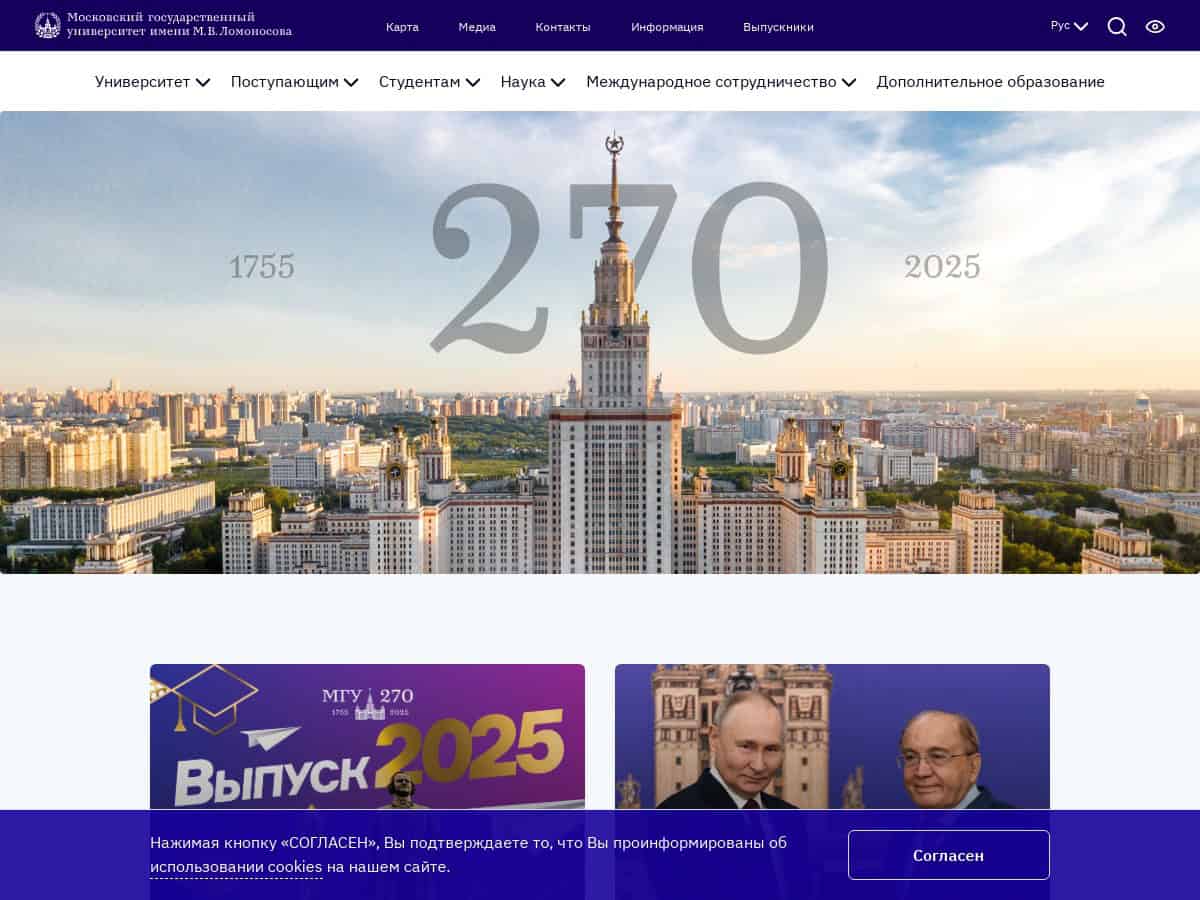
Founded in 1755 by Mikhail Lomonosov, MSU is Russia s oldest and one of its most prestigious universities, a leading center for science, education, and culture with a rich history and a vast range of academic programs.
Lomonosov Moscow State University, MSU, is the oldest and largest classical university in Russia. Empress Elizabeth signed the decree that founded it in 1755, on the proposal of the scientist and poet Mikhail Lomonosov and the statesman Ivan Shuvalov, and the university now carries Lomonosov’s name. It has about 45,000 students and 15,000 staff, and around one student in five comes from abroad. The main campus stands on the Sparrow Hills, called Leninskie Gory, above the Moskva river.
The Main Building, completed in 1953 in the style of Stalinist skyscrapers, has 36 floors above ground and a spire that brings the height to 240 metres. It was the tallest building in Europe until 1990. It houses lecture halls, a library, a museum of earth sciences and student accommodation, and it is surrounded by faculty buildings, a botanical garden and sports grounds. The older buildings on Mokhovaya Street, near the Kremlin, are used by humanities faculties.
MSU has around forty faculties and many research institutes, covering mathematics and mechanics, physics, chemistry, biology, geology, computing, economics, law, history, philology, journalism, psychology and medicine. Several Soviet and Russian Nobel laureates studied or worked here, among them Igor Tamm, Vitaly Ginzburg and Alexei Abrikosov in physics. Andrei Sakharov, who received the Nobel Peace Prize in 1975, graduated from the physics faculty, and Mikhail Gorbachev studied law.
Russian applicants enter by the Unified State Exam and the university’s own tests, with state-funded places and paid places. Foreign students can come through the government quota scholarship system or pay tuition, and many begin with a preparatory year in Russian. Fees vary by faculty, so check the current tariff. Teaching is in Russian, with a limited number of programmes in English. Since 2022, academic exchanges with institutions abroad have changed, so check the current status of agreements.
Moscow is expensive, but university dormitories are cheap, and the metro serves the campus.
Domains taught:
Chemistry, Computer Vision, Geotechnics, Life Sciences, Mathematics, Physics, Software Engineering
Diplomas*:
Bachelor, Doctor, Master
Status:
Public
Partnerships:
Extensive international collaborations with universities and research institutions worldwide; member of numerous international academic associations.
Research:
Wide-ranging fundamental and applied research across natural sciences, humanities, and social sciences, including significant contributions to space research, materials science, and computer science.
Famous Alumnis:
Mikhail Gorbachev, Andrei Sakharov, Ivan Turgenev, Olga Ladyzhenskaya
International recognition**:
Number of staff***:
15000
Current students***:
45000
Foreign students***:
20%
Cumulative former students***:
500000
Pros
Highly prestigious, comprehensive range of disciplines, strong research output, numerous notable alumni.
Cons
Can be highly competitive, large university bureaucracy, some facilities may be older.
Kazan Federal University sits close to this institution on geotechnics, chemistry and physics; it runs the same bachelor's, master's and doctoral programmes, and covers materials as well.
Novosibirsk State University takes a similar route through computer vision, chemistry and physics, and it is also a public institution, and teaches at the same levels, namely bachelor's, master's and doctoral.
The comparison with Saint Petersburg State University is straightforward on subjects, since both focus on chemistry, physics and mathematics, and it is also a public institution, and runs the same bachelor's, master's and doctoral programmes.
Moscow Institute of Physics and Technology sits close to this university on computer vision, physics and mathematics; it covers aerospace and nanotechnologies as well, and is far smaller, with about 7,000 students against roughly 45,000 here.
Perm State University is the closest domestic counterpart for geotechnics, chemistry and physics; it teaches at the same levels, namely bachelor's, master's and doctoral, and covers ecology and sustainability as well.
Most Similar Schools Abroad
Charles University brings a the Czech Republic setting to the same core fields, chemistry, physics and mathematics, and it is also a public institution, and teaches at the same levels, namely bachelor's, master's and doctoral.
Students considering a move abroad can look at University of Oslo in Norway, where geotechnics, chemistry and physics also form the core, and it teaches at the same levels, namely bachelor's, master's and doctoral, and covers astroscience as well.
University of Vienna brings a Austria setting to the same core fields, chemistry, physics and mathematics, and it is also a public institution, and runs the same bachelor's, master's and doctoral programmes.
In Hungary, University of Szeged teaches much the same core subjects, chemistry, physics and mathematics, and it covers microbiology and genetics and optics as well, and is smaller, enrolling about 22,693 students against roughly 45,000 here.
For a study option in Germany with a comparable spread of chemistry, physics and mathematics, Johannes Gutenberg University Mainz is the reference point: it teaches at the same levels, namely bachelor's, master's and doctoral, and covers microbiology and genetics and data analytics as well.
*our own picks (our criteria: a mix between domains, diploma delivered, reputation and size), but obviously too many criteria for an apple-to-apple ranking.
FAQ
Where is Moscow State University?
The main campus is at 1 Leninskie Gory in Moscow, Russia, on the Sparrow Hills.
When was it founded?
In 1755, by a decree of Empress Elizabeth, on the proposal of Mikhail Lomonosov and Ivan Shuvalov.
How large is it?
About 45,000 students and 15,000 staff.
How tall is the Main Building?
It has a height of 240 metres including the spire and was the tallest building in Europe until 1990.
Which Nobel laureates are linked to MSU?
Igor Tamm, Vitaly Ginzburg, Alexei Abrikosov and Andrei Sakharov, among others.
Who studied law there?
Mikhail Gorbachev, the last leader of the Soviet Union.
*: without any judgment of the quality, readers are strongly encouraged to check the official status of the exact diploma envisioned as many universities have a mix of recognized diplomas, not recognized, “co-delivered,” “equivalent to”, “some pathways” (…), can change over time, and can be named differently from one country to another.
**: international reputation: is based on some criteria that do not mean much in some domains or specialties (number of researchers, of scientific publications, on budget ….). Our approximate 1-4 scale:
known locally
known locally and internationally
is listed in some of the world university’s classifications
is listed among the 20 firsts in some of world university’s classifications
***: estimated numbers, based on online sources and/or feedbacks. The numbers can vary greatly depending on school organisation (ex.: school is part of a group, it employs internal staff or external consultants or has public staff without employing them …). Refer to all the links provided to have accurate and updated numbers.
Innovation.world is not affiliated with this school/university. We recommend to contact them directly on their website for any special request.
To complete or correct any information here or share your opinion, please comment below or > send us a direct message <.