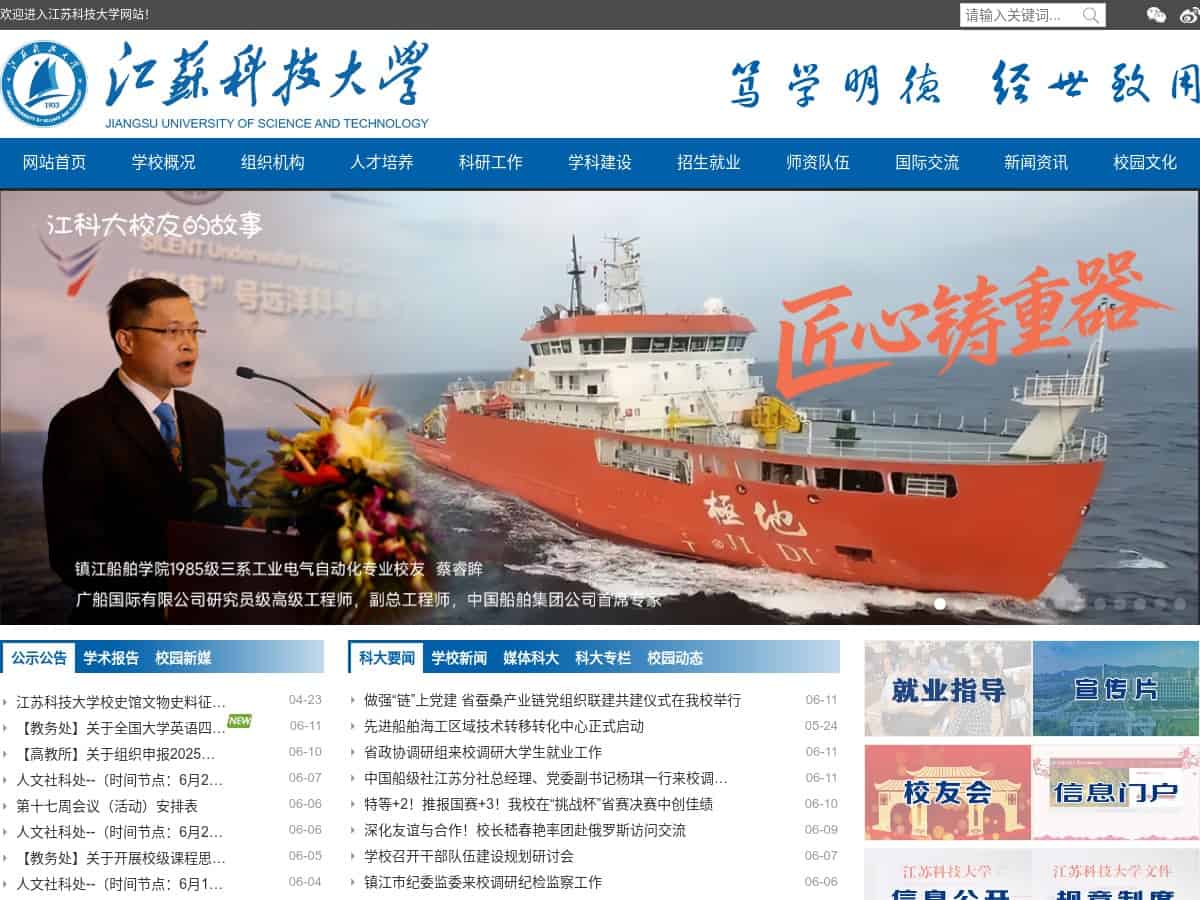
Zhenjiang in Jiangsu Province is the base of Jiangsu University of Science and Technology, an engineering-oriented public university whose profile rests on shipbuilding, ocean engineering and sericulture. The main address lies on Mengxi Road in the Jingkou District of Zhenjiang, and a further campus operates at Zhangjiagang in Suzhou. The institution is run at provincial level and counts among the key construction universities of Jiangsu.
Its origins go back to 1933, and its development followed the needs of the shipbuilding industry. A shipbuilding school was established in Shanghai in 1953 and moved to Zhenjiang in 1970. It became Zhenjiang Shipbuilding Institute in 1978 and East China Shipbuilding Institute in 1993, and it took its present name in 2004. Along the way the Sericulture Research Institute of the Chinese Academy of Agricultural Sciences joined the university, which explains why silk research sits beside marine engineering in its profile.
Teaching runs from bachelor’s through master’s to doctoral level. The directory profile highlights naval architecture and ocean engineering, mechanical engineering with a marine focus, and sericulture combined with biotechnology. Programmes of this kind prepare students for work in shipyards, design institutes, offshore engineering companies and silk-related research, which gives the university a narrower and more industrial character than a general comprehensive institution.
Domains taught:
AI and Machine Learning, Automation, Bioengineering, Chemistry, Civil Engineering, Computer Vision, Data Analytics, Ecology and Sustainability, Electrical and Electronics, Engineering, Fluid Dynamics, Food Science, Industrial Design, Life Sciences, Manufacturing, Marine Science, Materials, Mathematics, Mechanical Engineering, Microbiology and Genetics, Optics, Physics, Process Control, Project Management, Quality, Robotics, Signal Processing, Software Engineering, Statistics, Structural Engineering, Telecommunications, Thermodynamics, Transportations
Diplomas*:
Bachelor, Doctor, Master
Status:
Public
Partnerships:
Key university for shipbuilding and sericulture in Jiangsu. Strong links with maritime and textile industries.
SJTU lists mechanical engineering and naval architecture and ocean engineering among its fields, a close match for the shipbuilding side of this university.
Dalian Maritime University is a public institution focused on navigation technology, marine engineering and maritime logistics.
Shanghai Maritime University combines maritime transport, marine engineering and naval architecture in a public university.
Shanghai Ocean University is a public university covering aquaculture, marine fisheries and marine bioresources, which parallels the life-science strand of the sericulture programmes.
Jiangsu University is a public university in the same province, with agricultural engineering and machinery, automotive engineering and food science.
Most Similar Schools Abroad
Kobe University in Japan is a public university with maritime sciences and engineering, comparable to the marine engineering strength of this Chinese university.
Tokyo University of Marine Science and Technology in Japan is a public institution built around marine science and maritime systems engineering.
Admiral Makarov State University of Maritime and Inland Shipping in Russia is a public university specialising in navigation, marine engineering and port logistics.
Kaliningrad State Technical University in Russia is a public university whose specialities include shipbuilding, fisheries science and food technology.
University of Southampton in the United Kingdom is a public university with engineering and ocean and earth science, a broader counterpart for ocean-related engineering study.
*our own picks (our criteria: a mix between domains, diploma delivered, reputation and size), but obviously too many criteria for an apple-to-apple ranking.
FAQ
Where is Jiangsu University of Science and Technology located?
The main campus is in Zhenjiang, Jiangsu Province, with its address on Mengxi Road in the Jingkou District. Another campus is located at Zhangjiagang in Suzhou.
When did the university receive its current name?
The present name dates from 2004. Before that the institution was known as East China Shipbuilding Institute from 1993 and as Zhenjiang Shipbuilding Institute from 1978.
What subject areas define the university?
Shipbuilding, ocean and marine engineering, and sericulture form the core of its profile. Mechanical engineering with a marine focus and biotechnology are listed among its main specialities.
Why does a shipbuilding university teach sericulture?
The Sericulture Research Institute of the Chinese Academy of Agricultural Sciences became part of the university, so silk and silkworm research was added to the existing marine and engineering disciplines.
Is the university national or provincial?
It is a provincial institution and is described as a key construction university of Jiangsu Province.
Which degree levels can students earn there?
The university grants bachelor's, master's and doctoral degrees.
How far back do the roots of the institution reach?
The origins are dated to 1933, and a shipbuilding school was set up in Shanghai in 1953 before the move to Zhenjiang in 1970.
*: without any judgment of the quality, readers are strongly encouraged to check the official status of the exact diploma envisioned as many universities have a mix of recognized diplomas, not recognized, “co-delivered,” “equivalent to”, “some pathways” (…), can change over time, and can be named differently from one country to another.
**: international reputation: is based on some criteria that do not mean much in some domains or specialties (number of researchers, of scientific publications, on budget ….). Our approximate 1-4 scale:
known locally
known locally and internationally
is listed in some of the world university’s classifications
is listed among the 20 firsts in some of world university’s classifications
***: estimated numbers, based on online sources and/or feedbacks. The numbers can vary greatly depending on school organisation (ex.: school is part of a group, it employs internal staff or external consultants or has public staff without employing them …). Refer to all the links provided to have accurate and updated numbers.
Innovation.world is not affiliated with this school/university. We recommend to contact them directly on their website for any special request.
To complete or correct any information here or share your opinion, please comment below or > send us a direct message <.