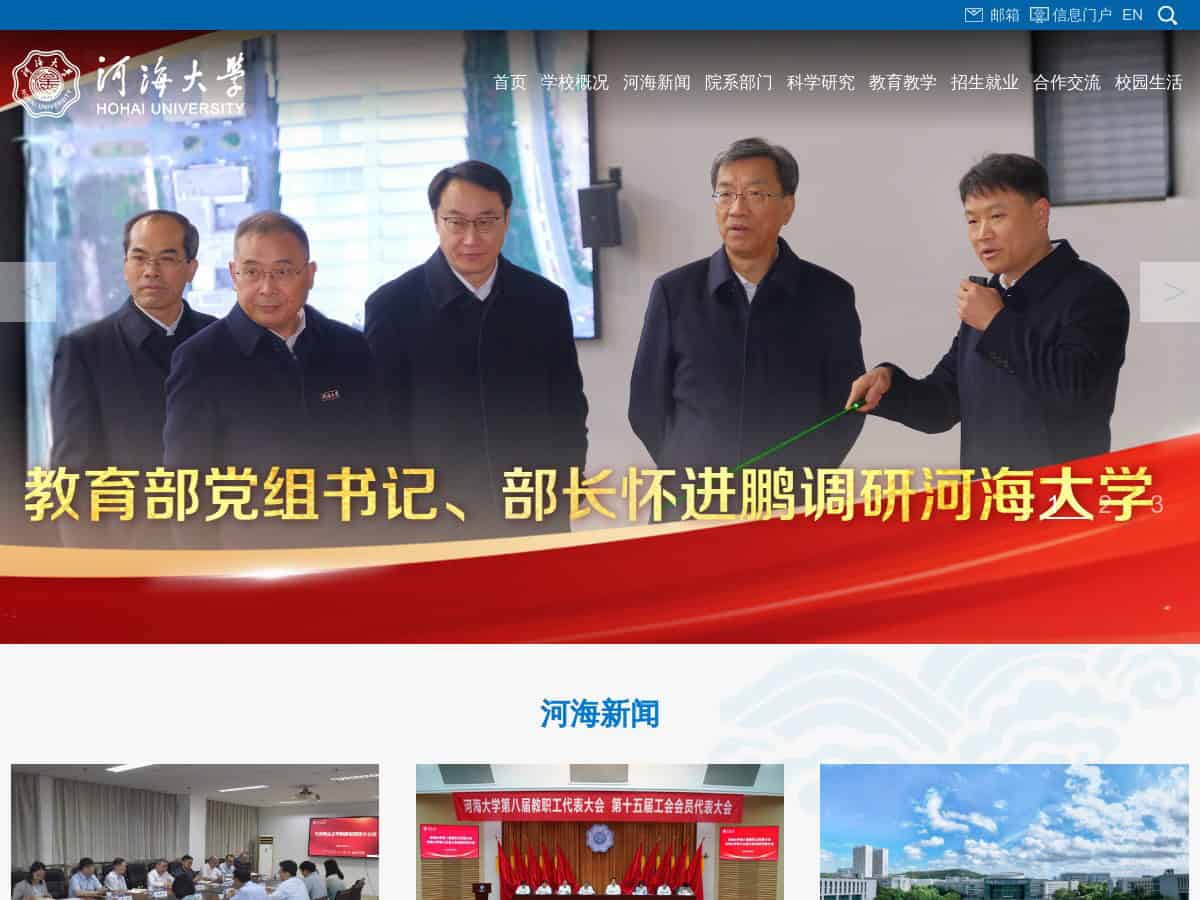
Address: 1 Xikang Road, Gulou District, 210098 Nanjing, Jiangsu, China
Hydraulic Engineering, Water Resources Engineering, Civil Engineering (Hydraulic Structures)
Hohai University, in Nanjing in Jiangsu province, goes back to 1915, when it was founded as the Hohai Civil Engineering School. Its roots lie in water-resources engineering education.
The institution changed shape several times. In 1924 it merged with an engineering department of another institution to form Hohai College of Engineering. In 1928 it became the Department of Water Resources of Central University, and in 1949 the Department of Water Resources of Nanjing University. In 1952, water-related departments from several universities were merged with the East China Engineering School of Water Resources to create the East China Technical University of Water Resources, and in 1985 the name Hohai University was restored.
Its history, which is documented both in the university’s own English-language history page and in encyclopaedic sources, shows a lineage centred on water resources and engineering, and this is reflected in the subjects listed for the institution in the directory: hydraulic engineering, water resources engineering and civil engineering. The university’s main base is in Nanjing. Applicants and researchers should consult the university’s international office pages for current programmes, language of instruction and fees. Because the institution has changed names several times, older publications may refer to it under a previous name, which is worth remembering when searching for historical research.
Domains taught:
AI and Machine Learning, Automation, Chemistry, Civil Engineering, Computer Vision, Data Analytics, Ecology and Sustainability, Electrical and Electronics, Engineering, Fluid Dynamics, Geotechnics, Life Sciences, Manufacturing, Marine Science, Materials, Mathematics, Mechanical Engineering, Physics, Process Control, Project Management, Robotics, Software Engineering, Statistics, Structural Engineering, Telecommunications, Thermodynamics, Transportations
Diplomas*:
Bachelor, Doctor, Master
Status:
Public
Partnerships:
Strong ties with Ministry of Water Resources, major dam projects, and international water organizations.
Research:
Water Conservancy & Hydropower Engineering, Port & Coastal Engineering, Water Environment & Ecology, Geotechnical Engineering for Water Projects.
Famous Alumnis:
Zhang Guangdou
International recognition**:
Number of staff***:
1800
Current students***:
50000
Foreign students***:
N/A%
Cumulative former students***:
180000
Pros
Leading university for hydraulic and water resources engineering in China and globally, strong research in these fields.
Cons
Highly specialized in water-related engineering.
Best For
Premier university for hydraulic engineering, water resources, and environmental engineering.
Tongji University is a Chinese public university whose listed fields include civil engineering and architecture with urban planning, a close match for the civil side of Hohai.
Southeast University, a Chinese university, offers architecture and civil engineering alongside electronic engineering.
Hunan University pairs civil engineering with mechanical and chemical engineering at a public Chinese institution.
For another engineering-centred public university, Dalian University of Technology lists chemical, mechanical and civil engineering.
Nanjing University of Information Science and Technology covers atmospheric science, meteorology and environmental science.
Most Similar Schools Abroad
In the Netherlands, IHE Delft Institute for Water Education focuses on water management, environmental science and hydraulic engineering, the closest thematic match in the pool.
The United States is represented by Utah State University, a public university with water resources among its listed fields.
India's Indian Institute of Technology Roorkee lists civil engineering and earth sciences as strengths.
Polytechnic University of Valencia, in Spain, teaches civil engineering, architecture and industrial engineering at a public institution.
*our own picks (our criteria: a mix between domains, diploma delivered, reputation and size), but obviously too many criteria for an apple-to-apple ranking.
FAQ
When was Hohai University founded?
Its origins lie in the Hohai Civil Engineering School, established in 1915. The current name Hohai University was restored in 1985 after several mergers and renamings.
Which city is Hohai University in?
The main campus is in Nanjing, in Jiangsu province, China.
What former names did Hohai University have?
Over the decades the school was part of Hohai College of Engineering, the Department of Water Resources of Central University and of Nanjing University, and then the East China Technical University of Water Resources. The Hohai University name returned in 1985.
What is Hohai University known for studying?
Its historical core is water resources and hydraulic engineering, and it also teaches civil engineering. Students interested in rivers, coasts or water management usually look at it for this reason.
How did the university come to carry its present name?
The name Hohai University was restored in 1985 after the period as the East China Technical University of Water Resources. Earlier names in the lineage include Hohai College of Engineering.
How did the East China Technical University of Water Resources relate to Hohai?
In 1952, water-related departments from several universities were merged with the East China Engineering School of Water Resources to form that institution. It was renamed Hohai University in 1985, so it is part of the same line of development.
How can international students find application details for Hohai University?
Entry requirements, tuition and programme languages vary by level. The university's international pages give the current procedure and deadlines, and they should be checked directly.
*: without any judgment of the quality, readers are strongly encouraged to check the official status of the exact diploma envisioned as many universities have a mix of recognized diplomas, not recognized, “co-delivered,” “equivalent to”, “some pathways” (…), can change over time, and can be named differently from one country to another.
**: international reputation: is based on some criteria that do not mean much in some domains or specialties (number of researchers, of scientific publications, on budget ….). Our approximate 1-4 scale:
known locally
known locally and internationally
is listed in some of the world university’s classifications
is listed among the 20 firsts in some of world university’s classifications
***: estimated numbers, based on online sources and/or feedbacks. The numbers can vary greatly depending on school organisation (ex.: school is part of a group, it employs internal staff or external consultants or has public staff without employing them …). Refer to all the links provided to have accurate and updated numbers.
Innovation.world is not affiliated with this school/university. We recommend to contact them directly on their website for any special request.
To complete or correct any information here or share your opinion, please comment below or > send us a direct message <.