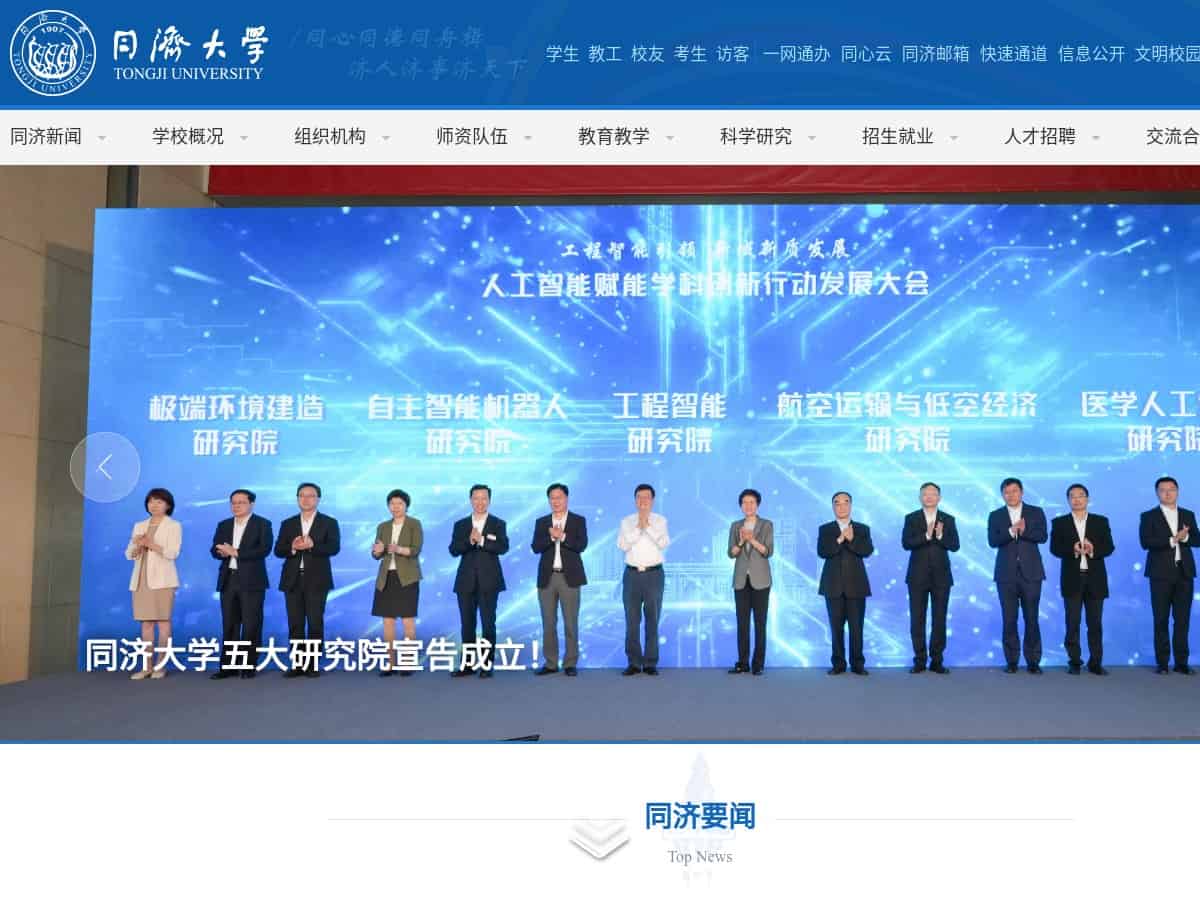
Tongji University is a public university in Shanghai whose origin lies in the German Medical School for the Chinese, founded in 1907 by the German government together with German physicians, among them Erich Paulun. It became Tongji German Medical School in 1908 and Tongji Medical and Engineering University in 1922, and in 1924 it was approved as one of the first national universities in China. During the Second Sino-Japanese War the campus moved six times over about 11,000 km, through provinces including Zhejiang, Jiangxi, Yunnan and Sichuan, before returning to Shanghai in 1946.
After the nationwide restructuring of 1949 the university became a polytechnic featuring civil engineering and architecture, and engineering disciplines from more than ten universities were gathered at Tongji. This made it one of the largest and most complete engineering universities in the country, above all in civil engineering. In April 2000 it merged with Shanghai Railway University.
Tongji has 37,492 students, of whom 18,956 are undergraduates and 17,871 are postgraduates, and a faculty of 2,815. It covers ten academic disciplines, from engineering and medicine to law and philosophy, offers 75 undergraduate majors and registers about 3,500 international students. The main Siping Road campus is in Yangpu District, the Jiading campus lies in the Shanghai International Automobile City in Anting, and the university library holds 4.45 million books.
Domains taught:
AI and Machine Learning, Automation, Bioengineering, Chemistry, Civil Engineering, Computer Vision, Data Analytics, Ecology and Sustainability, Electrical and Electronics, Engineering, Fluid Dynamics, Geotechnics, Industrial Design, Life Sciences, Manufacturing, Marine Science, Materials, Mathematics, Mechanical Engineering, Microbiology and Genetics, Nanotechnologies, Optics, Physics, Process Control, Project Management, Robotics, Software Engineering, Statistics, Structural Engineering, Telecommunications, Thermodynamics, Transportations
Diplomas*:
Bachelor, Doctor, Master
Status:
Public
Partnerships:
Strong historical ties with German universities. Partnerships with construction, automotive, and environmental companies.
Zhejiang University has about 60,000 students and is known for computer science and chemical engineering, a comprehensive counterpart in the Yangtze River Delta next to Shanghai.
Xi'an Jiaotong University enrolls about 40,000 students and is strong in energy and power engineering and mechanical engineering, a technical profile comparable to Tongji’s engineering schools.
Harbin Institute of Technology has about 35,000 students on its Harbin campus, with aerospace and mechanical engineering as flagship areas.
Wuhan University counts about 58,000 students, and its strength in surveying and mapping engineering and remote sensing complements Tongji’s work in civil engineering and urban planning.
Huazhong University of Science and Technology has about 58,000 students and focuses on mechanical and optical engineering, a large technical university similar to Tongji in orientation.
Most Similar Schools Abroad
Politecnico di Milano in Italy teaches engineering, architecture and design to about 47,000 students, and it is the closest match to Tongji’s combination of architecture and engineering.
Technische Universiteit Delft in the Netherlands has about 27,500 students and is strong in aerospace engineering, civil engineering and computer science.
Technische Universität München in Germany enrolls around 48,000 students in mechanical, electrical and information engineering, a good comparison for Tongji, which was founded by German physicians.
Karlsruher Institut für Technologie has about 23,000 students and works in mechanical engineering, computer science and physics, also in Germany.
Politecnico di Torino in Italy counts about 38,000 students and is known for automotive and aerospace engineering, which corresponds to Tongji’s Jiading campus in the automobile city.
*our own picks (our criteria: a mix between domains, diploma delivered, reputation and size), but obviously too many criteria for an apple-to-apple ranking.
FAQ
When was Tongji University founded?
It was founded in 1907 as the German Medical School for the Chinese in Shanghai, with the support of the German government and German physicians. A ceremony on 1 October 1907 marked the opening, and the school took the name Tongji German Medical School in 1908.
How did the university develop after its medical beginnings?
It was renamed Tongji Medical and Engineering University in 1922 and was approved as one of the first national universities in China in 1924. After 1949 it became a polytechnic university featuring civil engineering and architecture.
What happened during the Second Sino-Japanese War?
Teachers and students migrated six times, covering about 11,000 km through nine provinces and municipalities, among them Zhejiang, Jiangxi, Yunnan, Guizhou and Sichuan, and even Vietnam. The university returned to Shanghai in 1946.
What is Tongji best known for?
It is known above all for civil engineering, architecture and urban planning, because engineering disciplines from more than ten universities were brought together there after 1949. It has also grown in other engineering fields, medicine and the humanities.
How large is the university and where are the campuses?
There are 37,492 students and 2,815 faculty, and the main Siping Road campus is at 1239 Siping Road in Yangpu District. The Jiading campus is at 4800 Caoan Road in the Shanghai International Automobile City.
How many international students does Tongji have?
Around 3,500 international students are registered. The university has set up cooperation with several foreign institutions, including a partnership with Instituto Superior Técnico in Portugal.
Did Tongji merge with other institutions?
In April 2000 it merged with Shanghai Railway University, which itself had been formed in 1995 from Shanghai Railway College and Shanghai Railway Medical College.
*: without any judgment of the quality, readers are strongly encouraged to check the official status of the exact diploma envisioned as many universities have a mix of recognized diplomas, not recognized, “co-delivered,” “equivalent to”, “some pathways” (…), can change over time, and can be named differently from one country to another.
**: international reputation: is based on some criteria that do not mean much in some domains or specialties (number of researchers, of scientific publications, on budget ….). Our approximate 1-4 scale:
known locally
known locally and internationally
is listed in some of the world university’s classifications
is listed among the 20 firsts in some of world university’s classifications
***: estimated numbers, based on online sources and/or feedbacks. The numbers can vary greatly depending on school organisation (ex.: school is part of a group, it employs internal staff or external consultants or has public staff without employing them …). Refer to all the links provided to have accurate and updated numbers.
Innovation.world is not affiliated with this school/university. We recommend to contact them directly on their website for any special request.
To complete or correct any information here or share your opinion, please comment below or > send us a direct message <.