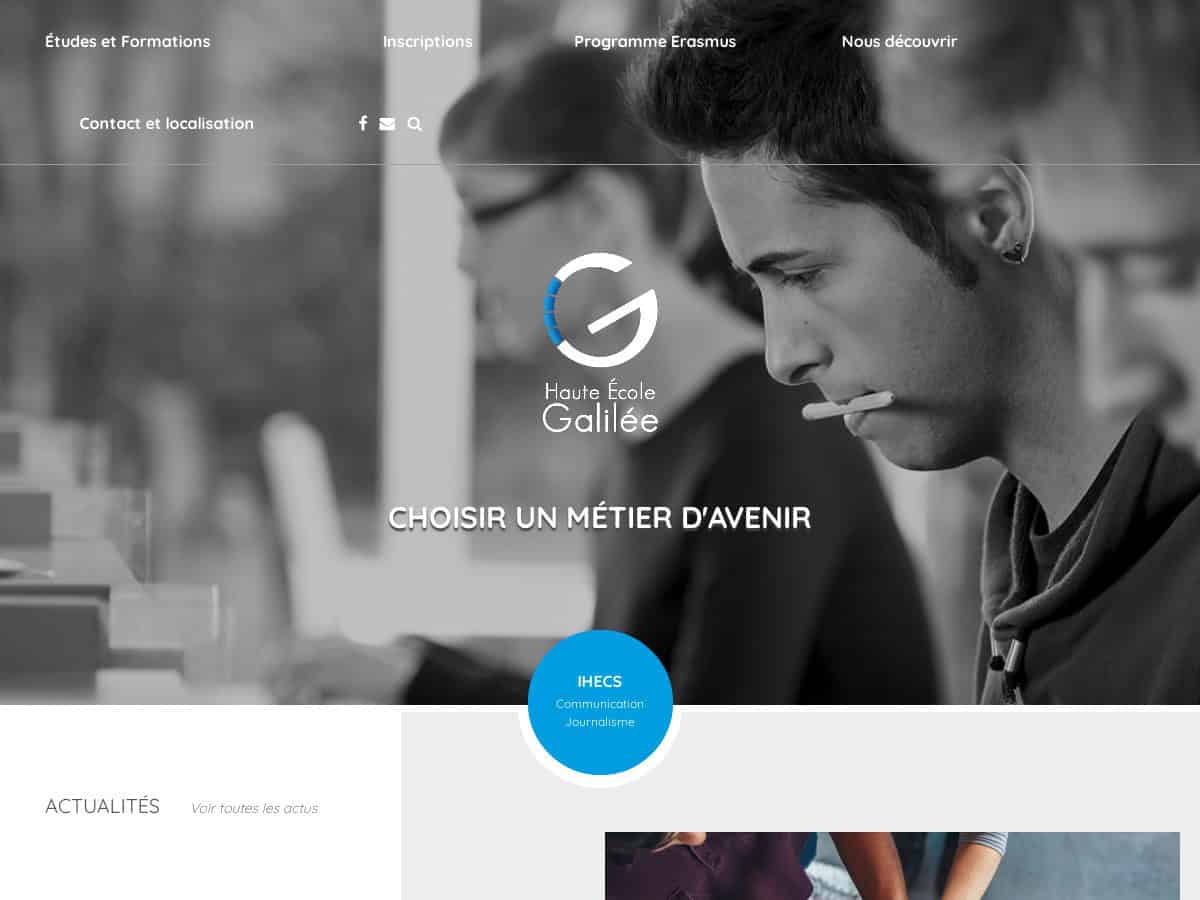
Address: 58-60 Rue de l’Étuve, 1000 Brussels, Brussels-Capital Region, Belgium
Journalism, Public Relations, Advertising
Haute École Galilée is a Belgian Catholic higher education institution belonging to the subsidized free confessional network of the Fédération Wallonie-Bruxelles, located in the heart of Brussels. It was restructured in 2023 when several of its departments merged with EPHEC, and now operates solely through its founding institute IHECS (Institut des Hautes Études des Communications Sociales), which was established in Tournai in 1958 and relocated to Brussels city center in 1990.
IHECS is widely recognized as one of Belgium’s leading schools for journalism and communication, combining rigorous theoretical foundations with intensive practical media training across four buildings steps away from the Grand Place.
Domains taught:
Ergonomics and UX, Project Management, Signal Processing, Software Engineering, Statistics
Diplomas*:
Bachelor, Master
Status:
Private
Partnerships:
Member of EJTA (European Journalism Training Association), Théophraste Network (global federation of francophone journalism schools), AUF (Agence universitaire de la francophonie), EUPRERA (European Public Relations Education and Research Association); co-diploma agreements with UCLouvain and Université libre de Bruxelles (ULB); over 110 institutional partners worldwide across Europe, Flanders, and outside Europe via Erasmus+, Erasmus Belgica, and Mercury/FAME mobility funds.
Research:
Protagoras think tank bridges academic research and professional political and public communication; research collaborations with ULB (ReSIC/Lasco), Sorbonne Paris IV, ISTC France, Artevelde Hogeschool Ghent, FHWien, and Sapienza Rome; topics include media studies, political communication, digital communication, argumentation, and media education.
Famous Alumnis:
N/A
International recognition**:
Number of staff***:
200
Current students***:
2200
Foreign students***:
10%
Cumulative former students***:
35000
Pros
Strong practical training with professional-grade studios and equipment; prime Brussels location near EU institutions; extensive international network with 110 partner institutions; project-based pedagogy with real professional experience; co-diplomas with major Belgian universities.
Cons
Primarily French-language instruction limiting accessibility for non-francophone students; narrow disciplinary focus on communication and media only; relatively small institution with limited infrastructure diversity; no STEM or technical programs.
Best For
Students seeking a career in journalism, communication, public relations, advertising, or media management in a francophone European context.
*: without any judgment of the quality, readers are strongly encouraged to check the official status of the exact diploma envisioned as many universities have a mix of recognized diplomas, not recognized, “co-delivered,” “equivalent to”, “some pathways” (…), can change over time, and can be named differently from one country to another.
**: international reputation: is based on some criteria that do not mean much in some domains or specialties (number of researchers, of scientific publications, on budget ….). Our approximate 1-4 scale:
known locally
known locally and internationally
is listed in some of the world university’s classifications
is listed among the 20 firsts in some of world university’s classifications
***: estimated numbers, based on online sources and/or feedbacks. The numbers can vary greatly depending on school organisation (ex.: school is part of a group, it employs internal staff or external consultants or has public staff without employing them …). Refer to all the links provided to have accurate and updated numbers.
Innovation.world is not affiliated with this school/university. We recommend to contact them directly on their website for any special request.
To complete or correct any information here or share your opinion, please comment below or > send us a direct message <.