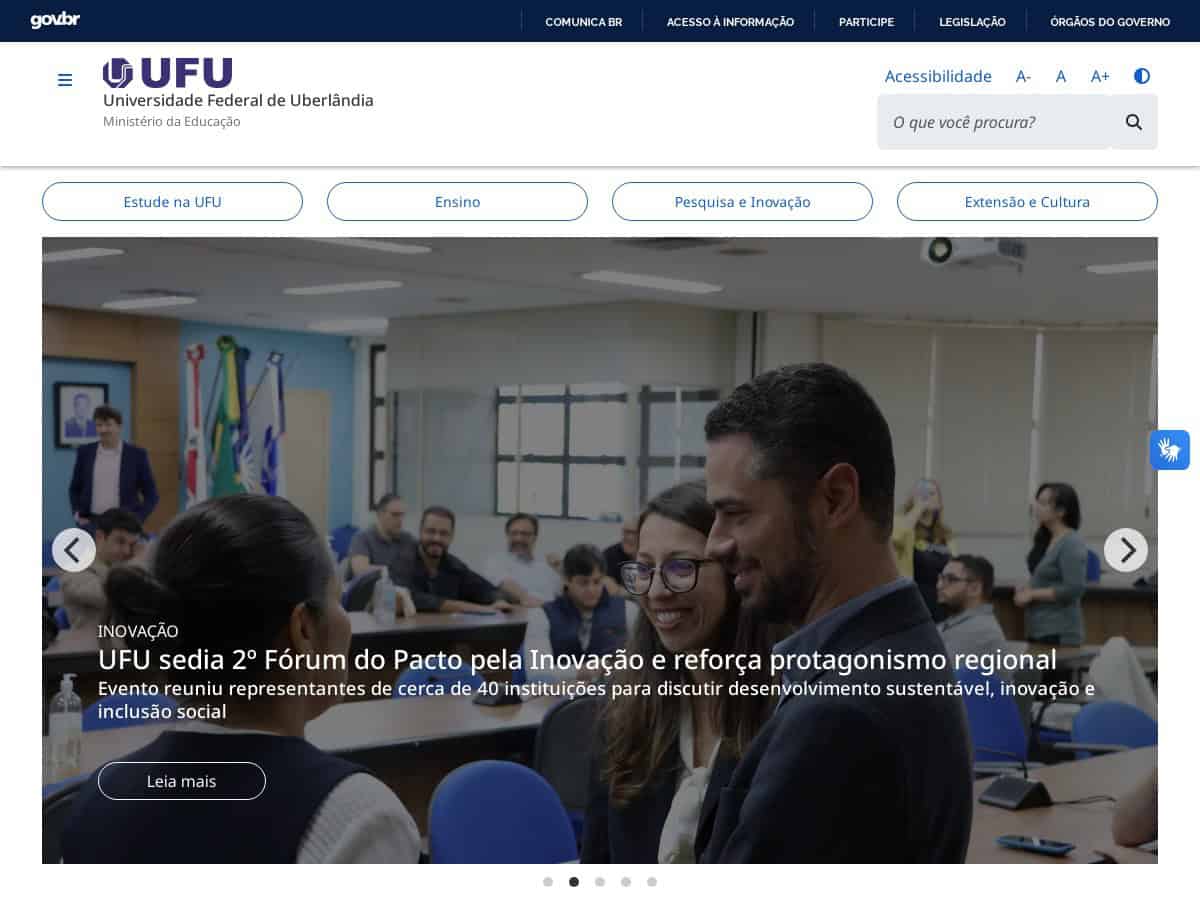
Address: Av. Amazonas, 7675, 38408-100 Uberlândia, Minas Gerais, Brazil
Engineering, Life Sciences, Computer Vision
Authorised in 1969 by Decree-Law No. 762 of 14 August 1969 as the Universidade de Uberlândia, the Federal University of Uberlândia became a federal university under Law No. 6,532 of 24 May 1978. Its statute describes it as a public foundation within the federal indirect administration, with its seat in Uberlândia, Minas Gerais.
The university has seven campuses. Four are in Uberlândia (Santa Mônica, Umuarama, Educação Física and Glória), and the others are in Ituiutaba (the Pontal campus), Monte Carmelo and Patos de Minas. Two special teaching units, the Escola Técnica de Saúde and the Escola de Educação Básica, sit alongside the faculties and institutes.
Its health facilities include the Hospital de Clínicas, the Hospital Odontológico and a veterinary hospital. Study levels run from undergraduate degrees to master’s and doctoral programmes and specialisation courses.
Domains taught:
Computer Vision, Engineering, Life Sciences
Diplomas*:
Bachelor, Doctor, Master
Status:
Public
Partnerships:
Partnerships with regional industries and educational institutions
*our own picks (our criteria: a mix between domains, diploma delivered, reputation and size), but obviously too many criteria for an apple-to-apple ranking.
FAQ
What law created the university?
Decree-Law No. 762 of 14 August 1969 authorised the Universidade de Uberlândia to operate. Law No. 6,532 of 24 May 1978 made it a federal university.
What is the legal form of the institution?
Its statute calls it a public foundation for higher education within the federal indirect administration. The headquarters and legal venue are in Uberlândia.
How many campuses are there?
There are seven. Uberlândia has four, called Santa Mônica, Umuarama, Educação Física and Glória, and the other three are Ituiutaba (Pontal), Monte Carmelo and Patos de Minas.
Which hospitals belong to the university?
They include the Hospital de Clínicas, the Hospital Odontológico and a veterinary hospital. They support clinical teaching in the health courses.
Are there schools below university level?
Yes, the Escola Técnica de Saúde and the Escola de Educação Básica are listed as special teaching units. They are separate from the degree faculties and institutes.
What levels of study are offered?
The university offers undergraduate degrees, master's and doctoral programmes and specialisation courses. Course lists are published on its website.
How does admission work?
Each course has its own entry route, announced in the notices on the university website, and the notice for the chosen year applies.
Additive Manufacturing, Biomedical Sensors, Engineering, Environmental Engineering, Healthcare, Research and Development
*: without any judgment of the quality, readers are strongly encouraged to check the official status of the exact diploma envisioned as many universities have a mix of recognized diplomas, not recognized, “co-delivered,” “equivalent to”, “some pathways” (…), can change over time, and can be named differently from one country to another.
**: international reputation: is based on some criteria that do not mean much in some domains or specialties (number of researchers, of scientific publications, on budget ….). Our approximate 1-4 scale:
known locally
known locally and internationally
is listed in some of the world university’s classifications
is listed among the 20 firsts in some of world university’s classifications
***: estimated numbers, based on online sources and/or feedbacks. The numbers can vary greatly depending on school organisation (ex.: school is part of a group, it employs internal staff or external consultants or has public staff without employing them …). Refer to all the links provided to have accurate and updated numbers.
Innovation.world is not affiliated with this school/university. We recommend to contact them directly on their website for any special request.
To complete or correct any information here or share your opinion, please comment below or > send us a direct message <.