Address: Av. Marechal Rondon, s/n, 49060-000 São Cristóvão, Sergipe, Brazil
Engineering, Life Sciences, Ecology and Sustainability
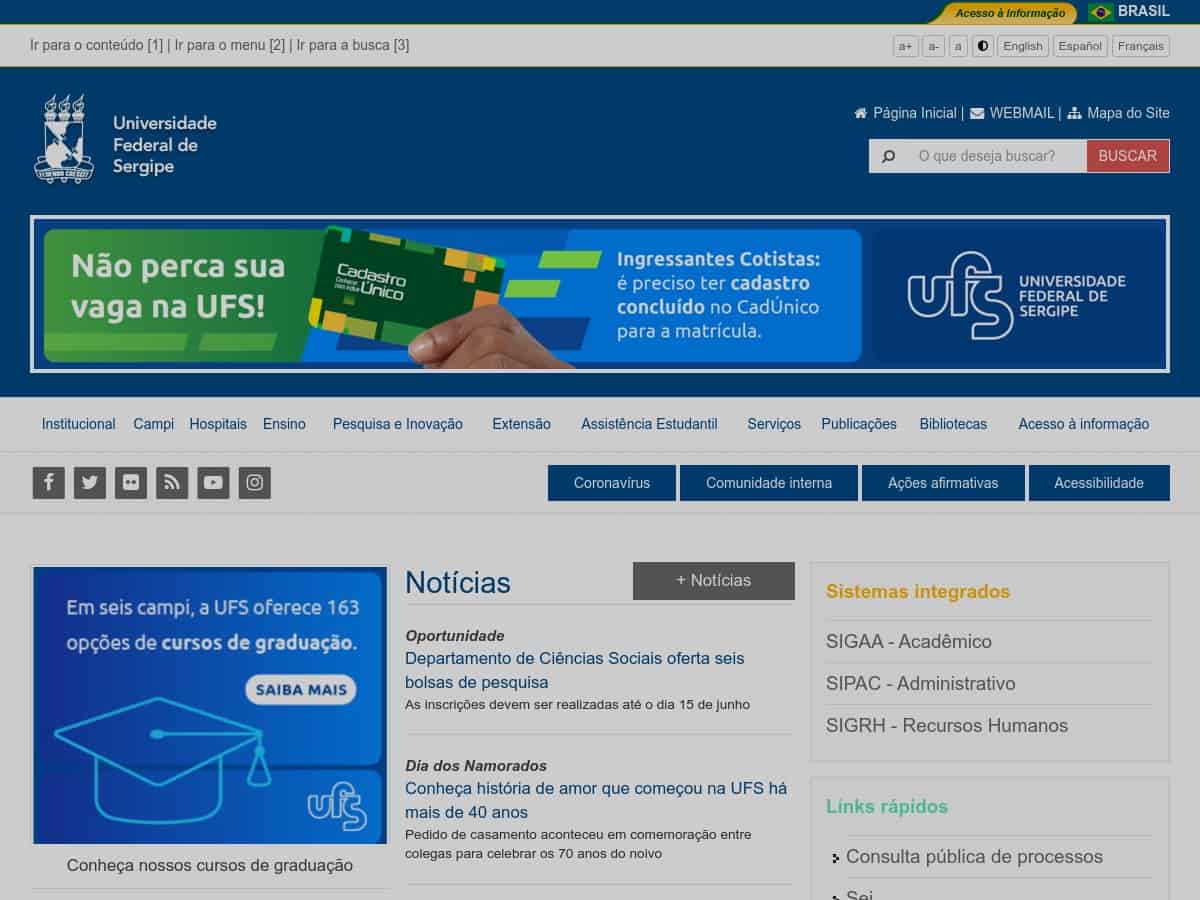
The Federal University of Sergipe (UFS) is a federal university in northeastern Brazil, headquartered in São Cristóvão in the state of Sergipe. It was created by Decree-Law in 1967 as a foundation maintained by the federal government and was installed in 1968.
The main campus, known as the Cidade Universitária, is in São Cristóvão and also houses the Colégio de Aplicação (CODAP), a school for basic education. Further campuses are located in Aracaju, Itabaiana, Laranjeiras, Lagarto and Nossa Senhora da Glória, which spreads the university across several parts of the state.
The university also runs a veterinary teaching hospital, the Hospital Veterinário Universitário, in São Cristóvão. Prospective students and researchers can find the current list of undergraduate and postgraduate courses, centres and departments through the official university pages.
Domains taught:
Ecology and Sustainability, Engineering, Life Sciences
Diplomas*:
Bachelor, Doctor, Master
Status:
Public
Partnerships:
Partnerships with local industry and environment agencies
Research:
Research on health and environmental sustainability
Federal University of Espírito Santo in Vitória, Espírito Santo, lists Engineering, Life Sciences, and Ecology and Sustainability as specialties.
Federal University of Pará in Belém, Pará, lists Ecology and Sustainability, Engineering, and Life Sciences.
Federal University of Santa Catarina in Florianópolis lists Engineering and Ecology and Sustainability as specialties.
Federal University of Bahia in Salvador, Bahia, in the same northeastern region, lists Engineering, Life Sciences, and Food Science.
Federal University of Rio Grande do Norte in Natal, in the northeast as well, lists Engineering, Life Sciences, and Telecommunications.
Most Similar Schools Abroad
National University of Life and Environmental Sciences of Ukraine in Kyiv, Ukraine, lists Agricultural Engineering, Ecology and Sustainability, and Food Technology.
Arizona State University in Tempe, United States, lists Engineering, Business (W. P. Carey), and Sustainability.
Blekinge Institute of Technology in Karlskrona, Sweden, lists Applied IT, Sustainable Development, and Engineering.
Hanzehogeschool Groningen in Groningen, Netherlands, lists Engineering, Energy Transition, and Life Sciences.
Southwest University in Chongqing, China, lists Agricultural Science & Biotechnology, Life Sciences & Ecology, and Food Science & Engineering.
*our own picks (our criteria: a mix between domains, diploma delivered, reputation and size), but obviously too many criteria for an apple-to-apple ranking.
FAQ
When was UFS created?
UFS was created by Decree-Law in 1967 as a foundation maintained by the federal government, and it was installed in 1968.
Where is UFS headquartered?
The headquarters and main campus are in São Cristóvão, in the state of Sergipe.
In which cities does UFS have campuses?
Besides the main campus in São Cristóvão, there are campuses in Aracaju, Itabaiana, Laranjeiras, Lagarto and Nossa Senhora da Glória.
Which school for basic education belongs to UFS?
The Colégio de Aplicação (CODAP) is a school for basic education located on the main campus.
Does UFS have a veterinary hospital?
Yes, the Hospital Veterinário Universitário operates in São Cristóvão.
What is the legal form of UFS?
It is a federal university set up as a foundation and maintained by the federal government.
Ecology, Engineering, Environmental Engineering, Environmental Impact, Environmental Technologies, Research and Development, Sustainable Development, Sustainable Materials
*: without any judgment of the quality, readers are strongly encouraged to check the official status of the exact diploma envisioned as many universities have a mix of recognized diplomas, not recognized, “co-delivered,” “equivalent to”, “some pathways” (…), can change over time, and can be named differently from one country to another.
**: international reputation: is based on some criteria that do not mean much in some domains or specialties (number of researchers, of scientific publications, on budget ….). Our approximate 1-4 scale:
known locally
known locally and internationally
is listed in some of the world university’s classifications
is listed among the 20 firsts in some of world university’s classifications
***: estimated numbers, based on online sources and/or feedbacks. The numbers can vary greatly depending on school organisation (ex.: school is part of a group, it employs internal staff or external consultants or has public staff without employing them …). Refer to all the links provided to have accurate and updated numbers.
Innovation.world is not affiliated with this school/university. We recommend to contact them directly on their website for any special request.
To complete or correct any information here or share your opinion, please comment below or > send us a direct message <.