Product Design, Manufacturing & Innovation Resources
Home » Federal University of ABC (UFABC)

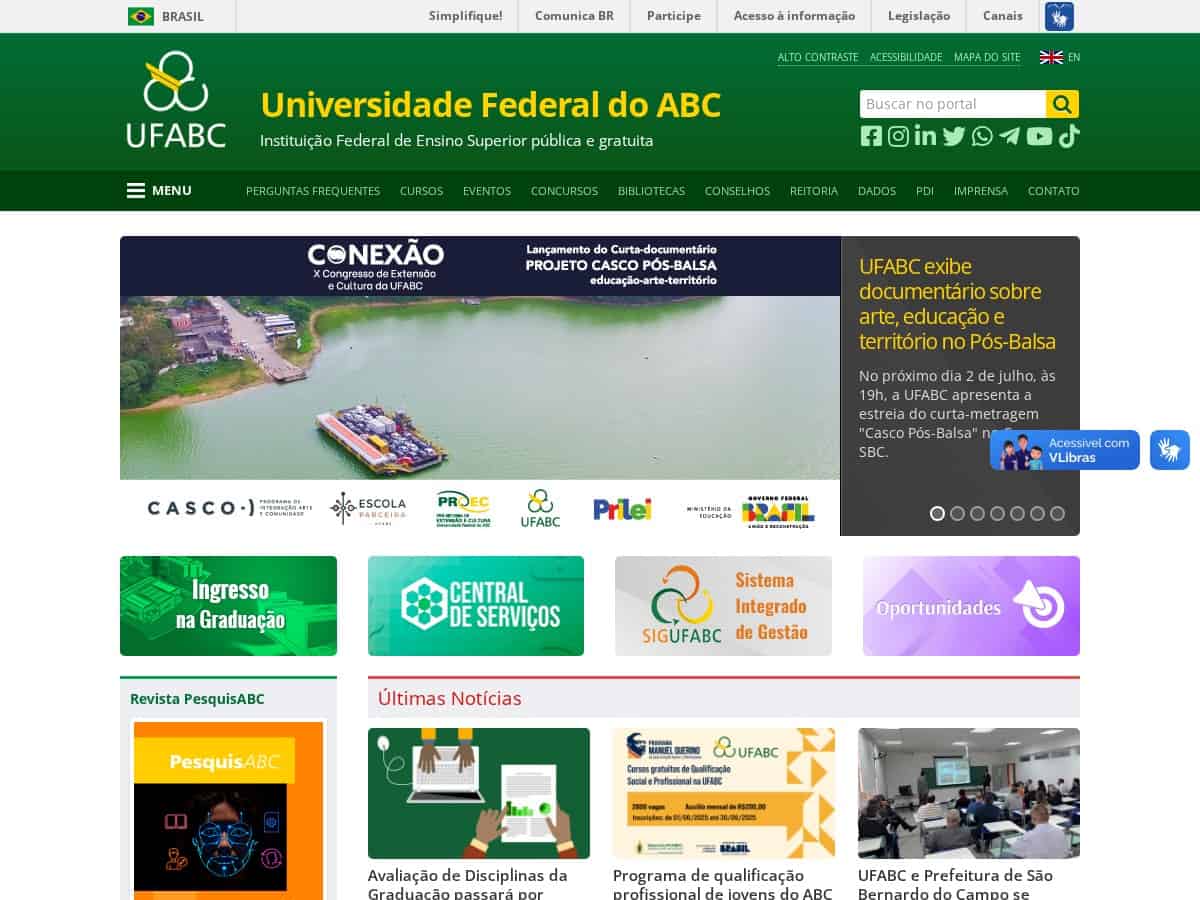
Federal University of ABC (UFABC)

Federal University of ABC (UFABC)
Address: Av. dos Estados, 5001, 09210-580 Santo André, São Paulo, Brazil
Engineering, Applied Sciences, Computer Vision

Founded in 2005, UFABC is a modern federal university focused on interdisciplinary science, technology, and engineering education.

Domains taught:

Diplomas*:

Status:

Partnerships:

Partnerships with multinational technology companies and international universities

Research:

Research in applied physics, engineering and computational sciences

Famous Alumnis:

N/A

International recognition**:

Number of staff***:

1500

Current students***:

9000

Foreign students***:

20%

Cumulative former students***:

12000

Pros

Innovative curricula, interdisciplinary approach

Cons

Newer with developing reputation

Best For

Modern interdisciplinary science

Most Similar Schools Locally

  • The comparison with Federal University of São Carlos is straightforward on subjects, since both focus on computer vision and engineering, and it is larger, enrolling about 14,000 students against roughly 9,000 here, and is also a public institution.
  • State University of Campinas offers a comparable education in computer vision and engineering: it is also a public institution, and teaches at the same levels, namely bachelor's, master's and doctoral.
  • On content, Federal University of Juiz de Fora and this institution are close, as both teach computer vision and engineering; it covers life sciences as well, and is larger, enrolling about 14,000 students against roughly 9,000 here.
  • Pontifical Catholic University of Rio de Janeiro overlaps with this university on computer vision and engineering, so the two are easy to compare, and it covers project management as well, and is slightly larger, at about 12,000 students against roughly 9,000 here.
  • Federal University of Rio Grande do Sul overlaps with this university on physics and engineering, so the two are easy to compare, and it covers materials as well, and is far larger, with about 30,000 students against roughly 9,000 here.

Most Similar Schools Abroad

  • Looking internationally, Hanyang University in South Korea is where computer vision and engineering get a comparable treatment; it is larger, enrolling about 25,000 students against roughly 9,000 here, and is private, whereas this institution is public.
  • For computer vision and engineering outside the home country, Incheon National University in South Korea is a natural reference; it is slightly larger, at about 12,000 students against roughly 9,000 here, and is also a public institution.
  • Technion - Israel Institute of Technology offers an international parallel to this institution, with physics and engineering as common ground; it covers aerospace and chemistry as well, and is larger, enrolling about 13,703 students against roughly 9,000 here.
  • Moscow Institute of Physics and Technology brings a Russia setting to the same core fields, computer vision and physics, and it covers aerospace and nanotechnologies as well, and is slightly smaller, at about 7,000 students against roughly 9,000 here.
  • University of Science and Technology Beijing in China pursues a similar profile in physics and engineering, and it is far larger, with about 27,311 students against roughly 9,000 here, and is also a public institution.

*our own picks (our criteria: a mix between domains, diploma delivered, reputation and size), but obviously too many criteria for an apple-to-apple ranking.

*: without any judgment of the quality, readers are strongly encouraged to check the official status of the exact diploma envisioned as many universities have a mix of recognized diplomas, not recognized, “co-delivered,” “equivalent to”,  “some pathways” (…), can change over time, and can be named differently from one country to another.


**: international reputation: is based on some criteria that do not mean much in some domains or specialties (number of researchers, of scientific publications, on budget ….). Our approximate 1-4 scale: 

  1. known locally
  2. known locally and internationally
  3. is listed in some of the world university’s classifications
  4. is listed among the 20 firsts in some of world university’s classifications

***: estimated numbers, based on online sources and/or feedbacks. The numbers can vary greatly depending on school organisation (ex.: school is part of a group, it employs internal staff or external consultants or has public staff without employing them …). Refer to all the links provided to have accurate and updated numbers.

Innovation.world is not affiliated with this school/university.
We recommend to contact them directly on their website for any special request.


To complete or correct any information here or share your opinion, please comment below or > send us a direct message <.

10th year anniversary

Full size images and downloads are only available, 100% free, for registered members.

> Login <















