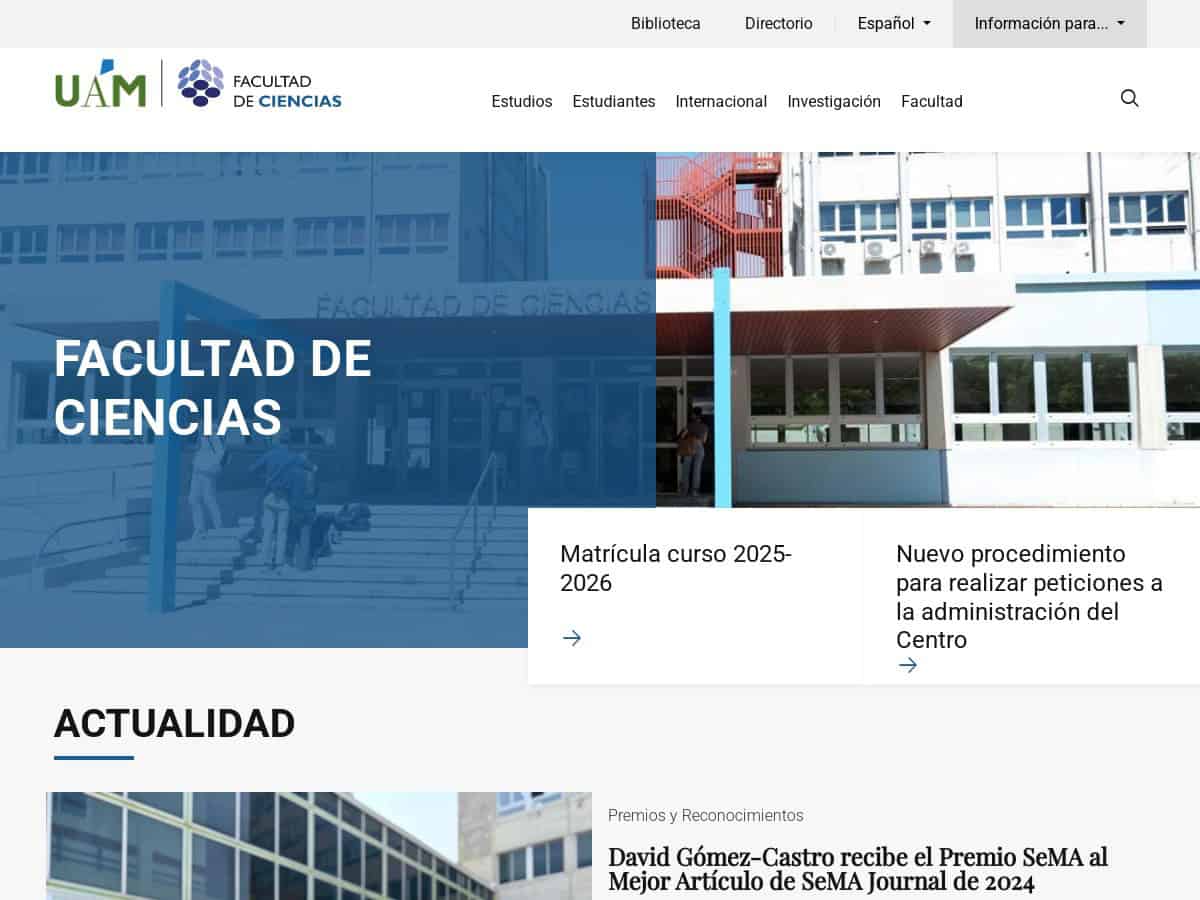
Address: Calle Francisco Tomás y Valiente, 7, Campus de Cantoblanco, 28049 Madrid, Madrid, Spain
Physics, Chemistry, Biology
The Faculty of Sciences of the Autonomous University of Madrid (UAM) is a leading center for science education and research in Spain, offering degrees in Biology, Chemistry, Physics, Mathematics, Environmental Sciences, Food Science and Technology, Biochemistry, and Chemical Engineering.
The Facultad de Ciencias of the Universidad Autónoma de Madrid is the science faculty of UAM, a public university created in 1968 on the Cantoblanco campus, about 15 kilometres north of central Madrid. The faculty has about 8,000 students and 700 staff, and around one student in ten comes from abroad. It occupies a group of buildings on Calle Francisco Tomás y Valiente, on a campus with woods, labs, residences and a direct commuter rail connection to Madrid.
The faculty teaches bachelor’s degrees in physics, chemistry, biology, mathematics, biochemistry, biotechnology, environmental sciences, geology, food science and nutrition, and chemical engineering, among others, as well as many master’s degrees. Courses are mostly in Spanish, but there are programmes in English, and the faculty hosts exchange students through Erasmus and international agreements. Class sizes are smaller than in many Madrid universities, and students take part in laboratory work from early years.
The campus contains a high density of research centres. The Severo Ochoa Centre for Molecular Biology is a joint institute of UAM and the CSIC, and the IMDEA Nanociencia and the Condensed Matter Physics Center, IFIMAC, work on nanomaterials, quantum matter and low-temperature physics. UAM groups also work with national centres in cancer research and in biotechnology. Research in physics, chemistry and biology is highly cited in Spain.
Admission to bachelor’s degrees uses the national university entrance exam and the cut-off marks of each degree, which vary every year. Public universities in the Community of Madrid set tuition per credit, with prices that are higher for repeated subjects and for students from outside the EU. Check the current tariff. Master’s degrees have separate application rounds and fees, and doctoral candidates are recruited through calls and fellowships.
Madrid is expensive for renters, but the campus offers residence halls and the commuter train connects Cantoblanco with Atocha and Chamartín in about 25 minutes.
Domains taught:
AI and Machine Learning, Astroscience, Bioengineering, Bioinformatics, Chemistry, Data Analytics, Ecology and Sustainability, Engineering, Food Science, Materials, Mathematics, Microbiology and Genetics, Nanotechnologies, Physics, Statistics
Diplomas*:
Bachelor, Doctor, Master
Status:
Public
Partnerships:
Part of UAM, a prestigious research university member of the CIVIS European University alliance. Strong links with CSIC research institutes located on campus (e.g., ICMAT, ICMM, CBM).
Research:
World-class research in areas like theoretical physics, materials science, molecular biology, nanotechnology, analytical chemistry, pure mathematics, environmental studies, and astrophysics.
Famous Alumnis:
Federico Mayor Zaragoza
International recognition**:
Number of staff***:
700
Current students***:
8000
Foreign students***:
10%
Cumulative former students***:
40000
Pros
Highly ranked science faculty with outstanding research facilities and opportunities, particularly due to close CSIC collaborations. Strong international reputation.
Cons
Very competitive admissions for many programs. Campus located outside central Madrid.
Best For
Students aiming for a top-tier, research-intensive education in a wide range of scientific disciplines, with exceptional research opportunities.
Facultad de Ciencias Físicas sits close to this university on astroscience, nanotechnologies and physics; it is smaller, enrolling about 3,000 students against roughly 8,000 here, and is also a public institution.
Another national school that puts food science, bioinformatics and nanotechnologies at the centre is Facultad de Ciencias Biológicas, and it is smaller, enrolling about 5,000 students against roughly 8,000 here, and is also a public institution.
The comparison with Facultad de Ciencias Matemáticas is straightforward on subjects, since both focus on statistics, mathematics and data analytics, and it runs the same bachelor's, master's and doctoral programmes, and is far smaller, with about 2,000 students against roughly 8,000 here.
University of Valencia shares the core fields of this institution, namely microbiology and genetics, chemistry and statistics; it runs the same bachelor's, master's and doctoral programmes, and covers finance and life sciences as well.
Also strong in microbiology and genetics, chemistry and ecology and sustainability, Autonomous University of Barcelona makes a sensible second look at home; it covers computer vision and life sciences as well, and is far larger, with about 37,166 students against roughly 8,000 here.
Most Similar Schools Abroad
University of Wrocław, in Poland, takes a similar route through astroscience, bioinformatics and nanotechnologies; it runs the same bachelor's, master's and doctoral programmes, and covers optics and signal processing as well.
Looking internationally, Jagiellonian University in Poland is where astroscience, bioinformatics and nanotechnologies get a comparable treatment; it runs the same bachelor's, master's and doctoral programmes, and covers optics and signal processing as well.
For a study option in Switzerland with a comparable spread of astroscience, bioinformatics and nanotechnologies, Universität Basel is the reference point: it covers signal processing and fluid dynamics as well, and is larger, enrolling about 13,000 students against roughly 8,000 here.
Université de Genève, in Switzerland, takes a similar route through astroscience, bioinformatics and nanotechnologies; it covers marine science and geotechnics as well, and is larger, enrolling about 19,000 students against roughly 8,000 here.
Abroad, Radboud Universiteit (the Netherlands) covers bioinformatics, nanotechnologies and microbiology and genetics in a comparable way, and it teaches at the same levels, namely bachelor's, master's and doctoral, and covers computer vision and software engineering as well.
*our own picks (our criteria: a mix between domains, diploma delivered, reputation and size), but obviously too many criteria for an apple-to-apple ranking.
FAQ
What is the Facultad de Ciencias of UAM?
The science faculty of the Universidad Autónoma de Madrid, a public university.
Where is it?
On Calle Francisco Tomás y Valiente 7, at the Cantoblanco campus, north of Madrid, Spain.
When was the university created?
In 1968.
How large is the faculty?
About 8,000 students and 700 staff.
What does it teach?
Physics, chemistry, biology, mathematics, biochemistry, biotechnology, environmental sciences, geology and chemical engineering, among others.
Which research centres are on campus?
The Severo Ochoa Centre for Molecular Biology, IMDEA Nanociencia and the Condensed Matter Physics Center IFIMAC.
How do you apply?
Bachelor's applicants use the national university entrance exam and the cut-off marks of each degree. Master's degrees have separate application rounds.
What does it cost?
Public universities in the Community of Madrid set tuition per credit. Check the current tariff.
In which language are courses taught?
Mostly in Spanish, with some programmes in English.
How far is it from central Madrid?
About 25 minutes by commuter train from Atocha or Chamartín.
Astrophysics, Biology, Chemistry, Environmental Engineering, Environmental Impact, Mathematics, Sustainable Development
*: without any judgment of the quality, readers are strongly encouraged to check the official status of the exact diploma envisioned as many universities have a mix of recognized diplomas, not recognized, “co-delivered,” “equivalent to”, “some pathways” (…), can change over time, and can be named differently from one country to another.
**: international reputation: is based on some criteria that do not mean much in some domains or specialties (number of researchers, of scientific publications, on budget ….). Our approximate 1-4 scale:
known locally
known locally and internationally
is listed in some of the world university’s classifications
is listed among the 20 firsts in some of world university’s classifications
***: estimated numbers, based on online sources and/or feedbacks. The numbers can vary greatly depending on school organisation (ex.: school is part of a group, it employs internal staff or external consultants or has public staff without employing them …). Refer to all the links provided to have accurate and updated numbers.
Innovation.world is not affiliated with this school/university. We recommend to contact them directly on their website for any special request.
To complete or correct any information here or share your opinion, please comment below or > send us a direct message <.