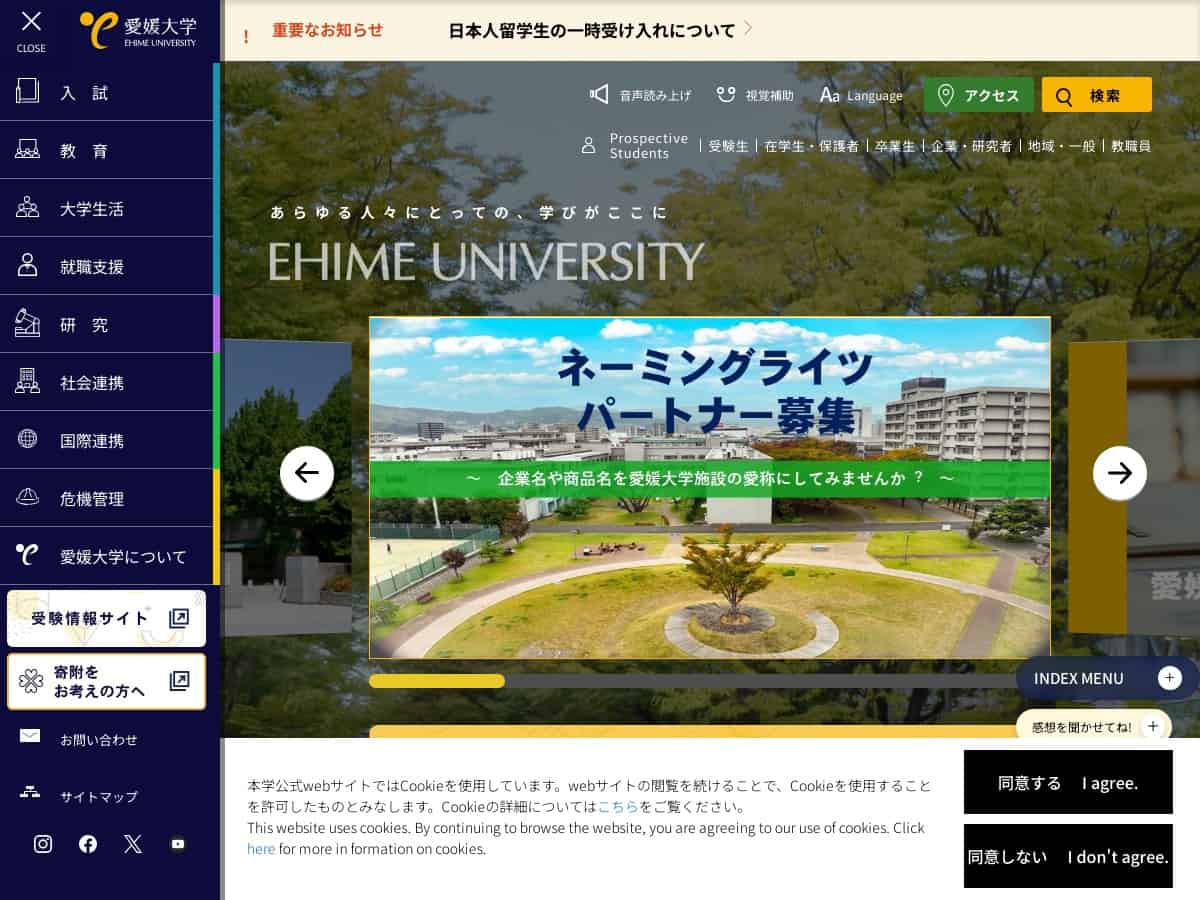
Ehime University is a national university in Matsuyama, the prefectural capital of Ehime on the island of Shikoku, Japan. It was established in 1949 as part of the postwar reform that created national universities across Japan.
Today the university has faculties of law and letters, education, collaborative regional innovation, science, medicine, engineering and agriculture. Graduate education includes schools for medicine, education, agriculture and science and engineering, and a united graduate school of agricultural sciences. The main Johoku campus is in Matsuyama, and the official website is published in Japanese and English.
Research centres include the Geodynamics Research Center, which reflects an emphasis on earth science beside engineering and agriculture. The directory profile lists engineering, with mechanical, electrical, materials, and civil and environmental strands, together with science and agriculture as the main areas. Students and researchers should consult the official English website for current statistics, entry procedures and tuition, which are revised periodically.
Domains taught:
Agriculture, AI and Machine Learning, Astroscience, Automation, Bioengineering, Bioinformatics, Chemistry, Civil Engineering, Computer Vision, Data Analytics, Ecology and Sustainability, Electrical and Electronics, Engineering, Fluid Dynamics, Food Science, Geotechnics, Industrial Design, Life Sciences, Manufacturing, Marine Science, Materials, Mathematics, Mechanical Engineering, Microbiology and Genetics, Nanotechnologies, Optics, Physics, Process Control, Robotics, Signal Processing, Software Engineering, Statistics, Structural Engineering, Telecommunications, Thermodynamics, Transportations
Diplomas*:
Bachelor, Doctor, Master
Status:
Public
Partnerships:
Leading university in Shikoku. Focus on regional challenges (e.g., coastal environment, paper industry).
Research:
Marine environmental science and aquaculture, Paper science and functional materials, Disaster prevention and mitigation, Proteo-medicine.
Famous Alumnis:
Masaoka Shiki (associated with Matsuyama)
International recognition**:
Number of staff***:
1300
Current students***:
10000
Foreign students***:
N/A%
Cumulative former students***:
N/A
Pros
Comprehensive university serving Shikoku, specific research strengths related to regional industries and environment.
Cons
Located in Matsuyama, Shikoku island.
Best For
Comprehensive national university in Shikoku with strong programs in engineering, science, and agriculture.
Tokushima University, in Tokushima, also stands on Shikoku and lists engineering with an optical focus, pharmaceutical sciences and agriculture.
Kanazawa University, in Kanazawa, pairs engineering with pharmaceutical sciences.
Chiba University, in Chiba, is distinguished by horticultural science, design and image science.
Kindai University covers fisheries science and aquaculture, agricultural science and engineering.
Most Similar Schools Abroad
Gyeongsang National University in South Korea lists engineering, agriculture and life sciences.
Università degli Studi di Messina, in Italy, covers engineering, life sciences and chemical sciences.
University of Southampton in the United Kingdom combines engineering, ocean and earth science, and computer science.
Ocean University of China, in China, lists oceanography, marine biology and aquaculture.
University of Hawaii at Manoa in the United States covers oceanography, astronomy, and Asian and Pacific studies.
*our own picks (our criteria: a mix between domains, diploma delivered, reputation and size), but obviously too many criteria for an apple-to-apple ranking.
FAQ
When was Ehime University founded?
It was established in 1949 as one of the national universities created in the postwar reform. The official history page describes its first faculties.
In which city is the main campus?
The university is in Matsuyama, in Ehime Prefecture on Shikoku. Its main Johoku campus is in Matsuyama.
Which faculties are available?
There are faculties of law and letters, education, collaborative regional innovation, science, medicine, engineering and agriculture. The official English site lists them with their departments.
What research centres does the university have?
A notable unit is the Geodynamics Research Center. Further centres are listed on the official website.
Does the university offer joint graduate study in agriculture?
Yes, a united graduate school of agricultural sciences is among its graduate schools. Participating universities and entry rules are explained by the school.
How can applicants find current numbers and fees?
Statistics, tuition and entry procedures are published on the official English website. These pages are updated for each academic year.
*: without any judgment of the quality, readers are strongly encouraged to check the official status of the exact diploma envisioned as many universities have a mix of recognized diplomas, not recognized, “co-delivered,” “equivalent to”, “some pathways” (…), can change over time, and can be named differently from one country to another.
**: international reputation: is based on some criteria that do not mean much in some domains or specialties (number of researchers, of scientific publications, on budget ….). Our approximate 1-4 scale:
known locally
known locally and internationally
is listed in some of the world university’s classifications
is listed among the 20 firsts in some of world university’s classifications
***: estimated numbers, based on online sources and/or feedbacks. The numbers can vary greatly depending on school organisation (ex.: school is part of a group, it employs internal staff or external consultants or has public staff without employing them …). Refer to all the links provided to have accurate and updated numbers.
Innovation.world is not affiliated with this school/university. We recommend to contact them directly on their website for any special request.
To complete or correct any information here or share your opinion, please comment below or > send us a direct message <.