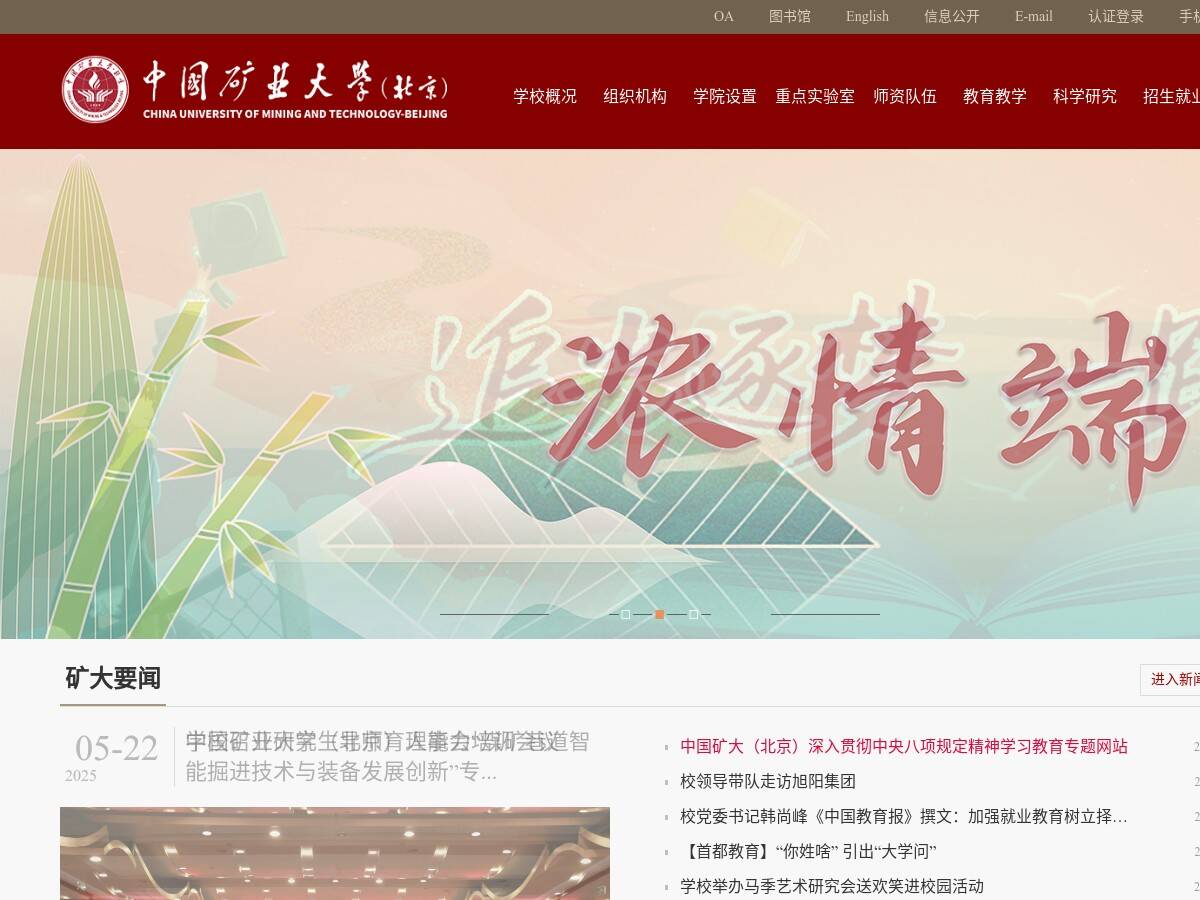
China University of Mining and Technology, Beijing, known as CUMTB, is the Beijing-based branch of a university whose line goes back to the Jiaozuo School of Railroad and Mines, founded in 1909. That school was renamed and relocated several times over the twentieth century before part of it settled in the capital.
The institution moved to Beijing in 1953, where it became the Beijing Institute of Mining and Technology. In 1978 the main school was relocated to Xuzhou, while the Beijing graduate school set up that year on Xueyuan Road stayed in the capital. A Beijing campus of the mining university was approved in 1997 on the basis of that graduate school, and in 2003 the two sides became independent institutions, so that CUMTB began operating under its current name. It was also listed in Project 211 in 1997.
CUMTB has two campuses in Beijing: one on Xueyuan Road in the Haidian district and one at Shahe in the Changping district. It is organised into a graduate school and more than a dozen schools, among them energy and mining engineering, emergency management and safety engineering, geoscience and surveying engineering, chemistry and environmental engineering, and artificial intelligence. The mix of schools reflects a profile centred on mining, safety and the earth sciences.
Domains taught:
AI and Machine Learning, Automation, Chemistry, Civil Engineering, Data Analytics, Ecology and Sustainability, Electrical and Electronics, Engineering, Fluid Dynamics, Geotechnics, Manufacturing, Materials, Mathematics, Mechanical Engineering, Physics, Process Control, Project Management, Software Engineering, Statistics, Structural Engineering, Telecommunications, Thermodynamics, Transportations
Diplomas*:
Bachelor, Doctor, Master
Status:
Public
Partnerships:
Strong ties with China’s coal mining industry, safety supervision administrations, and research institutes in Beijing.
Xi'an University of Science and Technology lists mining engineering, safety science and engineering, and surveying, a field overlap that is almost complete.
China University of Mining and Technology is a public university in Jiangsu with mining engineering, safety science and engineering, and surveying and mapping engineering among its listed fields.
Central South University, a public university in Hunan, lists mining engineering together with materials science and engineering and civil and transport engineering.
CUG is a public university in Wuhan, listed for geology and geological engineering and for geophysics and geomatics, which complements the earth-science side of this university.
Taiyuan University of Technology is a public university in Shanxi whose profile combines mining engineering with materials and chemical engineering.
Most Similar Schools Abroad
Technische Universität Bergakademie Freiberg in Germany is a public university specialised in geosciences, mining engineering and materials science.
Universität Potsdam, a public German university, is listed for earth and environmental sciences, a counterpart to the geoscience schools of CUMTB.
IFP Énergies nouvelles, a public French institution, works on energy technologies and geosciences for energy.
Hokkaido University in Japan is a public university with environmental and earth sciences next to civil engineering.
*our own picks (our criteria: a mix between domains, diploma delivered, reputation and size), but obviously too many criteria for an apple-to-apple ranking.
FAQ
Where does the university trace its origins?
It traces its roots to the Jiaozuo School of Railroad and Mines, established in 1909. The school moved several times before reaching Beijing in 1953.
How is CUMTB related to the university in Xuzhou?
Both come from the same mining institution. They were separated in 2003, after which the Beijing side operated independently under its own name.
When did the Beijing branch come into being?
A Beijing campus of the mining university was approved in 1997 on the basis of its Beijing graduate school. Independent operation under the present name began in 2003.
Where are the campuses?
One is on Xueyuan Road in Haidian district and the other at Shahe in Changping district, both in Beijing. The official site gives travel and contact details.
What are the main academic units?
There is a graduate school and over a dozen schools, such as energy and mining engineering, emergency management and safety engineering, geoscience and surveying engineering, chemistry and environmental engineering, and artificial intelligence.
Is it part of a national programme?
Yes, it was listed in China's Project 211 in 1997. Applicants can find current national and international programme information on the university's pages.
Environmental Engineering, Environmental Impact Assessment, Risk Management, Sustainable Development
*: without any judgment of the quality, readers are strongly encouraged to check the official status of the exact diploma envisioned as many universities have a mix of recognized diplomas, not recognized, “co-delivered,” “equivalent to”, “some pathways” (…), can change over time, and can be named differently from one country to another.
**: international reputation: is based on some criteria that do not mean much in some domains or specialties (number of researchers, of scientific publications, on budget ….). Our approximate 1-4 scale:
known locally
known locally and internationally
is listed in some of the world university’s classifications
is listed among the 20 firsts in some of world university’s classifications
***: estimated numbers, based on online sources and/or feedbacks. The numbers can vary greatly depending on school organisation (ex.: school is part of a group, it employs internal staff or external consultants or has public staff without employing them …). Refer to all the links provided to have accurate and updated numbers.
Innovation.world is not affiliated with this school/university. We recommend to contact them directly on their website for any special request.
To complete or correct any information here or share your opinion, please comment below or > send us a direct message <.