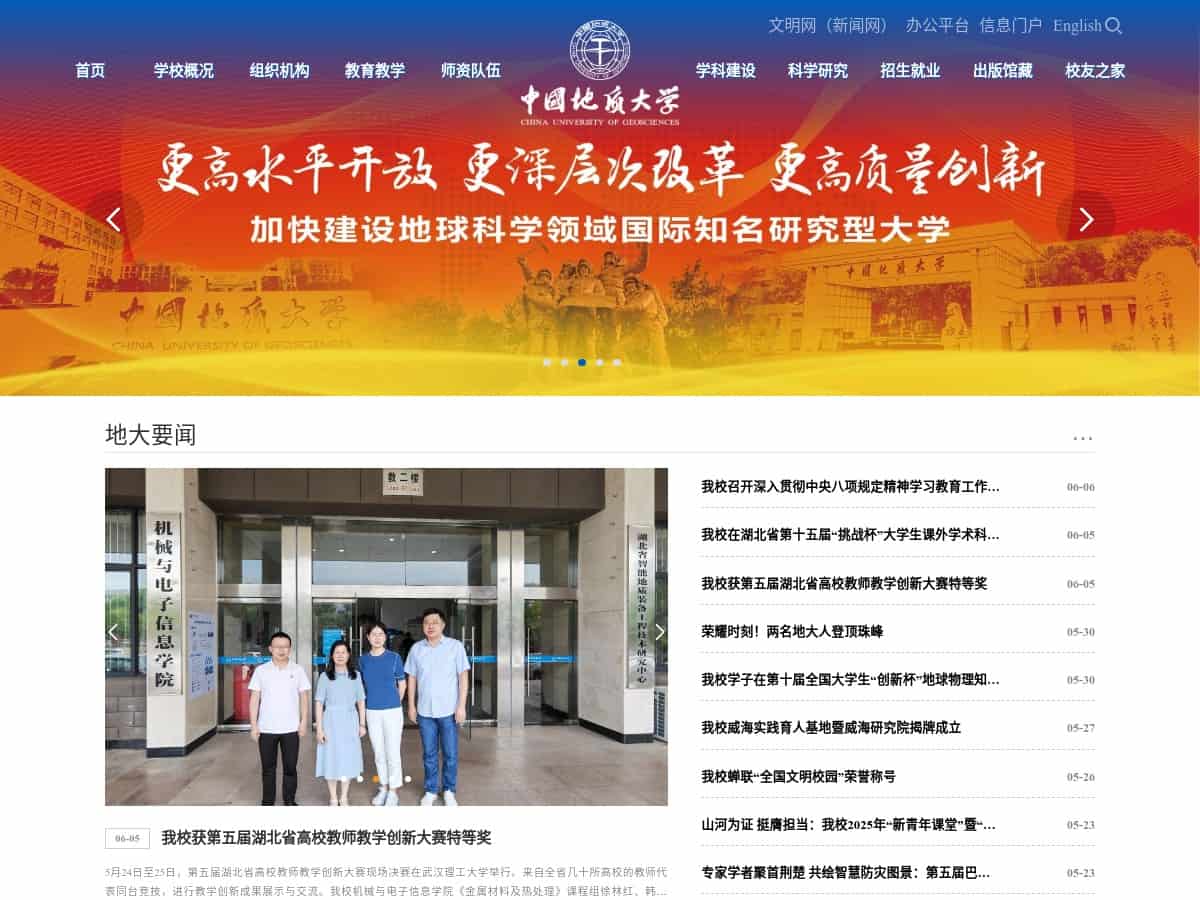
China University of Geosciences (Wuhan), abbreviated CUG, began in Beijing in 1952 as the Beijing College of Geology, formed by merging the geology departments of Peking University, Tsinghua University and other institutions. The Wuhan institution is a public university specialising in earth sciences.
Its location and name changed several times. In 1970 the college moved to Hubei and became Hubei College of Geology, and by the mid-1970s it had settled in Wuhan as Wuhan College of Geology. In 1987 it adopted the name China University of Geosciences and operated in both Wuhan and Beijing; since March 2005 the Wuhan and Beijing institutions have run independently, as CUG (Wuhan) and China University of Geosciences (Beijing).
The main campus is the Nanwangshan campus in Wuhan, and a further campus, Future City, opened in 2019. Its Yifu Museum houses dinosaur fossils, minerals and rocks. The university also maintains field training centres, including one at Zhoukoudian near Beijing.
Domains taught:
AI and Machine Learning, Automation, Chemistry, Civil Engineering, Computer Vision, Data Analytics, Ecology and Sustainability, Electrical and Electronics, Engineering, Fluid Dynamics, Geotechnics, Life Sciences, Marine Science, Materials, Mathematics, Mechanical Engineering, Optics, Physics, Process Control, Project Management, Software Engineering, Statistics, Structural Engineering, Telecommunications, Thermodynamics
Diplomas*:
Bachelor, Doctor, Master
Status:
Public
Partnerships:
Strong collaborations with geological survey agencies, mining and resource companies, and environmental protection departments.
Research:
Earth System Science, Mineral Resource Exploration & Evaluation, Geotechnical Engineering & Hazard Prevention, Environmental Geochemistry & Pollution Control.
Famous Alumnis:
Wang Yilin
International recognition**:
Number of staff***:
1800
Current students***:
30000
Foreign students***:
N/A%
Cumulative former students***:
N/A
Pros
Leading university for geosciences in China, strong research in geology and environmental science, large campus.
Cons
Highly specialized in geosciences and related fields.
Best For
Leading university for geology, geophysics, and environmental geoscience, with a Wuhan campus focus.
CUGB, the China University of Geosciences (Beijing), shares origins and an earth-science focus with CUG, though it is a separate public university in Beijing.
China University of Mining and Technology is a public university in Jiangsu covering mining and related engineering.
Wuhan University is a public university in the same city with surveying and mapping, remote sensing and hydraulic engineering.
CUPB, the China University of Petroleum (Beijing), a public university, trains specialists in oil and gas industries.
Jilin University combines geosciences, chemistry and automotive engineering as a public university in Jilin province.
Most Similar Schools Abroad
Indian Institute of Technology Dhanbad (IIT ) in India is a public institute with mining engineering, petroleum engineering and earth sciences.
Hokkaido University in Japan is a public institution with geotechnics and climate change among its specialties, relevant to the earth-science focus of CUG.
Luleå University of Technology in Sweden, public, specialises in mining and metallurgical engineering and space science.
Universität Hamburg, public, covers climate and earth system science alongside physics.
Universiteit Utrecht in the Netherlands, public, is built around earth sciences, life sciences and chemistry.
*our own picks (our criteria: a mix between domains, diploma delivered, reputation and size), but obviously too many criteria for an apple-to-apple ranking.
FAQ
How did China University of Geosciences (Wuhan) begin?
It began in 1952 as the Beijing College of Geology, created by merging the geology departments of several universities including Peking University and Tsinghua University.
Is it the same as China University of Geosciences in Beijing?
They share origins but are separate. Since March 2005 CUG (Wuhan) and CUG (Beijing) have operated independently.
Why did the university move to Wuhan?
The college relocated to Hubei in 1970 as Hubei College of Geology and settled in Wuhan by the mid-1970s, taking the name Wuhan College of Geology. In 1987 it adopted its present name.
Where are the campuses?
There are two campuses in Wuhan: the main Nanwangshan campus and the Future City campus.
What does the university specialise in?
It is a specialist institution for geosciences and related resources and environmental fields.
What is the Yifu Museum?
It is the university's museum, which displays fossils, minerals and rocks and is open to visitors.
How can international applicants find fees and admission rules?
The university's English site, en.cug.edu.cn, publishes programme information, and its international office can confirm current conditions.
Environmental Engineering, Environmental Impact, Environmental Impact Assessment, Pollution, Sustainable Development
*: without any judgment of the quality, readers are strongly encouraged to check the official status of the exact diploma envisioned as many universities have a mix of recognized diplomas, not recognized, “co-delivered,” “equivalent to”, “some pathways” (…), can change over time, and can be named differently from one country to another.
**: international reputation: is based on some criteria that do not mean much in some domains or specialties (number of researchers, of scientific publications, on budget ….). Our approximate 1-4 scale:
known locally
known locally and internationally
is listed in some of the world university’s classifications
is listed among the 20 firsts in some of world university’s classifications
***: estimated numbers, based on online sources and/or feedbacks. The numbers can vary greatly depending on school organisation (ex.: school is part of a group, it employs internal staff or external consultants or has public staff without employing them …). Refer to all the links provided to have accurate and updated numbers.
Innovation.world is not affiliated with this school/university. We recommend to contact them directly on their website for any special request.
To complete or correct any information here or share your opinion, please comment below or > send us a direct message <.