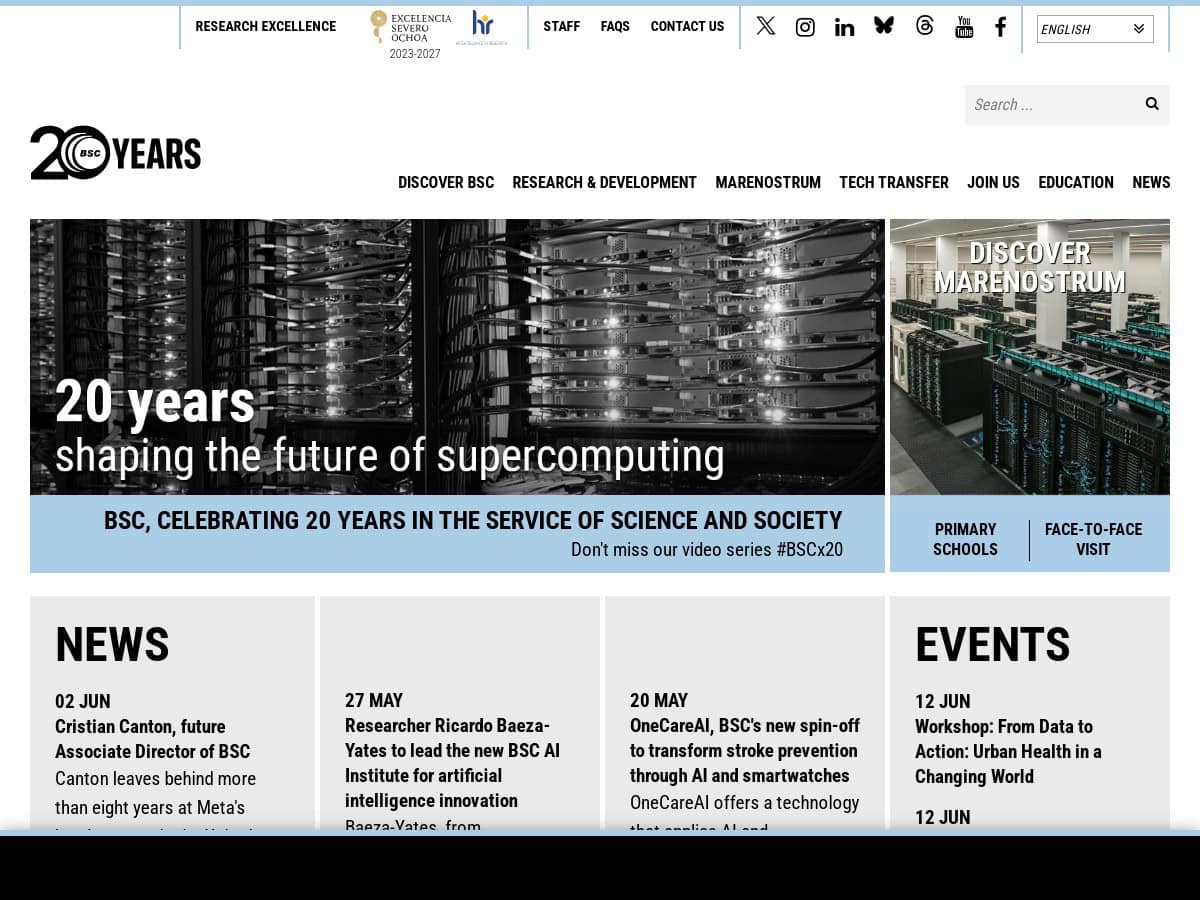
BSC-CNS is a leading research and supercomputing center in Spain, managing the MareNostrum supercomputer. While primarily a research institution, it is heavily involved in postgraduate training (Master, PhD) and collaborates closely with universities like UPC for academic programs related to high-performance computing, data science, and computational sciences.
The Barcelona Supercomputing Center, Centro Nacional de Supercomputación, BSC-CNS, is the national supercomputing centre of Spain. It is a research institute rather than a university, but it trains doctoral students and offers internships and master’s projects in cooperation with the Universitat Politècnica de Catalunya. It has about 700 staff and 300 students, and around half of the people working there come from abroad. The centre is on the Campus Nord in Barcelona, on Carrer de Jordi Girona.
The BSC was created in 2005 as a consortium of the Spanish government, the Catalan government and the UPC. Its supercomputer, MareNostrum, was first installed in 2004 in the Torre Girona chapel, a deconsecrated church on the campus, which made the centre known well beyond science. Later versions of the machine were installed in the chapel and in a new building, and MareNostrum 5, inaugurated in 2023, is one of the supercomputers of the European High Performance Computing Joint Undertaking.
The centre works in four main fields: computer sciences, life sciences, earth sciences, and computer applications in science and engineering. Teams develop programming models, processor architectures, simulation software for climate and air quality forecasts, genomics and drug design, and industrial simulations in engineering. The BSC plays a leading role in European projects on open-source processors based on the RISC-V architecture. It holds a Severo Ochoa accreditation as a centre of excellence.
Students do not enrol at BSC for a degree. Doctoral candidates register at a partner university, such as UPC, and carry out their research at the centre, usually with a salaried contract that is advertised in public calls. The centre also welcomes interns and visiting researchers, and it offers training courses on high-performance computing for scientists across Europe. Check the current calls and the conditions for non-EU candidates.
English is the working language, and Barcelona offers an international environment. The cost of living in the city is high, so the salary of a doctoral contract is important for newcomers.
Domains taught:
Agriculture, AI and Machine Learning, Astroscience, Bioengineering, Bioinformatics, Chemistry, Data Analytics, Ecology and Sustainability, Engineering, Fluid Dynamics, Materials, Mathematics, Mechanical Engineering, Nanotechnologies, Physics, Software Engineering, Statistics
Diplomas*:
Doctor, Master
Status:
Public
Partnerships:
Extensive international collaborations with research institutions, universities, and industry worldwide. Key partner in European HPC initiatives (e.g., PRACE, EuroHPC). Hosts PhD programs and co-organizes Master’s degrees with universities.
Research:
World-class research using supercomputing in areas like climate modeling, bioinformatics, materials science, engineering simulations, artificial intelligence, and earth sciences.
Famous Alumnis:
Mateo Valero
International recognition**:
Number of staff***:
700
Current students***:
300
Foreign students***:
50%
Cumulative former students***:
500
Pros
Access to one of Europe’s most powerful supercomputers, cutting-edge research projects, strong international environment, close links with university postgraduate programs.
Cons
Primarily a research center, not a degree-awarding university itself, but crucial for advanced technical/scientific training and research at Master/Doctoral level.
Best For
PhD students and researchers seeking to utilize high-performance computing for advanced scientific and engineering research. Master students in related fields offered via universities.
Consejo Superior de Investigaciones Científicas sits close to this institution on astroscience, agriculture and bioinformatics; it is far larger, with about 2,000 students against roughly 300 here, and is also a public institution.
A good alternative in the same country is Centro de Investigaciones Energéticas, Medioambientales y Tecnológicas, which likewise covers astroscience, nanotechnologies and fluid dynamics; it is smaller, enrolling about 100 students against roughly 300 here, and is also a public institution.
A good alternative in the same country is Instituto de Ciencias Fotónicas, which likewise covers nanotechnologies, bioengineering and physics; it covers optics and signal processing as well, and is smaller, enrolling about 150 students against roughly 300 here.
In terms of fields, Escuela de Ingeniería Informática is the nearest neighbour, with statistics, data analytics and AI and machine learning again at the core; it also offers bachelor's programmes and covers computer vision as well.
Most Similar Schools Abroad
Paul Scherrer Institut, based in Switzerland, is built around astroscience, bioinformatics and nanotechnologies much like this school, and it teaches at the same levels, namely master's and doctoral, and covers metrology and quality as well.
The closest overseas parallel on bioinformatics, nanotechnologies and fluid dynamics is ESPCI Paris - PSL, located in France; it covers microbiology and genetics and optics as well, and is slightly larger, at about 400 students against roughly 300 here.
Institut Pierre Simon Laplace (France) works on the same fields as this school, chiefly astroscience, fluid dynamics and chemistry; it has almost the same size, at about 300 students, and is also a public institution.
Scuola Internazionale Superiore di Studi Avanzati (Italy) works on the same fields as this school, chiefly astroscience, bioinformatics and nanotechnologies; it is also a public institution and runs the same master's and doctoral programmes.
Swiss Institute of Bioinformatics in Switzerland shares the bioinformatics, bioengineering and chemistry orientation of this school, and it is private, whereas this school is public, and teaches at the same levels, namely master's and doctoral.
*our own picks (our criteria: a mix between domains, diploma delivered, reputation and size), but obviously too many criteria for an apple-to-apple ranking.
FAQ
What is BSC-CNS?
The Barcelona Supercomputing Center, the national supercomputing centre of Spain.
Is it a university?
No. It is a research institute that trains doctoral students in cooperation with universities.
Where is it?
On Carrer de Jordi Girona 29 on the Campus Nord in Barcelona, Spain.
When was it created?
In 2005, as a consortium of the Spanish government, the Catalan government and the UPC.
How large is it?
About 700 staff and 300 students.
What is MareNostrum?
The supercomputer of the centre, first installed in 2004 in the Torre Girona chapel. MareNostrum 5 was inaugurated in 2023.
What does it work on?
Computer sciences, life sciences, earth sciences, and computer applications in science and engineering.
What is its role in open-source processors?
It plays a leading role in European projects on processors based on the RISC-V architecture.
How can you do a doctorate there?
You register at a partner university such as UPC and carry out the research at the centre, usually with a salaried contract. Check the current calls.
*: without any judgment of the quality, readers are strongly encouraged to check the official status of the exact diploma envisioned as many universities have a mix of recognized diplomas, not recognized, “co-delivered,” “equivalent to”, “some pathways” (…), can change over time, and can be named differently from one country to another.
**: international reputation: is based on some criteria that do not mean much in some domains or specialties (number of researchers, of scientific publications, on budget ….). Our approximate 1-4 scale:
known locally
known locally and internationally
is listed in some of the world university’s classifications
is listed among the 20 firsts in some of world university’s classifications
***: estimated numbers, based on online sources and/or feedbacks. The numbers can vary greatly depending on school organisation (ex.: school is part of a group, it employs internal staff or external consultants or has public staff without employing them …). Refer to all the links provided to have accurate and updated numbers.
Innovation.world is not affiliated with this school/university. We recommend to contact them directly on their website for any special request.
To complete or correct any information here or share your opinion, please comment below or > send us a direct message <.