Product Design, Manufacturing & Innovation Resources
Lar » Radiação ultravioleta

Radiação ultravioleta

1801
  • Johann Wilhelm Ritter
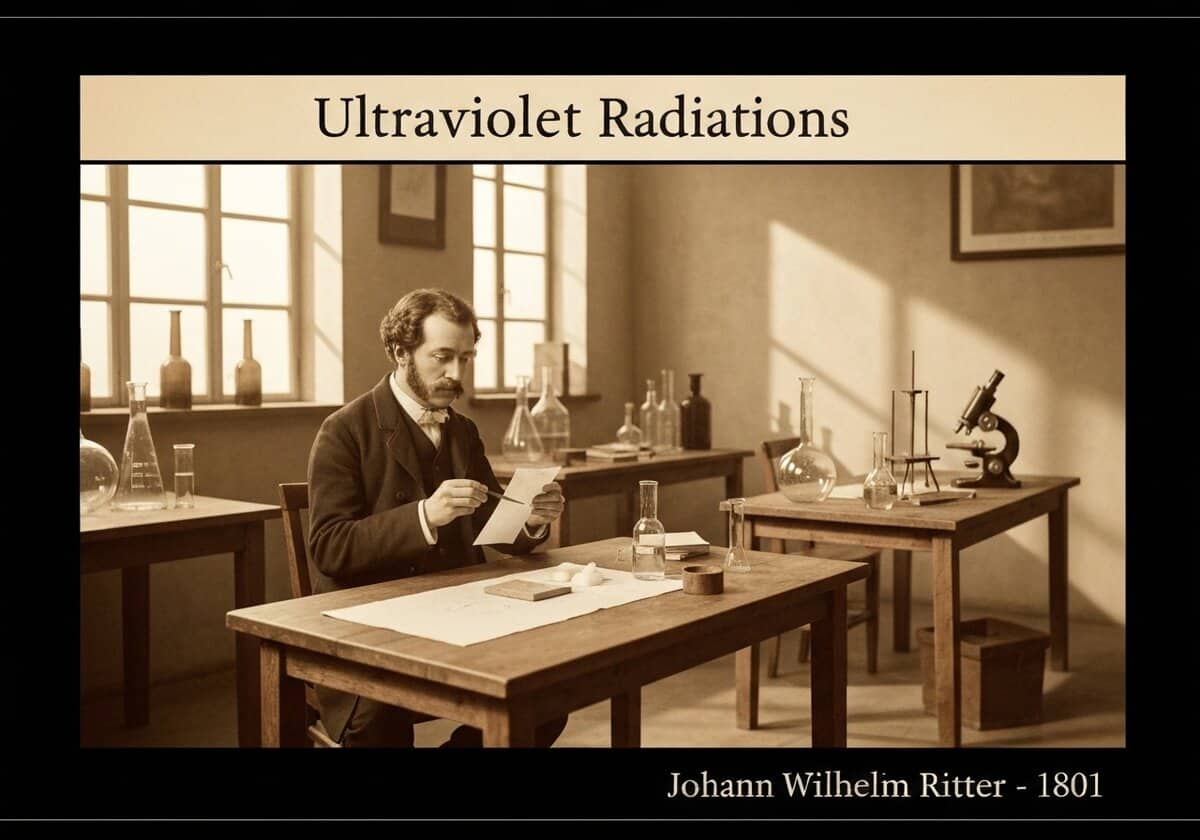
Johann Wilhelm Ritter's experiment with ultraviolet light and silver chloride paper in optics.

(Imagem gerada apenas para fins ilustrativos)

Em 1801, Johann Wilhelm Ritter observou que raios invisíveis além da extremidade violeta do espectro solar escureciam o papel embebido em cloreto de prata mais rapidamente do que a própria luz violeta. Isso demonstrou a existência de uma forma de luz além do espectro visível, que ele denominou "raios oxidantes", em contraste com os "raios de calor" (infravermelho) descobertos no ano anterior.
Johann Wilhelm Ritter’s experiment was a direct follow-up to William Herschel’s discovery of infrared radiation in 1800. Herschel had used a prism to split sunlight and placed thermometers beyond the red end of the spectrum, noting a temperature increase. Ritter, intrigued by this, decided to test the other end of the spectrum. He knew that silver chloride decomposed in the presence of light, and that this effect was more pronounced in violet light. He exposed strips of paper soaked in silver chloride to the solar spectrum produced by a prism. As expected, the paper darkened in the visible spectrum, with the effect increasing from red to violet. Crucially, he placed a strip just beyond the violet end, in a region where no visible light was present, and found that this strip darkened even more rapidly than the one in the violet light. This confirmed the existence of radiation with chemical activity stronger than visible light, located beyond the violet. His initial name, “oxidizing rays,” highlighted its chemical properties, which was later replaced by “chemical rays” and eventually “ultraviolet rays.” This discovery fundamentally expanded the known electromagnetic spectrum, proving that human vision perceives only a small fraction of it.

UNESCO Nomenclature: 2210
Óptica

Tipo

Descoberta científica

Interrupção

Fundamentais

Uso

Uso generalizado

Precursores

  • O trabalho de Isaac Newton sobre o espectro visível usando prismas
  • Descoberta da radiação infravermelha por William Herschel (1800)
  • Observações de Carl Wilhelm Scheele sobre o escurecimento de sais de prata pela luz.

Aplicações

Patentes:

NA

Ideias de Inovação Potencial

  • vestível uv sensors for personalized sun exposure tracking
  • uv-based data transmission through non-visible channels (li-fi)
  • smart windows that dynamically tint based on uv intensity
  • uv-activated drug delivery systems for targeted therapy
  • agricultural systems using specific uv wavelengths to enhance crop growth and pest resistance
  • uv-sensitive materials for 3d printing with enhanced resolution
  • portable water purification devices using uv leds powered by solar energy
  • forensic tools using uv to reveal latent evidence without chemical treatment
  • uv-based air quality sensors for detecting specific pollutants
  • art restoration techniques using uv to analyze and treat aged pigments
Relacionado a: descoberta da luz ultravioleta, Johann Ritter, cloreto de prata, espectro eletromagnético, espectroscopia, raios actínicos, raios químicos, óptica, história da física, luz.

Contexto histórico

Radiação ultravioleta

1800
1800
1800
1801
1802
1808
1811
1800
1800
1800
1800
1802
1802
1810
1816

(Caso a data seja desconhecida ou irrelevante, por exemplo, "mecânica dos fluidos", é fornecida uma estimativa aproximada de seu surgimento notável)

10º ano aniversário

Imagens em tamanho real e downloads estão disponíveis apenas, 100% gratuitos, para membros registrados.