Product Design, Manufacturing & Innovation Resources
Lar » Eletromagnetismo e Eletroímãs

Eletromagnetismo e Eletroímãs

1820
  • Hans Christian Ørsted
  • William Sturgeon
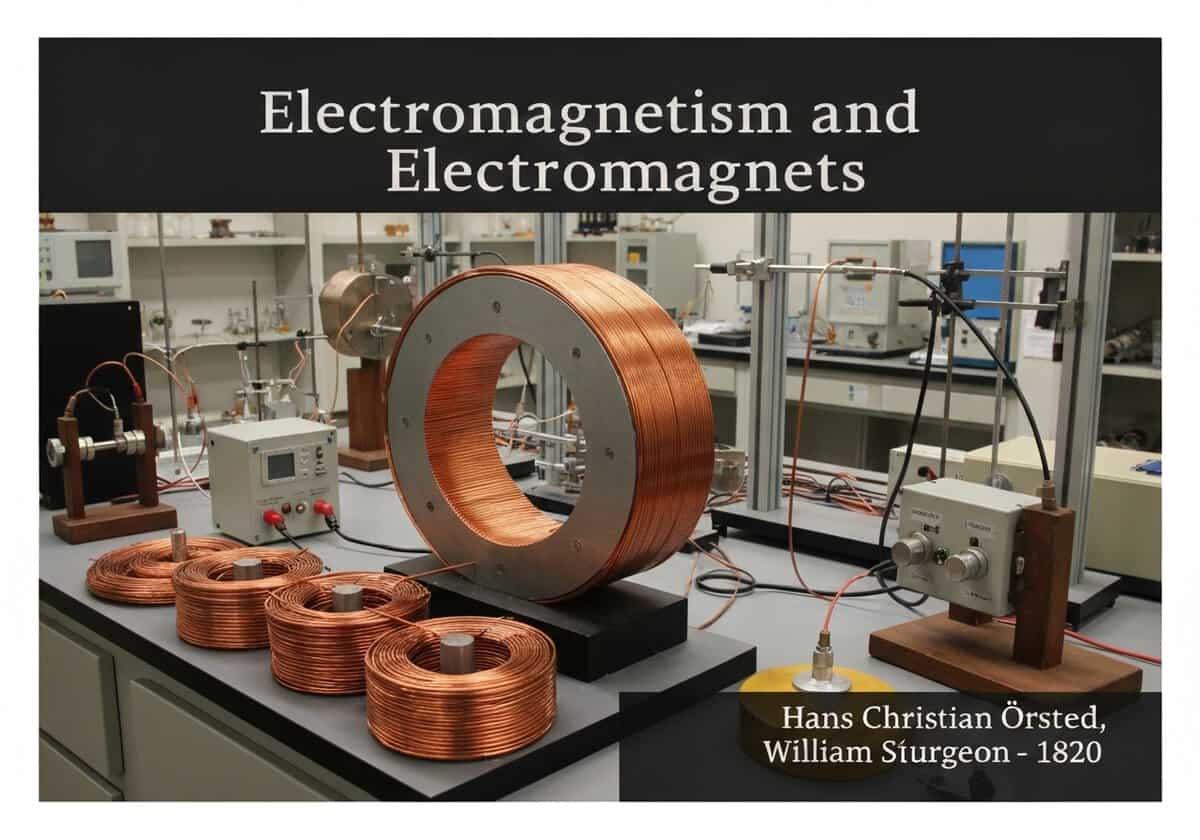
Electromagnet in a laboratory demonstrating electromagnetism principles.

(Imagem gerada apenas para fins ilustrativos)

Um eletroímã é um tipo de ímã Nesse princípio, o campo magnético é produzido por uma corrente elétrica. O campo desaparece quando a corrente é desligada. Normalmente, consiste em um fio enrolado em uma bobina. A intensidade do campo magnético é proporcional à corrente e ao número de espiras da bobina. Esse princípio foi descoberto por Hans Christian Ørsted.
Em 1820, Hans Christian Ørsted descobriu que uma corrente elétrica produz um campo magnético, um momento fundamental na física que ligou eletricidade e magnetismo. Pouco depois, em 1824, William Sturgeon criou o primeiro eletroímã prático, enrolando um fio condutor de corrente em torno de um núcleo de ferro. O núcleo de ferro amplifica significativamente o campo magnético, um fenômeno conhecido como permeabilidade magnética. O núcleo torna-se fortemente magnetizado pelo campo da bobina, e seu próprio campo magnético se soma ao da bobina, criando um campo total muito mais forte. Esta é uma forma de magnetismo induzido.

The direction of the magnetic field can be determined by the right-hand grip rule: if the fingers of the right hand are curled in the direction of the current flow around the coil, the thumb points in the direction of the magnetic north pole. The key advantage of an electromagnet over a permanent ímã is that its magnetic field can be rapidly changed by controlling the amount of electric current in the winding. This control is the basis for a vast array of modern tecnologias, from simple relays that act as electrically-controlled switches to the powerful superconducting magnets used in MRI scanners and particle accelerators, which require enormous magnetic fields.

UNESCO Nomenclature: 2212
Eletromagnetismo

Tipo

Dispositivo físico

Interrupção

Revolucionário

Uso

Uso generalizado

Precursores

  • invenção do pilha voltaica (bateria) por Alessandro Volta
  • compreensão de circuitos elétricos
  • conhecimento de ímãs permanentes (ímãs magnéticos)

Aplicações

  • motores e geradores elétricos
  • relés e solenoides
  • alto-falantes
  • máquinas de ressonância magnética
  • aceleradores de partículas
  • trens de levitação magnética (maglev)
  • guindastes de ferro-velho

Patentes:

NA

Ideias de Inovação Potencial

  • fast-switching electromagnets for haptic feedback systems
  • adaptive magnetic suspension for vehicles
  • electromagnetic launch systems (railguns) for space applications
  • contactless manipulation of materials in manufacturing
  • high-speed magnetic classificação of recyclable materials
  • electromagnetic pulse (emp) systems for non-lethal defense
  • active magnetic shielding for spacecraft against cosmic radiation
  • precision electromagnets for steering ion beams in medical therapy
  • wireless power transfer systems using resonant magnetic coupling
  • electromagnetic forming of sheet metal
Relacionado a: eletroímã, eletromagnetismo, Øersted, Sturgeon, corrente elétrica, campo magnético, solenoide, bobina, regra da mão direita, magnetismo induzido.

Contexto histórico

Eletromagnetismo e Eletroímãs

1816
1816-11-16
1820
1820
1822
1824
1827
1811
1816-11-16
1820
1820
1821
1822
1827
1829

(Caso a data seja desconhecida ou irrelevante, por exemplo, "mecânica dos fluidos", é fornecida uma estimativa aproximada de seu surgimento notável)

10º ano aniversário

Imagens em tamanho real e downloads estão disponíveis apenas, 100% gratuitos, para membros registrados.