SecureDrop Whistleblower Directory compared with Signal, ProtonMail and GlobaLeaks| SecureDrop Directory | Signal | ProtonMail | GlobaLeaks |
|---|
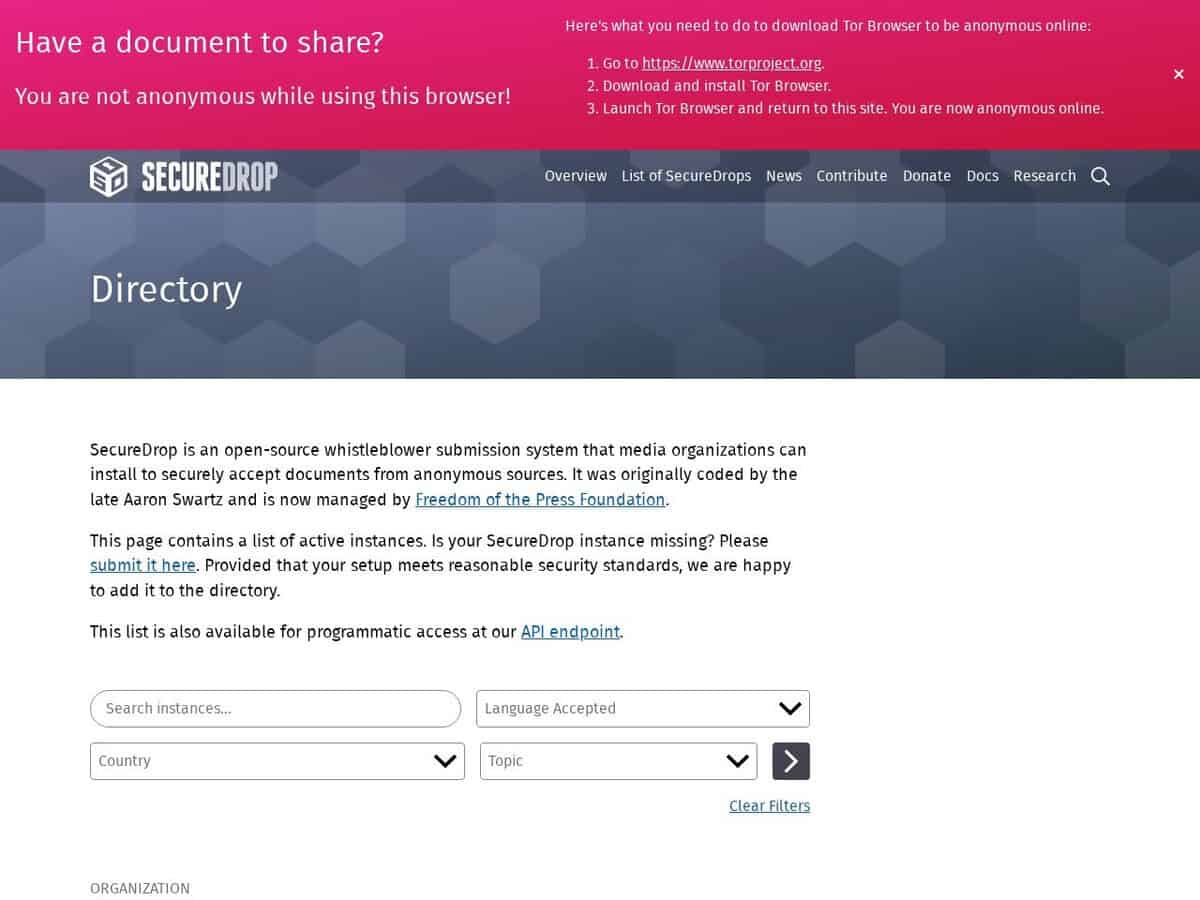
| Role: The Freedom of the Press Foundation maintains the official directory of SecureDrop instances. It points to the submission addresses of news organisations and is not a submission system itself. | Role: A free, open-source messaging app for calls and messages to individuals or groups. It is a general communication tool, not a channel dedicated to news organisations. | Role: An email service. The vendor states that it uses end-to-end and zero-access encryption, so Proton cannot read the content of a stored inbox. | Role: Free and open-source software used to set up and maintain a secure reporting platform. An organisation hosts it itself, unlike a directory of existing platforms. |
| Anonymity of the source: SecureDrop sites are reachable only as onion services on Tor. Sources receive a randomly generated code name to note down so that journalists can contact them later. | Anonymity of the source: Registration needs a working phone number verified by SMS, so the service is not anonymous by design. Usernames can hide the number from contacts, according to the EFF guide. | | |
| Licence and maintainer: The SecureDrop software is released under the GNU AGPL version 3 and developed by the Freedom of the Press Foundation, which took over the former DeadDrop project. | Licence and maintainer: Described as open source by the EFF guide. The exact licence of each component is not stated in the source consulted. | Licence and maintainer: The vendor describes its encryption as open source and independently audited. It does not state in the source consulted whether the rest of the service is open source. | Licence and maintainer: Released under AGPLv3 with additional terms under section 7, meant to inform whistleblowers about the technology and to make administrators keep systems up to date. |
| Cost model: Free to use, and messages travel over a data connection, so there are no SMS or MMS fees. | Cost model: A free plan with 1 GB of storage is offered. Mail Plus is a paid plan billed annually, with 15 GB of storage. | Cost model: The software is free. Hosting and administration costs fall on the organisation that runs the platform. |
| Platform and deployment: Android 5 or later and iOS 13 or later are the main targets. Desktop apps exist but require a linked phone. | | Platform and deployment: The repository includes Docker and Debian packaging, and documentation is hosted at docs.globaleaks.org. |