Mechanical Engineering, Information Technology, Light Industry Technologies
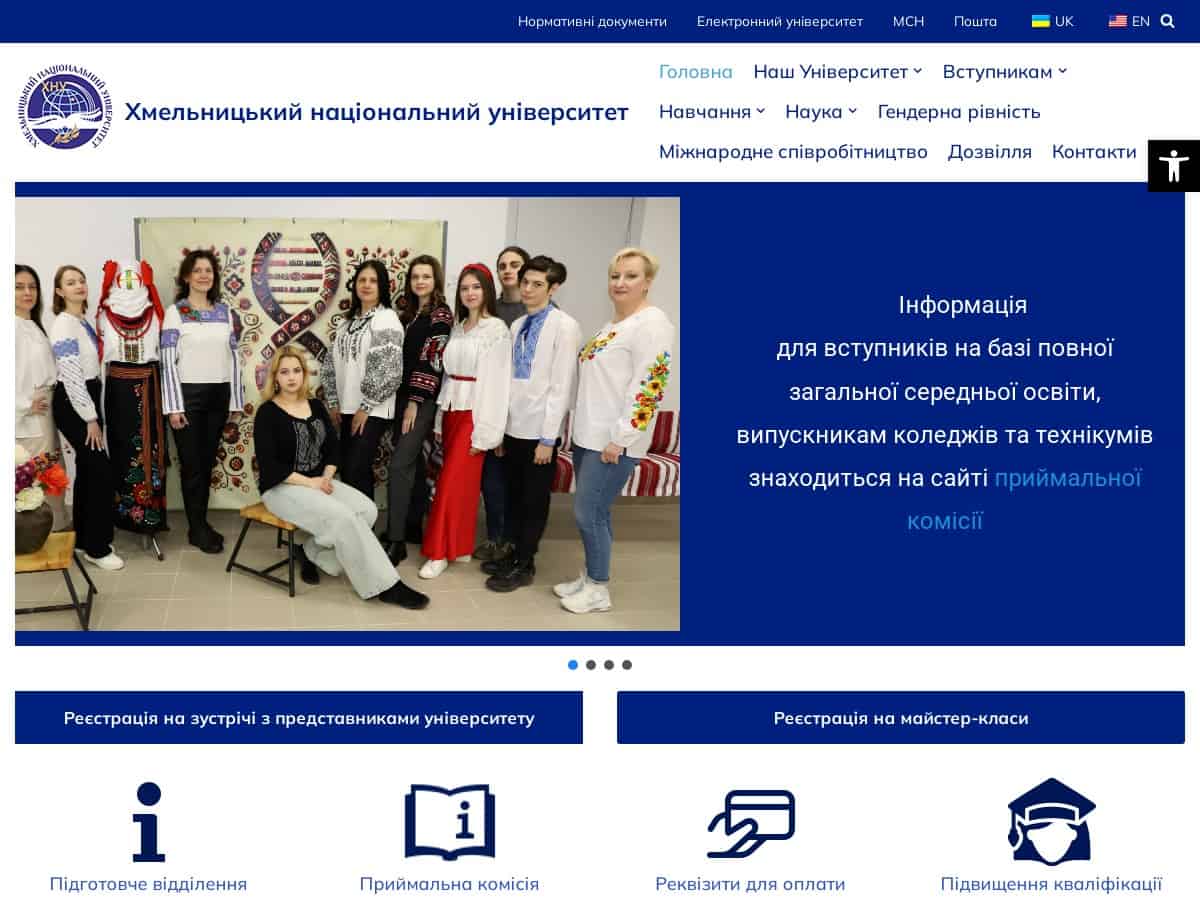
Khmelnytskyi National University is a university in the city of Khmelnytskyi, in the Podillia region of Ukraine, a region that English-language sources also spell Podolia. It began in 1962 as a general technical department of the Ukrainian printing institute, so its origins are technical rather than classical, and technology and engineering remain central to its profile.
The department became a branch of the printing institute in 1966 and an independent technological institute in 1967. It was renamed Khmelnytskyi Institute of Technology in 1989 and became the Technological University of Podillya in 1994. Reorganisation as Khmelnytskyi State University followed in 2003, and national status came in 2004. The 1967 institute’s name referred to household services technology, a lineage that sits alongside the light industry technologies in its listed specialties, which also include mechanical engineering and information technology.
A branch opened in Mukachevo in 1995 was later separated and is now Mukachevo State University. The university offers programmes at bachelor, master and doctoral levels. Applicants can consult its official English-language pages for current faculties, programmes and admission information.
Kyiv National University of Technologies and Design, in Kyiv, lists textile technology, fashion design and chemical technology of polymers, close to the light industry side of the Khmelnytskyi profile.
Mukachevo State University, in Mukachevo, grew out of the Khmelnytskyi branch and lists information technology, light industry technologies and engineering.
Ternopil Ivan Puluj National Technical University lists mechanical engineering, computer engineering and automation, and is based in Ternopil.
Vinnytsia National Technical University, in Vinnytsia, lists information technology, automation and optoelectronics.
Chernihiv Polytechnic National University in Chernihiv has information technology, mechanical engineering and electronics among its listed specialties.
Most Similar Schools Abroad
Poland's Łódź University of Technology, in Łódź, lists textile engineering and materials science, chemical technology and mechanical engineering with automation.
Zhejiang Sci-Tech University in Hangzhou, China, lists textile science and engineering, materials science and mechanical engineering with automation.
ENSAIT, in Roubaix, France, lists textile engineering and materials, smart textiles and sustainable textiles.
Hochschule Niederrhein - University of Applied Sciences, in Germany, lists textile and clothing technology, mechanical and process engineering, and electrical engineering with computer science.
Opole University of Technology, also in Poland, lists mechanical engineering and automation, electrical engineering and computer science, and civil engineering with logistics.
*our own picks (our criteria: a mix between domains, diploma delivered, reputation and size), but obviously too many criteria for an apple-to-apple ranking.
FAQ
When did Khmelnytskyi National University begin?
It began in 1962 as a general technical department of the Ukrainian printing institute.
How did the institution become independent?
The department turned into a branch of the printing institute in 1966 and became an independent technological institute in 1967.
Which names has it carried since 1989?
It became Khmelnytskyi Institute of Technology in 1989 and the Technological University of Podillya in 1994, then Khmelnytskyi State University in 2003.
When was national status granted?
The university received national status in 2004, producing its present title.
What fields does it list as its specialties?
Mechanical engineering, information technology and light industry technologies are the listed specialties.
What happened to its Mukachevo branch?
The branch opened in 1995 and was later separated, and the institution is now Mukachevo State University.
In which part of Ukraine is the university situated?
It stands in Khmelnytskyi, a city of the Podillia region of Ukraine.
Design for Manufacturing (DfM), Engineering, Information Technology (IT), Materials Science, Mechanical Engineering, Research and Development, Robotics, Sustainable Development
*: without any judgment of the quality, readers are strongly encouraged to check the official status of the exact diploma envisioned as many universities have a mix of recognized diplomas, not recognized, “co-delivered,” “equivalent to”, “some pathways” (…), can change over time, and can be named differently from one country to another.
**: international reputation: is based on some criteria that do not mean much in some domains or specialties (number of researchers, of scientific publications, on budget ….). Our approximate 1-4 scale:
known locally
known locally and internationally
is listed in some of the world university’s classifications
is listed among the 20 firsts in some of world university’s classifications
***: estimated numbers, based on online sources and/or feedbacks. The numbers can vary greatly depending on school organisation (ex.: school is part of a group, it employs internal staff or external consultants or has public staff without employing them …). Refer to all the links provided to have accurate and updated numbers.
Innovation.world is not affiliated with this school/university. We recommend to contact them directly on their website for any special request.
To complete or correct any information here or share your opinion, please comment below or > send us a direct message <.