Product Design, Manufacturing & Innovation Resources
» 인슐린의 발견 및 분리

인슐린의 발견 및 분리

1921
  • Frederick Banting
  • Charles Best
  • John Macleod
  • James Collip
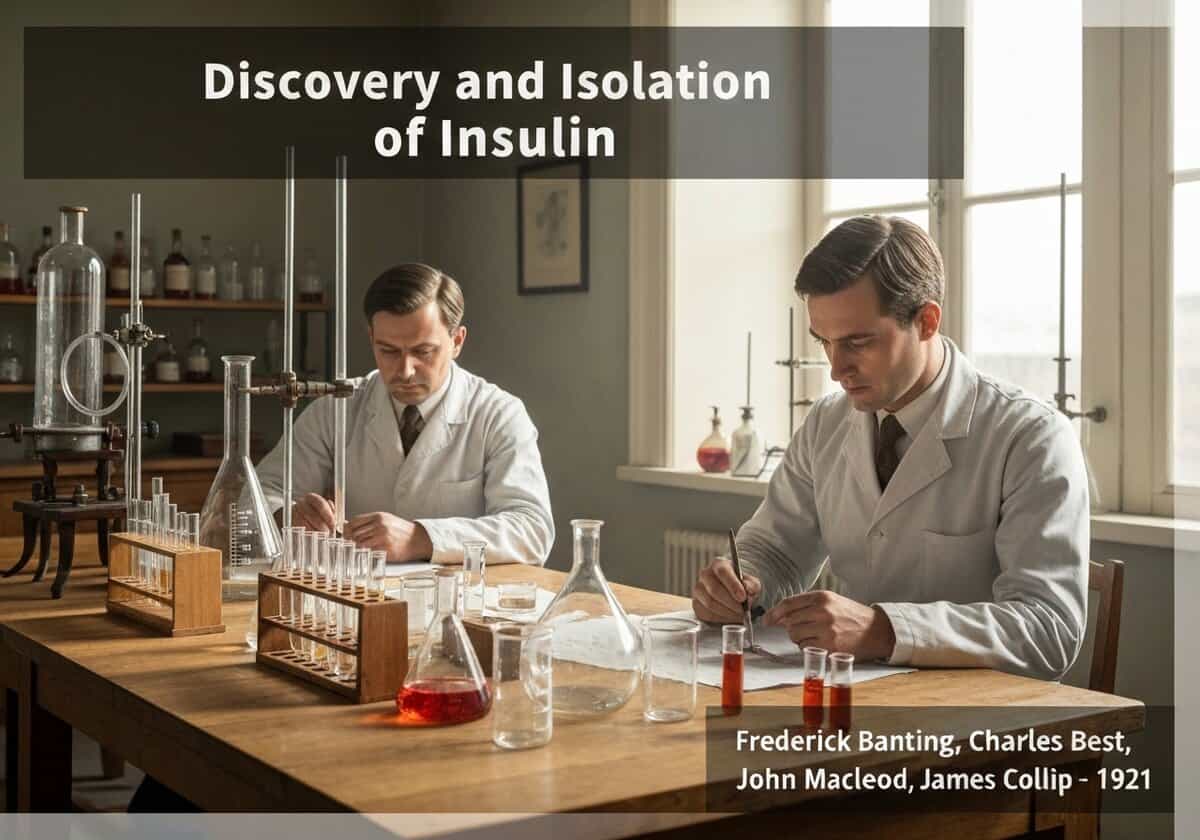
1921년 내분비학 연구, 밴팅과 베스트의 인슐린 분리 실험실 장면.

(설명을 위한 생성된 이미지입니다)

In 1921, Frederick Banting and Charles Best, under John Macleod’s direction at the University of Toronto, isolated insulin from canine pancreatic extracts. Biochemist James Collip then developed a purification process, making the extract safe for human use. This discovery transformed type 1 diabetes from a fatal disease into a manageable condition, earning Banting and Macleod the 1923 노벨 Prize.
Before 1921, a diagnosis of type 1 diabetes was a death sentence, often within months. The prevailing theory, proposed by researchers like Oskar Minkowski and Joseph von Mering in 1889, linked the pancreas to diabetes by showing that its removal in dogs induced the disease. The challenge was to isolate the specific anti-diabetic substance from the pancreas without it being destroyed by the organ’s own digestive enzymes. Frederick Banting, a young surgeon, hypothesized that ligating the pancreatic ducts would cause the enzyme-producing acinar cells to atrophy, leaving the islets of Langerhans, which he believed produced the sought-after secretion, intact. He proposed this idea to John Macleod, a prominent physiologist at the University of Toronto. Macleod was initially skeptical but provided Banting with lab space, ten dogs, and the assistance of a medical student, Charles Best. Over the summer of 1921, they successfully induced diabetes in dogs by removing their pancreas and then treated them with an extract from the degenerated pancreases of duct-ligated dogs. The extract, which they called “isletin,” effectively lowered blood glucose levels. The next crucial step was purification. Biochemist James Collip joined the team and developed a method using alcohol extraction to produce a purer, less toxic form of the extract suitable for human trials. The first human patient, 14-year-old Leonard Thompson, was successfully treated in January 1922, marking a turning point in medical history.

UNESCO Nomenclature: 2408
– Human biology

유형

의료 절차

분열

혁명가

용법

널리 사용됨

전구체

  • discovery by Oskar Minkowski and Joseph Von Mering that pancreatectomy causes diabetes (1889)
  • identification of the islets of langerhans by Paul Langerhans (1869)
  • suggestion by Edward Albert Sharpey-Schafer that a single chemical from the pancreas, which he named “insuline,” was responsible for glucose control (1916)
  • unsuccessful attempts by Georg Ludwig Zuelzer and others to create pancreatic extracts

응용 프로그램

  • treatment of type 1 diabetes
  • development of various insulin formulations (short-acting, long-acting)
  • management of hyperglycemia in type 2 diabetes
  • treatment of hyperkalemia
  • foundational research in endocrinology

특허:

  • US1469994

잠재적 혁신 아이디어

현재 하루 4만 건이 넘는 봇 트래픽을 차단하기 위해 이 콘텐츠는 커뮤니티 회원만 이용할 수 있습니다.
> 로그인 < 또는 >등록 < 이 콘텐츠를 비롯한 모든 제한된 콘텐츠와 도구는 (100% 무료로) 이용할 수 있습니다.

Related to: insulin discovery, Banting, Macleod, J. Collip, diabetes, pancreas, endocrinology, Nobel prize.

역사적 맥락

인슐린의 발견 및 분리

1880
1900
1910
1921
1930
1930
1940
1834-01-01
1880
1902
1920
1928
1930
1940
1950

(날짜를 알 수 없거나 관련이 없는 경우, 예를 들어 "유체역학"의 경우, 주목할 만한 등장 시기를 대략적으로 추정하여 제공합니다.)

관련 발명, 혁신 및 기술 원칙

고화질 이미지 및 다운로드는 등록된 회원에게만 100% 무료로 제공됩니다.

> 로그인 <