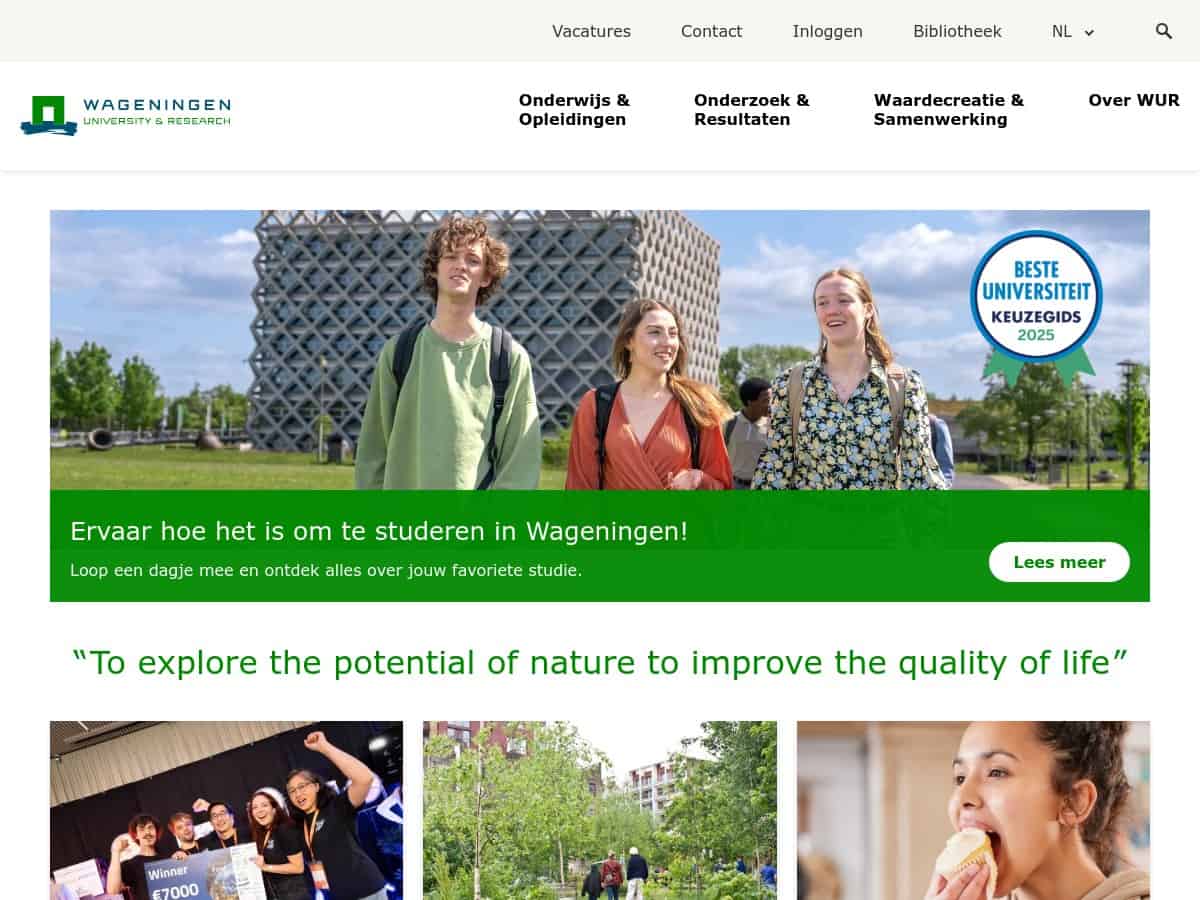
Food Science, Environmental Sciences, Life Sciences
Dating back to 1876, WUR is a leading international university and research center specializing in life sciences, agricultural and environmental science. It consistently ranks as one of the world’s best in these fields.
Wageningen University and Research, WUR, is a Dutch institution in the field of life sciences, agriculture and food. It began in 1876 as the National Agricultural School and became a university in 1918. The university has about 13,000 students and 6,500 staff when counting its research institutes, and about 30 percent of the students come from abroad. The campus lies on the edge of the small town of Wageningen, in Gelderland, between the Rhine and the forests of the Veluwe.
WUR works with a single mission, to explore the potential of nature to improve the quality of life. Its teaching covers agriculture and plant sciences, animal science, food technology, forestry, soil and water, environmental sciences, biotechnology, nutrition, economics of the food chain and the social sciences of rural development. Wageningen regularly leads international rankings in agriculture and forestry, and many students pursue careers in the food industry, development organisations and policy.
The Wageningen Research institutes, connected to the Dutch government, run studies in plant breeding, aquaculture, animal health, food safety, climate and land use. The university sits at the centre of Food Valley, a cluster of food companies and research groups, and it hosts a large number of start-ups on its campus. Field stations and experimental farms are used for teaching.
EU students pay the statutory Dutch tuition fee, which is around two and a half thousand euros a year, while students from outside the EU pay a higher institutional fee set by each programme. Check the current tariff. Applications go through Studielink, and international students apply directly for most master’s degrees. Most bachelor’s programmes are taught in English or Dutch, and master’s degrees are in English.
Wageningen is a small university town, and housing is a challenge for newcomers, but bicycles and cheap bars make student life easy. Utrecht and Arnhem are about 30 minutes away by bus or train.
Domains taught:
Agriculture, AI and Machine Learning, Bioengineering, Bioinformatics, Chemistry, Data Analytics, Ecology and Sustainability, Food Science, Life Sciences, Marine Science, Microbiology and Genetics, Nanotechnologies, Process Control, Statistics
Diplomas*:
Bachelor, Doctor, Master
Status:
Public
Partnerships:
Euroleague for Life Sciences (ELLS). Global partnerships with universities, research institutes, and NGOs.
Rijksuniversiteit Groningen offers a comparable education in marine science, bioinformatics and nanotechnologies: it covers astroscience and fluid dynamics as well, and is larger, enrolling about 37,000 students against roughly 13,000 here.
HAS Green Academy is the closest domestic counterpart for agriculture, food science and bioengineering; it is far smaller, with about 4,200 students against roughly 13,000 here, and is also a public institution.
Radboud Universiteit follows much the same lines as this institution, with bioinformatics, nanotechnologies and microbiology and genetics as common ground, and it is also a public institution, and teaches at the same levels, namely bachelor's, master's and doctoral.
Both schools build their programmes around marine science, agriculture and food science, and Van Hall Larenstein, University of Applied Sciences is the one to compare first within the country, since it also offers associate degree programmes, and is smaller, enrolling about 5,000 students against roughly 13,000 here.
Universiteit Leiden sits close to this university on bioinformatics, nanotechnologies and microbiology and genetics; it teaches at the same levels, namely bachelor's, master's and doctoral, and covers astroscience and computer vision as well.
Most Similar Schools Abroad
In Japan, Hokkaido University teaches much the same core subjects, marine science, agriculture and food science, and it teaches at the same levels, namely bachelor's, master's and doctoral, and covers astroscience and aerospace as well.
Universität Hohenheim (Germany) works on the same fields as this university, chiefly agriculture, food science and bioinformatics; it covers aerospace and geotechnics as well, and is slightly smaller, at about 9,000 students against roughly 13,000 here.
Università degli Studi della Tuscia in Italy pursues a similar profile in agriculture, food science and bioinformatics, and it teaches at the same levels, namely bachelor's, master's and doctoral, and covers industrial design and civil engineering as well.
For a study option in Italy with a comparable spread of agriculture, food science and bioinformatics, Università degli Studi di Sassari is the reference point: it has almost the same size, at about 13,000 students, and is also a public institution.
If this university is on your list for marine science, bioinformatics and nanotechnologies, Université de Lausanne in Switzerland deserves a comparison, because it is also a public institution, and teaches at the same levels, namely bachelor's, master's and doctoral.
*our own picks (our criteria: a mix between domains, diploma delivered, reputation and size), but obviously too many criteria for an apple-to-apple ranking.
FAQ
Where is WUR?
At Droevendaalsesteeg 2 in Wageningen, in the province of Gelderland, Netherlands.
When was it founded?
In 1876, as the National Agricultural School. It became a university in 1918.
How large is it?
About 13,000 students and 6,500 staff, counting the research institutes.
What is WUR best known for?
Agriculture, food technology, forestry, environmental sciences, nutrition and life sciences.
What is Food Valley?
A cluster of food companies and research groups around Wageningen.
What are the Wageningen Research institutes?
Government-linked institutes that run studies on plant breeding, aquaculture, animal health, food safety and climate.
What does it cost?
EU students pay the statutory Dutch tuition fee, around two and a half thousand euros a year. Students from outside the EU pay a higher institutional fee. Check the current tariff.
How do you apply?
Through Studielink for bachelor's degrees, and directly for most master's degrees for international students.
In which language are courses taught?
Most bachelor's programmes in English or Dutch, and master's degrees in English.
Is Wageningen easy for housing?
No. It is a small town and housing is a challenge for newcomers.
*: without any judgment of the quality, readers are strongly encouraged to check the official status of the exact diploma envisioned as many universities have a mix of recognized diplomas, not recognized, “co-delivered,” “equivalent to”, “some pathways” (…), can change over time, and can be named differently from one country to another.
**: international reputation: is based on some criteria that do not mean much in some domains or specialties (number of researchers, of scientific publications, on budget ….). Our approximate 1-4 scale:
known locally
known locally and internationally
is listed in some of the world university’s classifications
is listed among the 20 firsts in some of world university’s classifications
***: estimated numbers, based on online sources and/or feedbacks. The numbers can vary greatly depending on school organisation (ex.: school is part of a group, it employs internal staff or external consultants or has public staff without employing them …). Refer to all the links provided to have accurate and updated numbers.
Innovation.world is not affiliated with this school/university. We recommend to contact them directly on their website for any special request.
To complete or correct any information here or share your opinion, please comment below or > send us a direct message <.