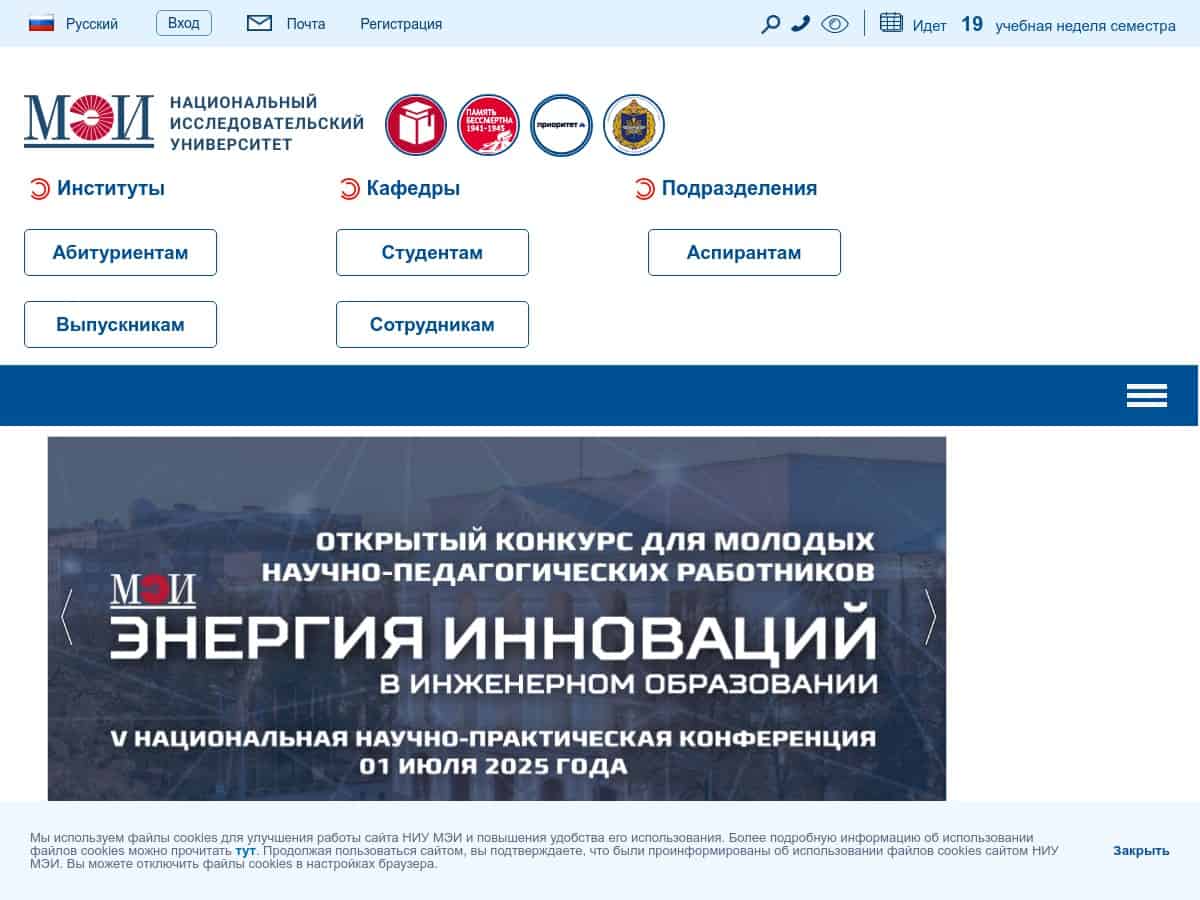
Address: 14 Krasnokazarmennaya St., Moscow, 111250, Russia
Power Engineering, Electrical Engineering, Thermal Engineering
Founded in 1930, MPEI (National Research University) is a leading Russian technical university in the field of power engineering, electrical engineering, electronics, informatics, and radio engineering.
The Moscow Power Engineering Institute, MPEI, was founded in 1930 as the country industrialised, when the power engineering faculty of the Moscow Higher Technical School and other units were combined to train engineers for electrification, a central goal of Soviet planning. The main campus is in Lefortovo, on Krasnokazarmennaya Street, in the east of Moscow, in an area that has been home to military and technical institutions since the eighteenth century. It has about 15,000 students and 2,500 staff, and it holds the status of National Research University.
The institute is among the leading Russian universities for energy. Its institutes and faculties cover power engineering, electrical engineering, electronics, radio engineering, informatics, mechanical engineering, nuclear and thermal power, renewable energy and economics of energy. A large part of the engineers who built and ran power stations, grids and heating systems in the Soviet Union and Russia studied here. Teaching relies on laboratories and on simulators for the operation of thermal and nuclear power plants.
MPEI has branches in Smolensk and in Volzhsky, and its research covers thermal and hydropower, high-voltage engineering, smart grids, energy efficiency, electric drives, microelectronics, nanomaterials, photonics, radar, telecommunications and information security. Cooperation with energy companies provides projects, internships and employment for graduates. The institute used to host many foreign students, especially from countries in Asia, Africa and the Middle East, and it taught power engineering in several languages.
Admission is through the Unified State Exam and the university’s own tests for some courses. Programmes are mainly in Russian, with some in English. Since 2022 international cooperation has been affected by sanctions and restrictions, so prospective foreign students should check the current status of visas, programmes and exchanges. Public places are funded by the state, and fees for others differ by programme. Check the current tariff.
The campus is reached by metro and by bus from several stations in the Lefortovo area, and student dormitories are available. Moscow offers a large network of public transport and a very active cultural scene.
Domains taught:
Automation, Electrical and Electronics, Engineering, Physics, Process Control, Software Engineering, Thermodynamics
Diplomas*:
Bachelor, Doctor, Master
Status:
Public
Partnerships:
Collaborations with numerous universities and companies in over 60 countries; trains international students in power engineering.
Research:
Research focuses on energy efficiency, new energy sources, thermal and nuclear power engineering, electrical grids, IT in energy, and radio electronics.
Famous Alumnis:
Li Peng, Ion Iliescu
International recognition**:
Number of staff***:
2500
Current students***:
15000
Foreign students***:
20%
Cumulative former students***:
160000
Pros
Premier university for power engineering, strong industry connections, extensive research facilities, long history of training international specialists.
Cons
Specialized focus on energy and electrical fields, some older infrastructure.
On content, Ivanovo State Power Engineering University and this institution are close, as both teach thermodynamics, process control and automation; it covers mechanical engineering as well, and is smaller, enrolling about 6,000 students against roughly 15,000 here.
Kazan State Power Engineering University sits close to this institution on thermodynamics, process control and automation; it is smaller, enrolling about 7,000 students against roughly 15,000 here, and is also a public institution.
Sevastopol State University offers a comparable education in automation, physics and electrical and electronics: it teaches at the same levels, namely bachelor's, master's and doctoral, and covers marine science and robotics as well.
Ulyanovsk State Technical University takes a similar route through thermodynamics, automation and electrical and electronics, and it is smaller, enrolling about 10,000 students against roughly 15,000 here, and is also a public institution.
Saratov State Technical University takes a similar route through thermodynamics, automation and electrical and electronics, and it is slightly larger, at about 17,000 students against roughly 15,000 here, and is also a public institution.
Most Similar Schools Abroad
A foreign alternative with a similar emphasis on thermodynamics, process control and automation is Shanghai University of Electric Power in China, and it runs the same bachelor's, master's and doctoral programmes, and covers transportations and optics as well.
For automation, electrical and electronics and software engineering outside the home country, Odesa National Polytechnic University in Ukraine is a natural reference; it has almost the same size, at about 15,000 students, and is also a public institution.
For process control, automation and electrical and electronics outside the home country, University of South-Eastern Norway in Norway is a natural reference; it covers marine science and nanotechnologies as well, and is slightly larger, at about 18,000 students against roughly 15,000 here.
V. N. Karazin Kharkiv National University offers an international parallel to this institution, with physics, electrical and electronics and software engineering as common ground; it is also a public institution, and runs the same bachelor's, master's and doctoral programmes.
Abroad, Northeast Dianli University (China) covers thermodynamics, process control and automation in a comparable way, and it is also a public institution, and teaches at the same levels, namely bachelor's, master's and doctoral.
*our own picks (our criteria: a mix between domains, diploma delivered, reputation and size), but obviously too many criteria for an apple-to-apple ranking.
FAQ
Where is MPEI?
At 14 Krasnokazarmennaya Street, in the Lefortovo district in the east of Moscow, Russia.
When was it founded?
In 1930.
How large is it?
About 15,000 students and 2,500 staff.
What is its status?
National Research University.
What does it teach?
Power engineering, electrical engineering, electronics, radio engineering, informatics, nuclear and thermal power, renewable energy and the economics of energy.
Does it have branches?
Yes, in Smolensk and Volzhsky.
What are its research areas?
Thermal and hydropower, high-voltage engineering, smart grids, energy efficiency, electric drives, microelectronics, photonics, radar and information security.
How do students enter?
Through the Unified State Exam and the university's own tests for some courses.
What is the language of teaching?
Mainly Russian, with some programmes in English.
What does it cost?
Public places are funded by the state, and fees for others differ by programme. Check the current tariff.
Energy, Environmental Engineering, Information Technology (IT), Renewable Energy, Research and Development
*: without any judgment of the quality, readers are strongly encouraged to check the official status of the exact diploma envisioned as many universities have a mix of recognized diplomas, not recognized, “co-delivered,” “equivalent to”, “some pathways” (…), can change over time, and can be named differently from one country to another.
**: international reputation: is based on some criteria that do not mean much in some domains or specialties (number of researchers, of scientific publications, on budget ….). Our approximate 1-4 scale:
known locally
known locally and internationally
is listed in some of the world university’s classifications
is listed among the 20 firsts in some of world university’s classifications
***: estimated numbers, based on online sources and/or feedbacks. The numbers can vary greatly depending on school organisation (ex.: school is part of a group, it employs internal staff or external consultants or has public staff without employing them …). Refer to all the links provided to have accurate and updated numbers.
Innovation.world is not affiliated with this school/university. We recommend to contact them directly on their website for any special request.
To complete or correct any information here or share your opinion, please comment below or > send us a direct message <.