Product Design, Manufacturing & Innovation Resources
家 » クロルアルカリ法

クロルアルカリ法

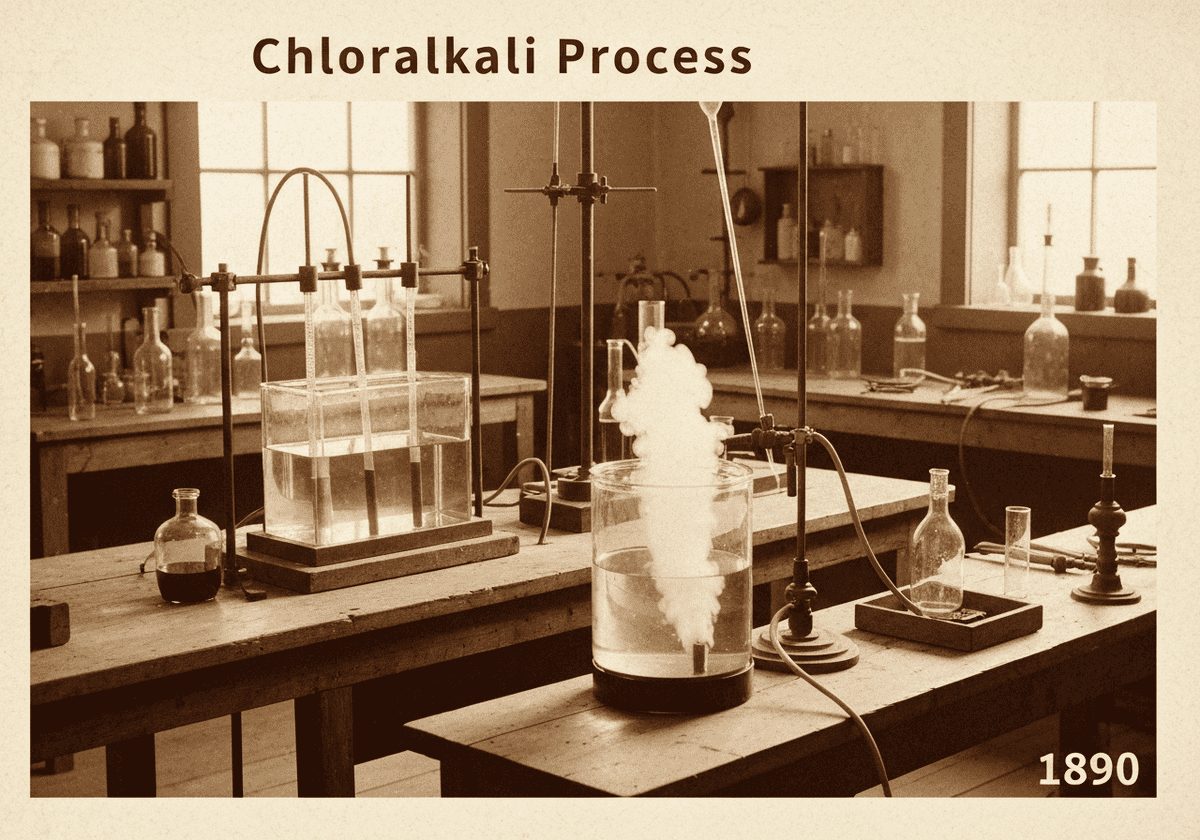
1890
化学工学分野の古い実験室における、クロルアルカリ法のための電気分解装置。

(画像はイメージです)

The chloralkali process is an industrial method for the electrolysis of sodium chloride (NaCl) solution, known as brine. It is the primary source for producing chlorine (Cl₂), sodium hydroxide (NaOH), and hydrogen (H₂), which are essential commodity chemicals. Modern methods use a membrane cell to separate the anode and cathode products, ensuring high purity and efficiency.
The chloralkali process is one of the largest-scale applications of electrolysis, fundamental to the modern chemical industry. The overall reaction is [latex]2NaCl + 2H_2O \rightarrow 2NaOH + Cl_2 + H_2[/latex]. The process takes place in an electrolytic cell with a brine solution as the electrolyte. At the anode, chloride ions are oxidized to form chlorine gas: [latex]2Cl^- \rightarrow Cl_2 + 2e^-[/latex]. At the cathode, water is reduced to form hydrogen gas and hydroxide ions: [latex]2H_2O + 2e^- \rightarrow H_2 + 2OH^-[/latex].

このプロセスの重要な側面は、塩素と水酸化ナトリウムという生成物を分離しておくことです。分離してしまうと、次亜塩素酸ナトリウムと塩素酸ナトリウムが生成されてしまうからです。従来、これは水銀電池や隔膜電池を用いて行われていましたが、環境問題(水銀汚染)や効率の低さから、これらの電池はほとんど使われなくなりました。現代の標準は膜電池です。この電池は、陽極室と陰極室を隔てる陽イオン交換膜(通常はNafionなどのパーフルオロポリマー製)を使用します。この膜はNa⁺などの陽イオンは透過しますが、Cl⁻やOH⁻などの陰イオンは透過しません。ナトリウムイオンは膜を介して陽極室から陰極室に移動し、陰極で生成された水酸化物イオンと結合して高純度の水酸化ナトリウムを生成します。

この技術は、クロルアルカリプロセスのエネルギー効率と製品純度を大幅に向上させると同時に、水銀に関連する環境リスクを排除しました。しかし、3つの主要な化学物質を同時に生産するため、塩素と苛性ソーダ(NaOH)の市場需要のバランスを取る必要があり、プロセスの経済性は複雑になります。

UNESCO Nomenclature: 3305
化学工学

タイプ

工業プロセス

混乱

革命的

使用法

広く普及している

前駆物質

  • ハンフリー・デービーによる塩水の最初の電気分解
  • 大規模発電のためのダイナモの発明
  • 初期の隔膜式電池および水銀電池技術の開発
  • ファラデーの電気分解の法則

アプリケーション

  • PVCプラスチックの製造(塩素から)
  • 浄水処理および消毒剤(塩素および次亜塩素酸ナトリウム)
  • パルプ・製紙製造(漂白)
  • 石鹸、洗剤、繊維製品の製造(水酸化ナトリウム)
  • 多種多様な製品の化学合成

特許:

NA

潜在的なイノベーションのアイデア

  • zero-gap cell configurations to minimize ohmic resistance and energy use
  • oxygen depolarized cathodes that consume oxygen instead of producing hydrogen, lowering cell voltage
  • direct conversion of co2 using hydrogen from the process to produce methanol
  • advanced ion-exchange membranes with higher selectivity and durability
  • electrolysis of seawater to produce chlorine for on-site biofouling prevention in power plants
  • small-scale, modular chloralkali plants for decentralized water treatment
  • using renewable energy to power the process, creating ‘green’ chlorine and naoh
  • catalytic electrodes that reduce the overpotential for chlorine evolution
関連キーワード:クロルアルカリ法、電気分解、塩素、水酸化ナトリウム、苛性ソーダ、塩水、膜セル、工業化学。

歴史的背景

クロルアルカリ法

1875-01-01
1881
1884
1890
1890
1899-01-01
1900
1870
1876
1882-01-01
1886-04-23
1890
1897
1900
1900

(日付が不明または関連性がない場合、例えば「流体力学」などでは、その注目すべき出現時期の概算値が提示されます。)

10年目 周年

フルサイズの画像とダウンロードは、登録会員のみが100%無料で利用できます。