Product Design, Manufacturing & Innovation Resources
집 » 염소알칼리 공정

염소알칼리 공정

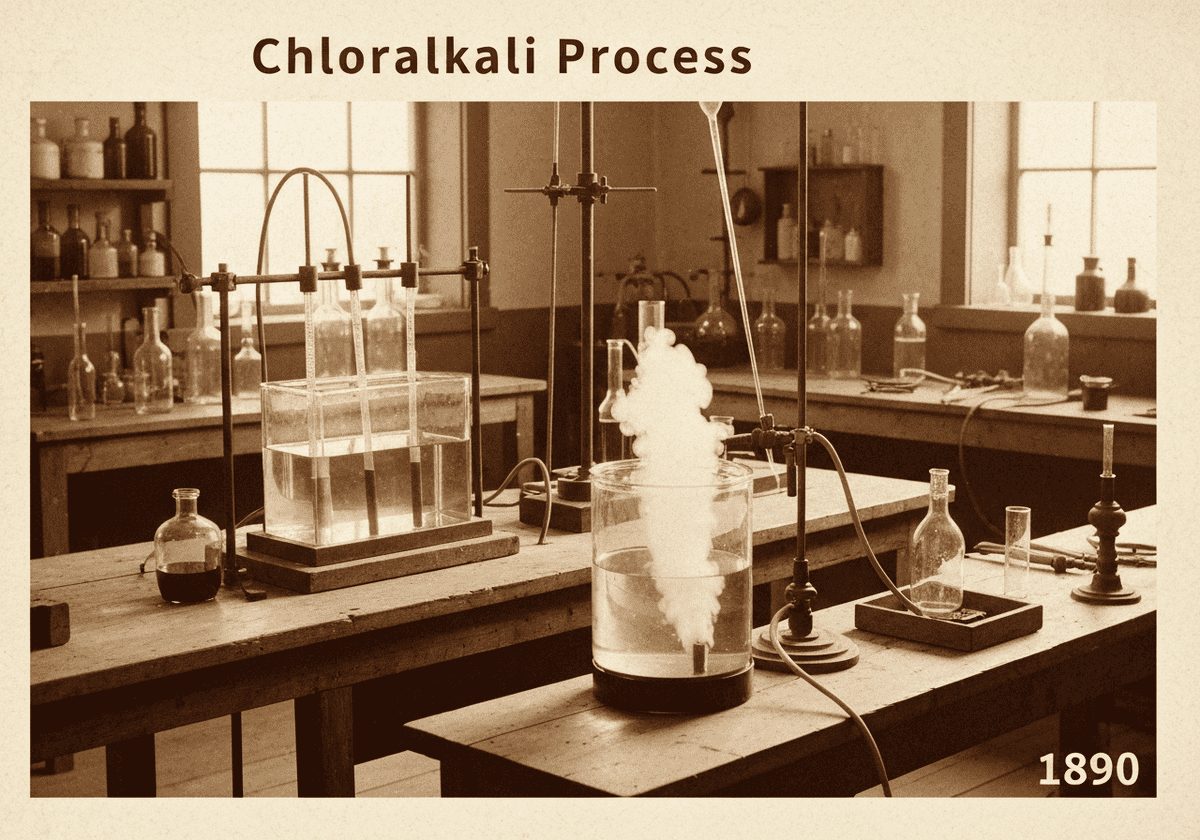
1890
화학공학 실험실의 오래된 공간에 설치된 염소알칼리 공정용 전기분해 장치.

(설명을 위한 생성된 이미지입니다)

The chloralkali process is an industrial method for the electrolysis of sodium chloride (NaCl) solution, known as brine. It is the primary source for producing chlorine (Cl₂), sodium hydroxide (NaOH), and hydrogen (H₂), which are essential commodity chemicals. Modern methods use a membrane cell to separate the anode and cathode products, ensuring high purity and efficiency.
The chloralkali process is one of the largest-scale applications of electrolysis, fundamental to the modern chemical industry. The overall reaction is [latex]2NaCl + 2H_2O \rightarrow 2NaOH + Cl_2 + H_2[/latex]. The process takes place in an electrolytic cell with a brine solution as the electrolyte. At the anode, chloride ions are oxidized to form chlorine gas: [latex]2Cl^- \rightarrow Cl_2 + 2e^-[/latex]. At the cathode, water is reduced to form hydrogen gas and hydroxide ions: [latex]2H_2O + 2e^- \rightarrow H_2 + 2OH^-[/latex].

이 공정에서 가장 중요한 측면은 생성물인 염소와 수산화나트륨을 분리하는 것입니다. 만약 분리된다면 이들은 반응하여 차아염소산나트륨과 염소산염을 생성할 것입니다. 과거에는 수은 전해조나 격막 전해조를 사용하여 이를 달성했지만, 수은 오염과 낮은 효율이라는 환경 문제로 인해 대부분 사용이 중단되었습니다. 현대의 표준은 막 전해조입니다. 이 전해조는 양이온 교환막(일반적으로 나피온과 같은 과불화 중합체로 만들어짐)을 사용하여 양극과 음극을 분리합니다. 이 막은 Na⁺와 같은 양이온은 투과시키지만 Cl⁻ 및 OH⁻와 같은 음이온은 투과시키지 않습니다. 나트륨 이온은 막을 통과하여 양극에서 음극으로 이동하고, 음극에서 생성된 수산화 이온과 결합하여 고순도 수산화나트륨을 생성합니다.

이 기술은 염소알칼리 공정의 에너지 효율과 제품 순도를 크게 향상시키는 동시에 수은과 관련된 환경 위험을 제거했습니다. 세 가지 주요 화학 물질을 동시에 생산하기 때문에 염소와 가성소다(NaOH)에 대한 시장 수요의 균형을 맞춰야 하므로 공정의 경제성이 복잡합니다.

UNESCO Nomenclature: 3305
화학공학

유형

산업 공정

분열

혁명가

용법

널리 사용됨

전구체

  • 험프리 데이비의 염수 전기분해 초기 연구
  • 대규모 전력 생산을 위한 다이너모의 발명
  • 초기 격막 및 수은 전지 기술의 개발
  • 패러데이의 전기분해 법칙

응용 프로그램

  • PVC 플라스틱 생산 (염소로부터)
  • 정수 및 소독제(염소 및 차아염소산나트륨)
  • 펄프 및 제지 제조(표백)
  • 비누, 세제 및 섬유 생산(수산화나트륨)
  • 다양한 제품의 화학 합성

특허:

NA

잠재적 혁신 아이디어

  • zero-gap cell configurations to minimize ohmic resistance and energy use
  • oxygen depolarized cathodes that consume oxygen instead of producing hydrogen, lowering cell voltage
  • direct conversion of co2 using hydrogen from the process to produce methanol
  • advanced ion-exchange membranes with higher selectivity and durability
  • electrolysis of seawater to produce chlorine for on-site biofouling prevention in power plants
  • small-scale, modular chloralkali plants for decentralized water treatment
  • using renewable energy to power the process, creating ‘green’ chlorine and naoh
  • catalytic electrodes that reduce the 과전압 for chlorine evolution
관련 용어: 염소알칼리 공정, 전기분해, 염소, 수산화나트륨, 가성소다, 염수, 막 전지, 산업 화학.

역사적 맥락

염소알칼리 공정

1875-01-01
1881
1884
1890
1890
1899-01-01
1900
1870
1876
1882-01-01
1886-04-23
1890
1897
1900
1900

(날짜를 알 수 없거나 관련이 없는 경우, 예를 들어 "유체역학"의 경우, 주목할 만한 등장 시기를 대략적으로 추정하여 제공합니다.)

10년차 기념일

고화질 이미지 및 다운로드는 등록된 회원에게만 100% 무료로 제공됩니다.

> 로그인 <