Product Design, Manufacturing & Innovation Resources
Lar » O Efeito Signor-Lipps

O Efeito Signor-Lipps

1982
  • Philip W. Signor
  • Jere H. Lipps
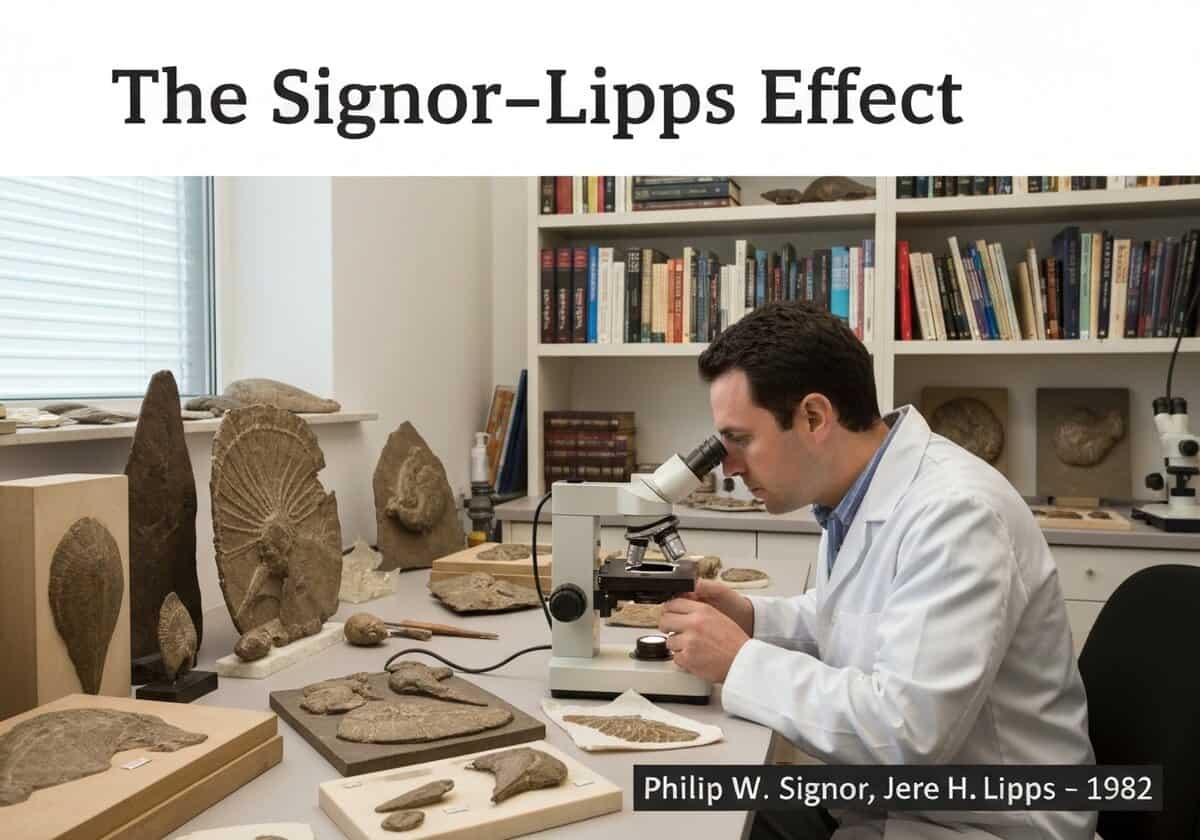
Paleontologist analyzing fossil specimens in a laboratory setting, focusing on extinction events.

(Imagem gerada apenas para fins ilustrativos)

The Signor–Lipps effect is a paleontological principle stating that, because the fossil record is incomplete, the last known fossil of a species will almost certainly predate the actual extinction of that species. This artifact can make abrupt extinções em massa appear gradual in the fossil record, as the last appearances of different species are smeared backward in time.


Proposed by Philip W. Signor and Jere H. Lipps in 1982, the Signor–Lipps effect addresses a fundamental challenge in interpreting the fossil record: its inherent incompleteness. The chance of any individual organism being fossilized is extremely low, and the chance of paleontologists finding that fossil is even lower. Consequently, the known fossil range of a taxon (its first to last appearance) is almost always shorter than its true temporal range. The effect is particularly significant when analyzing extinction events. For a group of species that went extinct simultaneously in a catastrophic event, their last known fossils will not be found in the same rock layer. Instead, due to random sampling (fossilization and discovery), their last appearances will be scattered through the rock layers leading up to the event.

This creates an illusion of a gradual decline in biodiversity, even if the extinction was geologically instantaneous. For example, before the Alvarez hypothesis gained wide acceptance, many scientists argued that the fossil record showed dinosaurs dwindling in diversity for millions of years before the K-Pg boundary, suggesting a gradual cause. The Signor–Lipps effect provides a powerful counter-argument: this apparent decline could simply be an artifact of an incomplete fossil record approaching a sudden termination point. To counteract this effect, paleontologists now use statistical confidence intervals to estimate the true extinction horizon and prioritize searching for fossils in the layers immediately preceding a suspected mass extinction boundary, a practice known as “ground-truthing” the last appearance data.

UNESCO Nomenclature: 2508
†Geologia

Tipo

Princípio científico

Interrupção

Incremental

Uso

Uso generalizado

Precursores

  • princípios de estratigrafia e sobreposição
  • A discussão de Charles Darwin sobre a "imperfeição do registro geológico" em "Sobre a origem das espécies"
  • Desenvolvimento da bioestratigrafia para datação de camadas rochosas
  • teoria da amostragem estatística
  • Tafonomia, o estudo de como os organismos se decompõem e se fossilizam.

Aplicações

  • Utilizado por paleontólogos para avaliar criticamente o ritmo dos eventos de extinção.
  • Fornece informações sobre métodos estatísticos para estimar as datas reais de extinção a partir de dados fósseis incompletos.
  • Destaca a importância da amostragem de alta resolução (por exemplo, em escala centimétrica) ao longo dos limites de extinção.
  • aplicada na biologia da conservação para compreender a “dívida de extinção” das espécies atualmente vivas.

Patentes:

NA

Ideias de Inovação Potencial

  • bayesian statistical models to estimate true extinction dates from sparse fossil data
  • AI-powered image recognition for automated fossil identification in the field
  • dna sequencing of ancient sediments (sedaDNA) to detect species presence without fossils
  • high-resolution 3d scanning of rock outcrops to digitally map fossil distributions
  • predictive modeling to identify geographic areas with high potential for preserving fossils across extinction boundaries
  • citizen science projects using mobile apps to crowdsource fossil discoveries
  • non-invasive subsurface imaging techniques to locate fossil beds
  • robotic micro-excavation tools for delicate fossil recovery
  • chemical “biomarker” analysis to trace the presence of extinct organisms
  • development of a global, open-access fossil occurrence database to improve statistical power
Relacionado a: Efeito Signor-Lipps, registro fóssil, paleontologia, tafonomia, extinção, viés de amostragem. k-pg limite, gradualismo, catastrofismo, distribuição fóssil.

Contexto histórico

O Efeito Signor-Lipps

1978
1980
1980
1982
1990
1990
1990
1975
1980
1980
1982
1990
1990
1990
1990

(Caso a data seja desconhecida ou irrelevante, por exemplo, "mecânica dos fluidos", é fornecida uma estimativa aproximada de seu surgimento notável)

10º ano aniversário

Imagens em tamanho real e downloads estão disponíveis apenas, 100% gratuitos, para membros registrados.