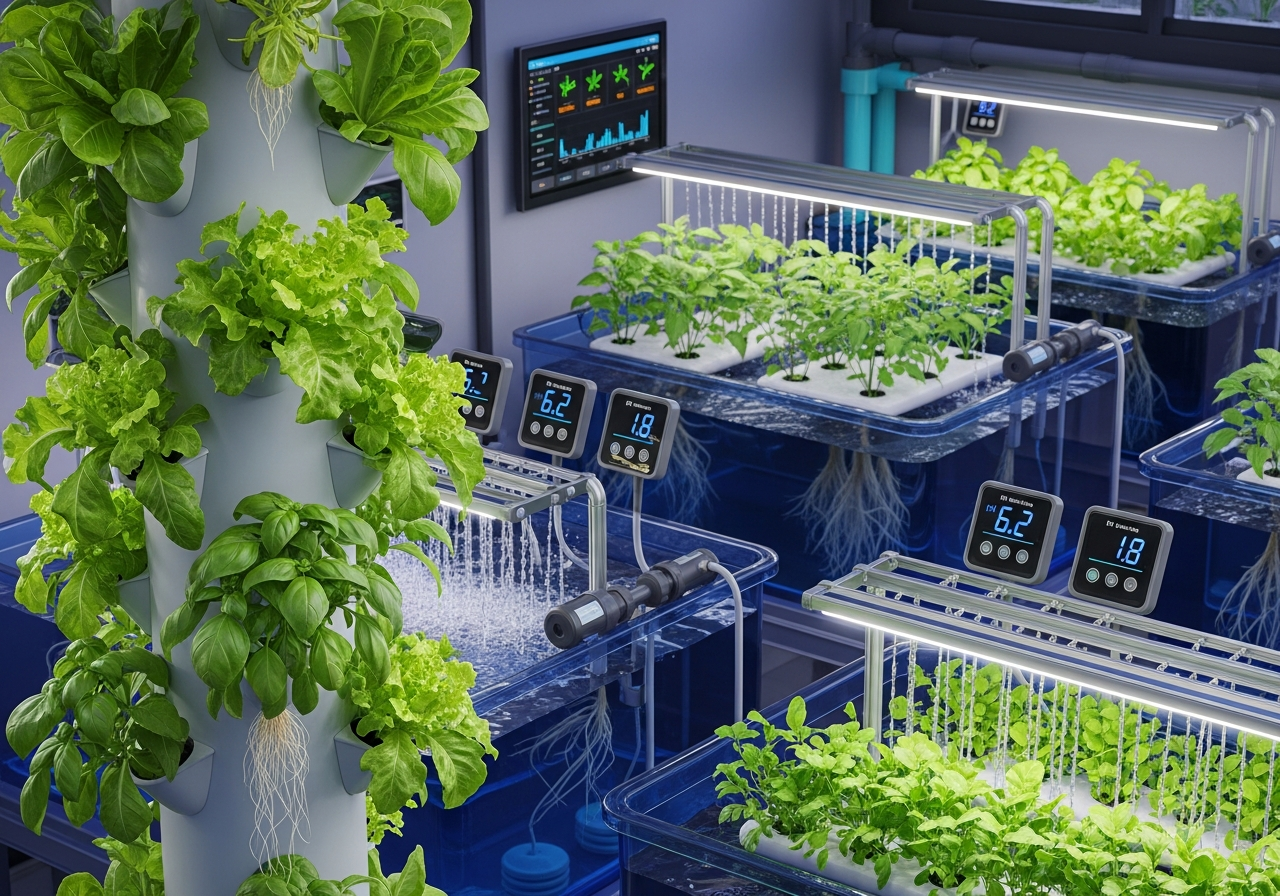
水耕栽培 sustains plant development through the continuous or intermittent immersion of root structures in mineral-enriched aqueous solutions. This discipline employs inert substrates or static water bodies to stabilize the rhizosphere, bypassing traditional soil requirements. Current intellectual property and scientific literature prioritize Nutrient 膜 養殖技術(NFT)の水力制御、深層水耕栽培(DWC)の酸素供給、およびイオン選択性電極の統合。
この索引は、循環式養殖システムの構造、基質の多孔性、養液膜の厚さに関する技術情報を網羅しています。これらの技術進歩により、制御された環境下におけるミネラル吸収と水利用効率が向上します。以下の記録は、商業規模の水産養殖における自動pH制御、電気伝導率モニタリング、および水力工学の進歩を記録したものです。
これは、水耕栽培に関する英語の世界中の出版物と特許の最新のセレクションです。多くの科学オンラインジャーナルの中から、深層水耕栽培、養液膜栽培、潮汐式栽培、湛水式栽培、クラツキー法、ウィックシステム、ミネラルウール、膨張粘土、ココヤシ繊維、パーライト、バーミキュライト、毛細管現象、栽培ベッド、浮遊プラットフォーム、循環システム、廃水式栽培、水耕栽培、基質栽培、凝集栽培、水耕栽培、湛水テーブル、砂利栽培、溶液浸漬、根浸漬といったテーマに分類され、焦点を絞っています。
Microgreen seed starter system
Patent published on the 2026-10-15 in US under Ref US20260314541 by GOMICROFRESH LLC [US] (Semark Thomas [us])
Abstract: A microgreen seed starter system includes a dome having a top portion and a bottom portion configured to couple together to form an enclosed growing area. The bottom portion defines an internal cavity configured to receive water to form a reservoir. One or more porous growing trays are positioned within the dome and are configured to obtain moisture from the reservoir via capillary action. The top portion includes a groove sized and shaped to receive an integrated growing light, which may be rem[...]
Our summary: The microgreen seed starter system features a dome with a water reservoir and porous trays for moisture absorption. It includes a removable growing light and stackable design for efficient indoor cultivation. The system is designed for low-maintenance and space-efficient growing of microgreens.
microgreen, seed starter, growing system, capillary action
Patent
Air treatment device
Patent published on the 2026-10-14 in EP under Ref EP4822263 by VERSUNI HOLDING BV [NL] (Wei Zhang [nl])
Abstract: Provided is an air treatment device that includes an air displacement assembly, and an air purification unit for purifying air displaced by the air displacement assembly. The air purified by the air purification unit flows away from the air purification unit along a flow path. The air treatment device has a tank for holding water, with the tank being arranged beneath the air purification unit when the air treatment device is orientated for use. A wick has a first portion disposed in the tank, an[...]
Our summary: The air treatment device includes an air displacement assembly and an air purification unit. It features a water tank positioned beneath the purification unit for humidifying the purified air. A wick facilitates water transport through capillary action to enhance air quality.
air treatment, air purification, humidification, capillary action
Patent
Firewall without a metal sheet layer
Patent published on the 2026-10-07 in EP under Ref EP4818428 by SAINT GOBAIN PLACO [FR] (Lenker Christoph [de])
Abstract: The invention pertains to a firewall without a metal sheet layer and comprises at least the following:- a stud frame made of metal drywall profiles (3, 6);- at least partial filling of the cavities between adjacent drywall profiles (3, 6) with mineral wool;- a double-sided, at least two-layer cladding (20, 21) with gypsum boards, wherein- the gypsum boards of all cladding layers (20, 21) are designed as fleece-reinforced gypsum boards.[...]
Our summary: The invention describes a firewall constructed without a metal sheet layer. It features a stud frame made of metal drywall profiles filled with mineral wool. The design includes double-sided cladding with fleece-reinforced gypsum boards.
Firewall, Metal Drywall Profiles, Mineral Wool, Gypsum Boards
Patent
Method and system for producing poly(hydroxyalkanoate) (pha) biopolymer
Patent published on the 2026-09-23 in GB under Ref GB2704951 by SYMBIO TECH LIMITED [GB] (Carlo Fedeli [gb], Mattia Parati [gb])
Abstract: A method for producing poly(hydroxyalkanoate) PHA biopolymer comprising: preparing a biowaste substrate comprising a cellular biomass and/or an acellular material; adding the biowaste and a supplementary substrate to a fermenter 210; growing under optimal process conditions and controlling parameters; and isolating the PHA. The biowaste may be a bacterium or an algae, such as a seaweed by-product. The seaweed may be red, brown, or green seaweed, or from Euchema, Gracilaria, Saccharina, Laminaria[...]
Our summary: The method involves producing poly(hydroxyalkanoate) biopolymer from biowaste substrates. It includes fermentation under controlled conditions and isolation of PHA. The system comprises a fermenter and control unit for optimal production.
PHA, biopolymer, fermentation, biowaste
Patent
Method for erecting a prefabricated building using modular element
Patent published on the 2026-09-16 in GB under Ref GB2704643 by AVVYLAND LTD [GB] (Alexey Sokolov [gb], Roman Savushkin [gb])
Abstract: A method for erecting a prefabricated building, comprising: the assembly of premanufactured construction modules to form at least the floor (figure 4: 1) and walls (figure 3: 2), wherein each module is designed as a box module 4 / 5 / 6 with outer, size, and inner lift-off panels, characterised in that modules of various sizes are used, with the width and length of each modules being multiples of a standard unit. The building further comprises floor beam modules 9 installed between the floor mod[...]
Our summary: A method for erecting a prefabricated building involves assembling premanufactured modules to create floors and walls. Various sizes of box modules are used, designed with lift-off panels for operational flexibility. The structure includes interconnecting floor and wall beam modules with service openings for utility routing.
prefabricated construction, modular building, assembly method, box modules
Patent
Reducing mixer buildup of binder material through staged addition of raw materials
Patent published on the 2026-09-10 in US under Ref US20260265144 by UNITED STATES GYPSUM CO [US] (Kaladharan Gopakumar [us], O'sullivan James Brendan [us], Liu Richard Zhengjun [us])
Abstract: [0000] A method of making a rapid setting binder composition is provided by adding the liquids and solids to a mixer and once homogeneously mixed, adding expanded perlite. This method reduces the buildup in the mixer and is more efficient than the prior art methods. Products made using the method are also provided.[...]
Our summary: A method for making a rapid setting binder composition involves staged addition of raw materials to a mixer. This approach minimizes binder material buildup and enhances efficiency compared to traditional methods. The resulting products demonstrate improved performance.
mixer buildup, binder composition, staged addition, expanded perlite
Patent
A Review of Its Potential for Low-Carbon and Circular Construction
Published on 2026-02-02 by Olga Szlachetka, Justyna Dzi?cio? @MDPI
Abstract: The growing demand for low-carbon, resource-efficient, and multifunctional construction materials has intensified interest in solutions that can support both circular economy strategies and sustainable urban development. Expanded perlite—a lightweight volcanic material with low embodied energy and multiple functional properties—is increasingly considered a potential component of circular and nature-based material systems. This paper critically examines whether expande[...]
Our summary: This review evaluates expanded perlite as a sustainable material for low-carbon and circular construction. It discusses its applications in various civil engineering contexts and identifies research gaps in durability and implementation. The paper emphasizes the importance of addressing health concerns and highlights the material s potential in promoting climate-resilient urban systems.
expanded perlite, low-carbon construction, circular economy, sustainable materials
Effects of Polypropylene Microplastics and Copper Contamination on Rice Seedling Growth
Published on 2026-02-02 by Ziwen Hao, Steven Xu, Siquan Huang, Lin Wang @MDPI
Abstract: This study investigates the effects of polypropylene microplastics (PP-MPs) and copper (Cu), applied individually and in combination, on the growth (root and shoot length, fresh and dry biomass), peroxidase (POD) activity, and Cu accumulation of rice seedlings. A hydroponic experiment was conducted with four treatments: control (CK), PP, Cu, and PP+Cu. Exposure to PP-MPs slightly promoted seedling growth, whereas Cu markedly inhibited growth and induced chlorosis. Compared with Cu alone, co-expo[...]
Our summary: This study examines the effects of polypropylene microplastics and copper on rice seedling growth. Exposure to microplastics promoted growth slightly, while copper inhibited it and caused chlorosis. Co-exposure to both substances improved shoot growth and altered antioxidant responses, highlighting the complexity of their interactions.
Microplastics, Copper, Rice Seedlings, Antioxidant Responses
Publication