Product Design, Manufacturing & Innovation Resources
Casa » Il criterio di Rayleigh (risoluzione ottica)

Il criterio di Rayleigh (risoluzione ottica)

1900
  • John William Strutt, 3rd Baron Rayleigh
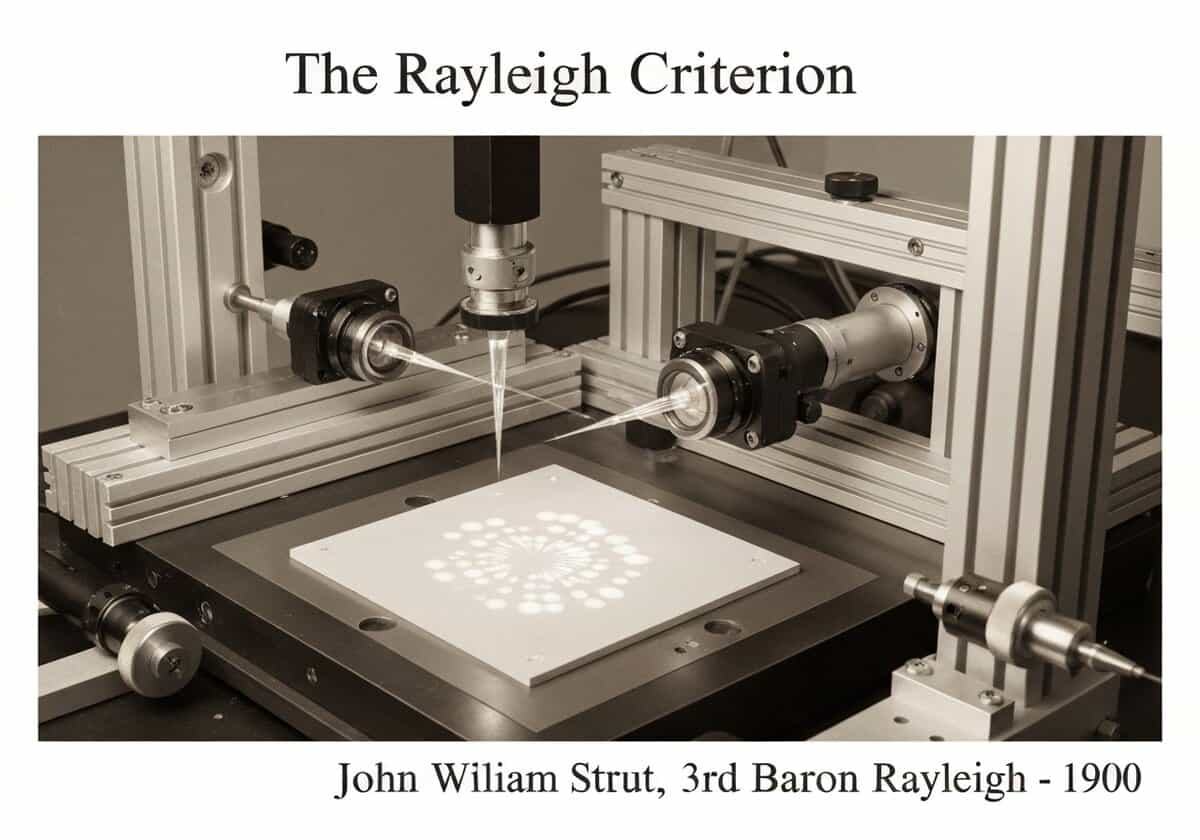
Sistema di fotolitografia a proiezione che illustra il criterio di Rayleigh in ottica.

(Immagine generata a solo scopo illustrativo)

La dimensione minima delle caratteristiche che un sistema di fotolitografia a proiezione può stampare è limitata dalla diffrazione ed è approssimata dal criterio di Rayleigh. La dimensione critica (CD) è data da [latex]CD = k_1 cdot frac{lambda}{NA}[/latex], dove [latex]lambda[/latex] è la lunghezza d'onda della luce, NA è l'apertura numerica della lente e [latex]k_1[/latex] è un coefficiente legato al processo. Caratteristiche più piccole richiedono lunghezze d'onda più corte o aperture numeriche più elevate.

The Rayleigh criterion is a fundamental principle in optics that defines the limit of resolution for any imaging system, including the projection systems used in photolithography. It states that two point sources are just resolvable when the center of the diffraction pattern of one is directly over the first minimum of the diffraction pattern of the other. In the context of lithography, this translates to the smallest line or space that can be reliably printed. The formula [latex]CD = k_1 \cdot \frac{\lambda}{NA}[/latex] encapsulates the three primary levers for improving resolution. Firstly, reducing the wavelength ([latex]\lambda[/latex]) of the light source has been a major driver of progress, moving from g-line (436 nm) and i-line (365 nm) mercury lamps to Deep UV (DUV) excimer lasers like KrF (248 nm) and ArF (193 nm), and ultimately to Extreme UV (EUV) at 13.5 nm. Secondly, increasing the numerical aperture (NA) of the projection lens allows it to capture more diffracted light orders, leading to a sharper image. NA is defined as [latex]NA = n \sin \theta[/latex], where n is the refractive index of the medium between the lens and the wafer. Thirdly, the process factor [latex]k_1[/latex] represents the ‘cleverness’ of the process, encompassing improvements like resolution enhancement techniques (RET), photoresist chemistry, and process control. While theoretically [latex]k_1[/latex] has a minimum of 0.25, practical manufacturing values have been pushed down from ~0.8 towards ~0.3 through immense engineering effort. This equation has been the guiding principle for the semiconductor industry’s roadmap for decades, driving the relentless scaling predicted by Moore’s Law.

UNESCO Nomenclature: 2209
- Elettromagnetismo

Tipo

Sistema astratto

Interruzione

Fondamento

Utilizzo

Uso diffuso

Precursori

  • Huygens-Fresnel principle of wave propagation
  • Fraunhofer diffraction theory
  • development of high-quality optical lenses

Applicazioni

  • design of high-resolution microscopes
  • semiconductor lithography process development
  • astronomical telescope design
  • data storage density limits in optical discs (cd, dvd, blu-ray)

Brevetti:

NA

Idee e potenziali innovazioni

A causa dell'eliminazione del traffico generato dai bot, che attualmente supera i 40.000 al giorno, questo contenuto è riservato ai membri della community.
> Accedi O > Registrati L'accesso a questo contenuto, così come a tutti gli altri contenuti e strumenti riservati, è (100% gratuito).

Argomenti correlati: criterio di Rayleigh, risoluzione, apertura numerica, lunghezza d'onda, fattore k1, limite di diffrazione, fotolitografia, DUV, EUV, ottica.

Contesto storico

Il criterio di Rayleigh (risoluzione ottica)

1900
1900
1900
1900
1902
1902
1907
1900
1900
1900
1900
1900-12-14
1902
1904
1907

(se la data è sconosciuta o non rilevante, ad esempio "meccanica dei fluidi", viene fornita una stima approssimativa della sua notevole comparsa)

Le immagini a grandezza naturale e i download sono disponibili, 100% gratuitamente, solo per i membri registrati.

> Login <