Product Design, Manufacturing & Innovation Resources
घर » रेले मानदंड (प्रकाशिक विभेदन)

रेले मानदंड (प्रकाशिक विभेदन)

1900
  • John William Strutt, 3rd Baron Rayleigh
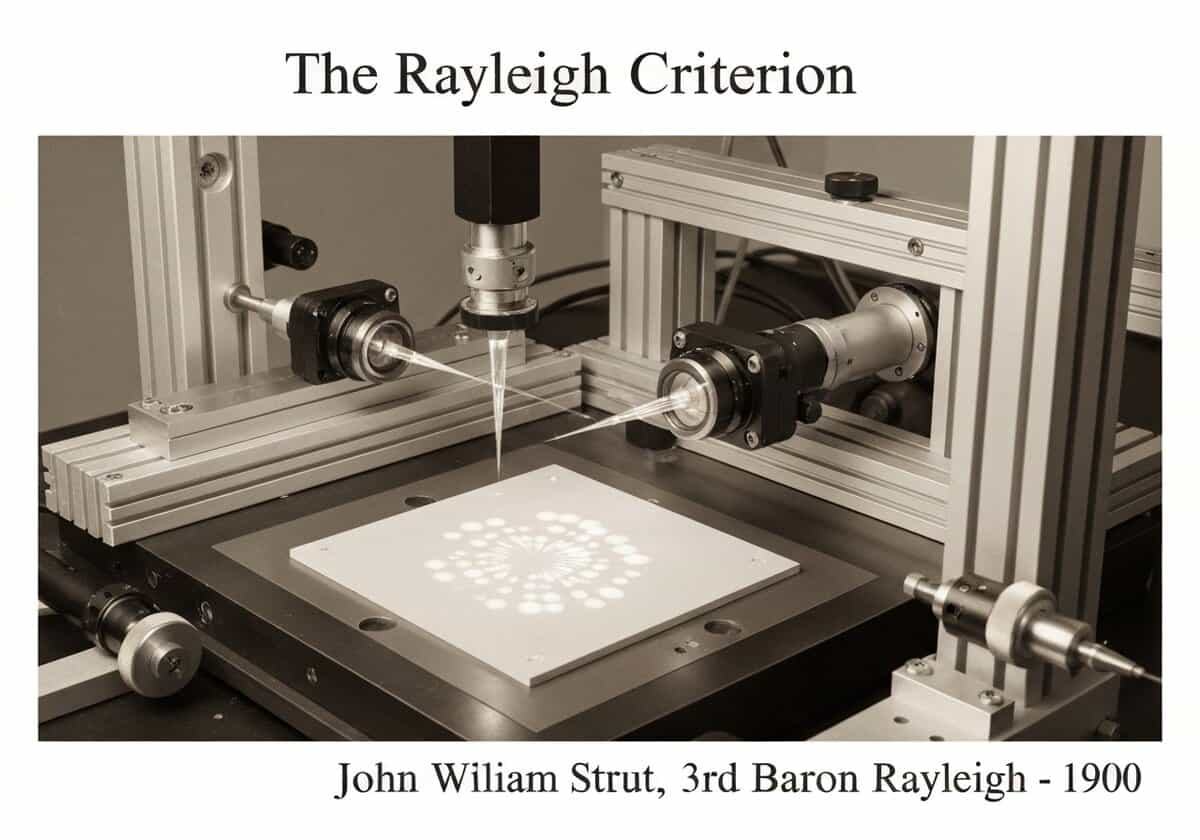
प्रोजेक्शन फोटोलिथोग्राफी प्रणाली जो प्रकाशिकी में रेले मानदंड को दर्शाती है।.

(यह छवि केवल उदाहरण के लिए बनाई गई है)

प्रोजेक्शन फोटोलिथोग्राफी प्रणाली द्वारा मुद्रित की जा सकने वाली न्यूनतम फीचर साइज विवर्तन द्वारा सीमित होती है और इसे रेले मानदंड द्वारा अनुमानित किया जाता है। क्रांतिक आयाम (CD) को [latex]CD = k_1 cdot frac{lambda}{NA}[/latex] द्वारा दर्शाया जाता है, जहाँ [latex]lambda[/latex] प्रकाश की तरंगदैर्घ्य है, NA लेंस का संख्यात्मक एपर्चर है, और [latex]k_1[/latex] एक प्रक्रिया-संबंधी गुणांक है। छोटी विशेषताओं के लिए कम तरंगदैर्घ्य या उच्च संख्यात्मक एपर्चर की आवश्यकता होती है।

The Rayleigh criterion is a fundamental principle in optics that defines the limit of resolution for any imaging system, including the projection systems used in photolithography. It states that two point sources are just resolvable when the center of the diffraction pattern of one is directly over the first minimum of the diffraction pattern of the other. In the context of lithography, this translates to the smallest line or space that can be reliably printed. The formula [latex]CD = k_1 \cdot \frac{\lambda}{NA}[/latex] encapsulates the three primary levers for improving resolution. Firstly, reducing the wavelength ([latex]\lambda[/latex]) of the light source has been a major driver of progress, moving from g-line (436 nm) and i-line (365 nm) mercury lamps to Deep UV (DUV) excimer lasers like KrF (248 nm) and ArF (193 nm), and ultimately to Extreme UV (EUV) at 13.5 nm. Secondly, increasing the numerical aperture (NA) of the projection lens allows it to capture more diffracted light orders, leading to a sharper image. NA is defined as [latex]NA = n \sin \theta[/latex], where n is the refractive index of the medium between the lens and the wafer. Thirdly, the process factor [latex]k_1[/latex] represents the ‘cleverness’ of the process, encompassing improvements like resolution enhancement techniques (RET), photoresist chemistry, and process control. While theoretically [latex]k_1[/latex] has a minimum of 0.25, practical manufacturing values have been pushed down from ~0.8 towards ~0.3 through immense engineering effort. This equation has been the guiding principle for the semiconductor industry’s roadmap for decades, driving the relentless scaling predicted by Moore’s Law.

UNESCO Nomenclature: 2209
विद्युतचुंबकत्व

Type

सार प्रणाली

व्यवधान

मूलभूत

उपयोग

व्यापक उपयोग

शगुन

  • तरंग प्रसार का ह्यूजेन्स-फ्रेस्नेल सिद्धांत
  • फ्रौनहोफर विवर्तन सिद्धांत
  • उच्च गुणवत्ता वाले ऑप्टिकल लेंसों का विकास

आवेदन

  • उच्च-रिज़ॉल्यूशन माइक्रोस्कोप का डिज़ाइन
  • सेमीकंडक्टर लिथोग्राफी प्रक्रिया विकास
  • खगोलीय दूरबीन डिजाइन
  • ऑप्टिकल डिस्क (सीडी, डीवीडी, ब्लू-रे) में डेटा भंडारण घनत्व की सीमाएँ

पेटेंट:

NA

संभावित नवाचार विचार

बॉट ट्रैफिक को कम करने के कारण, जो वर्तमान में प्रति दिन 40,000 से अधिक है, यह सामग्री केवल समुदाय के सदस्यों के लिए आरक्षित है।
> लॉगिन < या > रजिस्टर < इस सामग्री और अन्य सभी प्रतिबंधित सामग्रियों और उपकरणों तक पहुंच (100% निःशुल्क) है।

संबंधित विषय: रेले मानदंड, रिज़ॉल्यूशन, न्यूमेरिकल अपर्चर, तरंगदैर्ध्य, k1 कारक, विवर्तन सीमा, फोटोलिथोग्राफी, DUV, EUV, प्रकाशिकी।

ऐतिहासिक संदर्भ

रेले मानदंड (प्रकाशिक विभेदन)

1900
1900
1900
1900
1902
1902
1907
1900
1900
1900
1900
1900-12-14
1902
1904
1907

(यदि तिथि अज्ञात है या प्रासंगिक नहीं है, उदाहरण के लिए "द्रव यांत्रिकी", तो इसके उल्लेखनीय उद्भव का एक अनुमानित आंकड़ा प्रदान किया गया है)

शीर्ष पोस्ट और लेख

शीर्ष मूल उपकरण

पंजीकृत सदस्यों के लिए पूर्ण आकार की छवियाँ और डाउनलोड 100% निःशुल्क उपलब्ध हैं।