Product Design, Manufacturing & Innovation Resources
» レイリー基準(光学分解能)

レイリー基準(光学分解能)

1900
  • John William Strutt, 3rd Baron Rayleigh
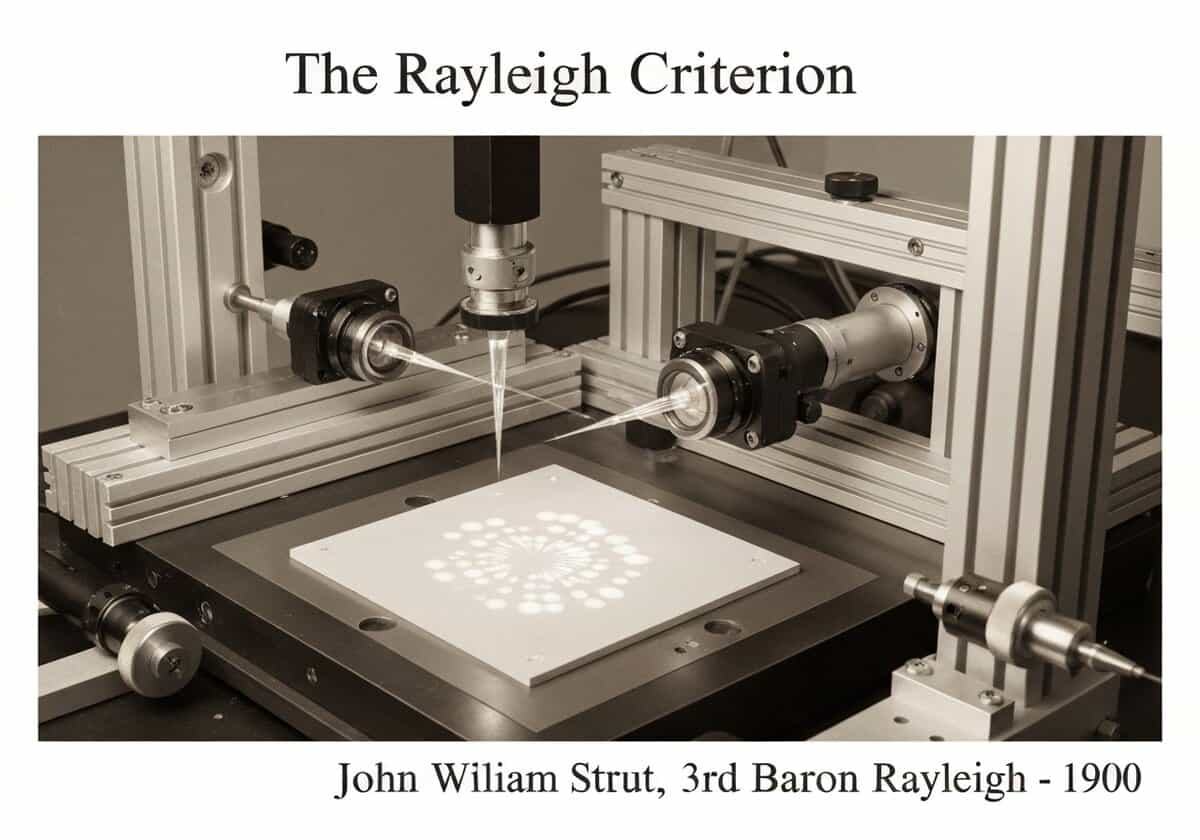
光学におけるレイリー基準を示す投影フォトリソグラフィーシステム。.

(画像はイメージです)

投影フォトリソグラフィシステムで印刷できる最小パターンサイズは回折によって制限され、レイリー基準によって近似されます。臨界寸法 (CD) は、[latex]CD = k_1 cdot frac{lambda}{NA}[/latex] で与えられます。ここで、[latex]lambda[/latex] は光の波長、NA はレンズの開口数、[latex]k_1[/latex] はプロセス関連の係数です。より小さなパターンには、より短い波長またはより高い開口数が必要です。

The Rayleigh criterion is a fundamental principle in optics that defines the limit of resolution for any imaging system, including the projection systems used in photolithography. It states that two point sources are just resolvable when the center of the diffraction pattern of one is directly over the first minimum of the diffraction pattern of the other. In the context of lithography, this translates to the smallest line or space that can be reliably printed. The formula [latex]CD = k_1 \cdot \frac{\lambda}{NA}[/latex] encapsulates the three primary levers for improving resolution. Firstly, reducing the wavelength ([latex]\lambda[/latex]) of the light source has been a major driver of progress, moving from g-line (436 nm) and i-line (365 nm) mercury lamps to Deep UV (DUV) excimer lasers like KrF (248 nm) and ArF (193 nm), and ultimately to Extreme UV (EUV) at 13.5 nm. Secondly, increasing the numerical aperture (NA) of the projection lens allows it to capture more diffracted light orders, leading to a sharper image. NA is defined as [latex]NA = n \sin \theta[/latex], where n is the refractive index of the medium between the lens and the wafer. Thirdly, the process factor [latex]k_1[/latex] represents the ‘cleverness’ of the process, encompassing improvements like resolution enhancement techniques (RET), photoresist chemistry, and process control. While theoretically [latex]k_1[/latex] has a minimum of 0.25, practical manufacturing values have been pushed down from ~0.8 towards ~0.3 through immense engineering effort. This equation has been the guiding principle for the semiconductor industry’s roadmap for decades, driving the relentless scaling predicted by Moore’s Law.

UNESCO Nomenclature: 2209
電磁気学

タイプ

抽象システム

混乱

基礎

使用法

広く普及している

前駆物質

  • ホイヘンス・フレネルの波動伝播原理
  • フラウンホーファー回折理論
  • 高品質光学レンズの開発

アプリケーション

  • 高解像度顕微鏡の設計
  • 半導体リソグラフィプロセス開発
  • 天体望遠鏡の設計
  • 光ディスク(CD、DVD、ブルーレイ)におけるデータ記憶密度の限界

特許:

NA

潜在的なイノベーションのアイデア

ボットによるトラフィック(現在1日あたり4万件以上)を排除するため、このコンテンツはコミュニティメンバー限定となっています。
> ログイン < または > 登録 < (100%無料)でこれにアクセスできます。他のすべての制限付きコンテンツとツールも同様です。

関連キーワード:レイリー基準、解像度、開口数、波長、k1係数、回折限界、フォトリソグラフィー、DUV、EUV、光学。

歴史的背景

レイリー基準(光学分解能)

1900
1900
1900
1900
1902
1902
1907
1900
1900
1900
1900
1900-12-14
1902
1904
1907

(日付が不明または関連性がない場合、例えば「流体力学」などでは、その注目すべき出現時期の概算値が提示されます。)

関連する発明、革新、および技術原理

フルサイズの画像とダウンロードは、登録会員のみが100%無料で利用できます。