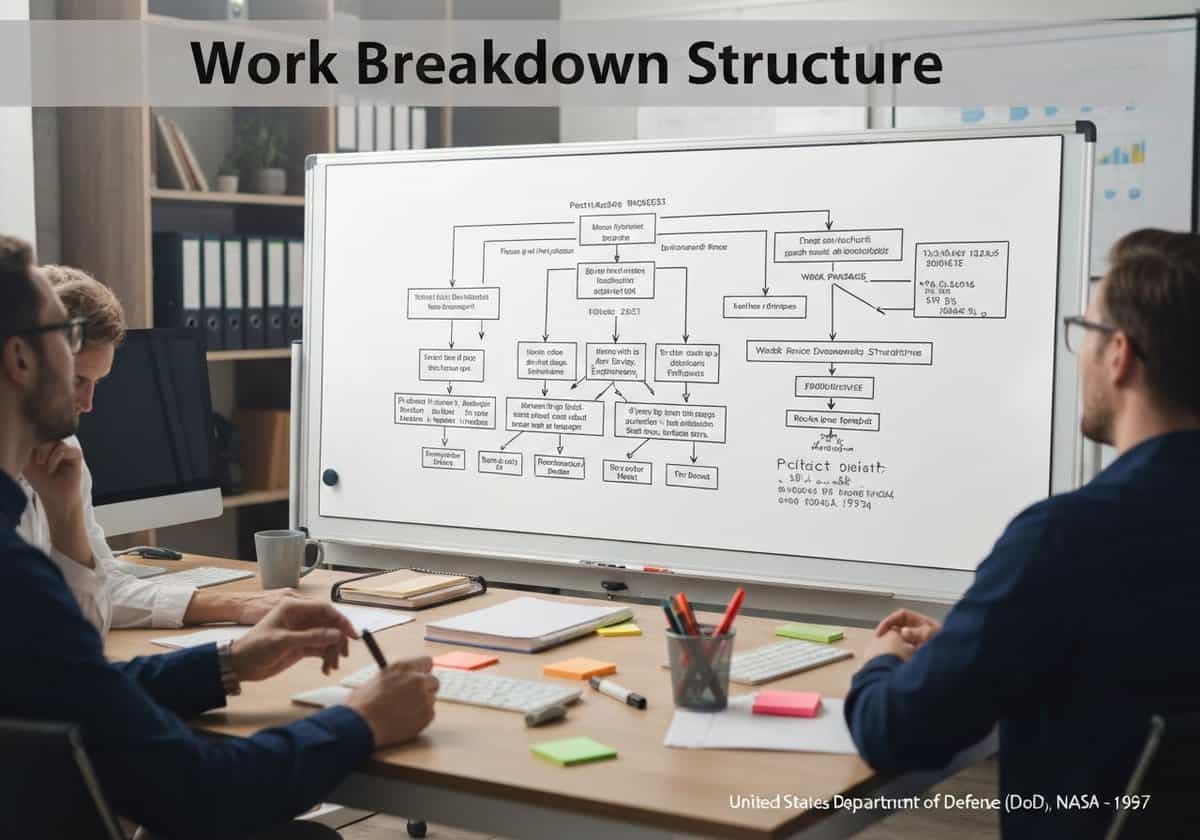
Work Breakdown Structure
1957
- United States Department of Defense (DoD)
- NASA
A Work Breakdown Structure (sometimes abbreviated WBS) is a key project deliverable that organizes the team’s work into manageable sections. It is a hierarchical and incremental decomposition of the project into phases, deliverables, and work packages. The WBS is a tree structure that shows a subdivision of effort required to achieve an objective, such as a program, project, or contract.
The Work Breakdown Structure (WBS) concept was developed by the U.S. Department of Defense in 1957 as part of the Polaris missile program, in conjunction with the Program Evaluation and Review Technique (PERT). Its primary innovation was to provide a systematic, deliverable-oriented way to deconstruct a large, complex project into smaller, more manageable components. The fundamental principle of the WBS is the ‘100% Rule,’ which states that the WBS must capture all the work defined in the project scope—and only the work in the scope. It represents the total effort and deliverables of the project.
The WBS is typically depicted as a hierarchical chart, resembling an organization chart. The top level (Level 1) represents the entire project. Subsequent levels break down the work into major deliverables or phases. The decomposition continues until the work is broken down into ‘work packages,’ which are the lowest level of the WBS. A work package is a piece of work that can be realistically estimated, scheduled, and assigned to an individual or a team. To complement the visual chart, a WBS dictionary is often created. This document provides detailed information about each WBS element, including a description of the work, deliverables, budget, schedule, and assigned responsibility. The WBS is not a schedule or a plan, but rather the foundation upon which schedules, cost estimates, and resource plans are built. It provides a common framework for all project stakeholders, ensuring a clear and shared understanding of the project’s scope.
UNESCO Nomenclature: 5312
– Management sciences
Precursors
- Organizational charts
- Systems engineering principles
- Early military project planning techniques
- Hierarchical decomposition concepts from mathematics and logic
Applications
- cost estimating and budgeting
- resource allocation
- schedule development
- risk management
- procurement management
- scope control and change management
Potential Innovations Ideas
Due to scrapping bot traffic, currently more than 40k per day, this content is reserved to community members.
> Login < or > Register < (100% free) to access this, so as all other restricted content and tools.
Related to: work breakdown structure, WBS, project management, scope, deliverable, decomposition, work package, project planning, hierarchy, scope management.